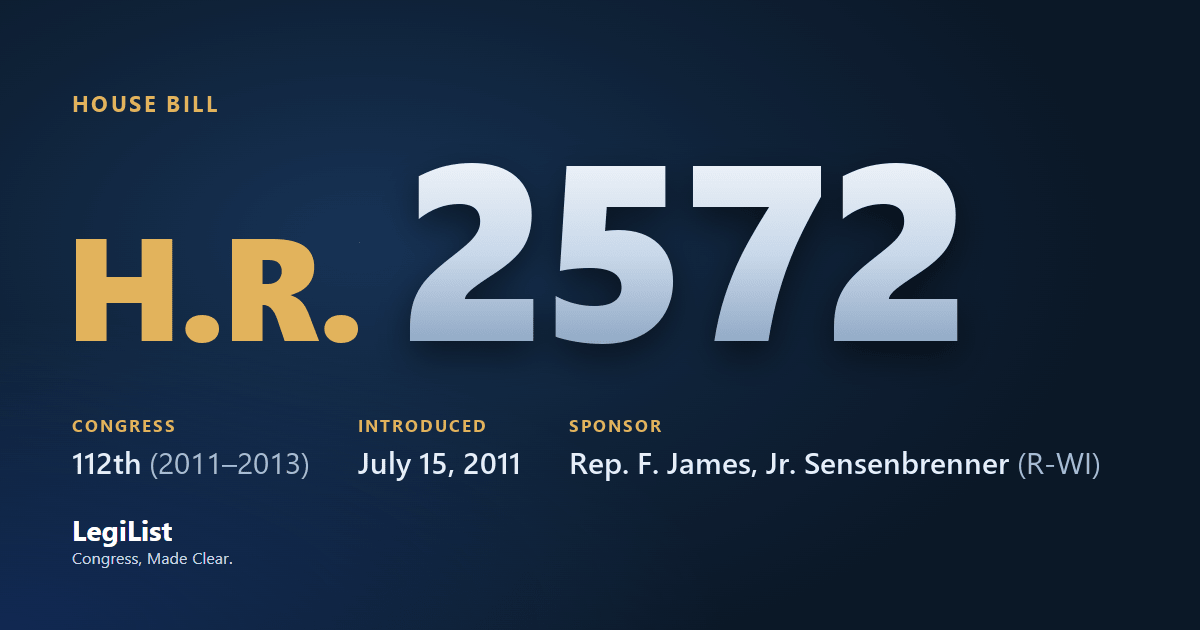
Clean Up Government Act of 2011
Latest action · Sep 21, 2012 Placed on the Union Calendar, Calendar No. 499.
Progress
Where this bill reached, and when. A stage with no date was not reached; one that failed a vote and later carried shows the date it carried.
- IntroducedJul 15, 2011
- Passed HouseNot reached
- Passed SenateNot reached
- To the PresidentNot reached
- Became lawNot reached
Summary
Clean Up Government Act of 2011 - Amends the federal criminal code to revise and expand prohibitions against bribery, theft of public money, and other public corruption offenses.
(Sec. 2) Modifies general venue rules for criminal prosecutions to allow prosecutions in any district in which an act in furtherance of an offense is committed.
(Sec. 3) Increases the maximum term of imprisonment for theft or bribery involving federally assisted programs from 10 to 20 years. Reduces from $5,000 to $1,000 the threshold amount for bribery offenses.
(Sec. 4) Increases the maximum term of imprisonment for theft and embezzlement of public property or records from 10 to 15 years.
(Sec. 5) Increases the maximum term of imprisonment for: (1) bribery of public officials and witnesses from 15 to 20 years, and (2) seeking or accepting anything of value personally for testimony as a witness or for such witness's absence from 2 to 5 years.
Modifies elements relating to the crime of bribery of public officials and witnesses to prohibit public officials from accepting any thing or things of value, other than what is permitted by rule or regulation of the House of Representatives or the Senate, including those rules and regulations governing the acceptance of campaign contributions.
.Modifies the crime of illegal gratuities to require: (1) knowledge that a gratuity is being received by or given to a public official because of his or her position or status, and (2) that such gratuity has a value of not less than $1,000.
(Sec. 6) Extends the prohibition against the theft or embezzlement of public property or records to property or records of the District of Columbia.
(Sec. 7) Expands the crime of illegal gratuities to include gratuities given to a public official because of such official's position.
(Sec. 8) Expands the definition of "official act," for purposes of the prohibition against bribery, to include conduct that falls within the range of official duties of the public official, which may be more than a single act or a course of conduct.
(Sec. 9) Directs the United States Sentencing Commission to review and, if appropriate, amend its guidelines and policy statements relating to public corruption offenses to reflect the intent of Congress that penalties for such offenses meet the requirements of this Act.
(Sec. 10) Extends the statute of limitations for specified public corruption offenses, including extortion, bribery, and racketeering activity that involves bribery chargeable under state law, to six years.
(Sec. 11) Increases the maximum term of imprisonment for: (1) solicitation by federal officers and employees of political contributions from other federal officers and employees (from three to five years), (2) promise of employment as a reward for political activity (from one to three years), (3) deprivation of such employment for political activity (from one to three years), (4) intimidation to secure political contributions (from three to five years), (5) solicitation and acceptance of contributions in federal offices (from three to five years), and (6) coercion of political activity by federal employees (from three to five years).
(Sec. 12) Includes as predicates for authorizing wiretaps the crimes of: (1) embezzlement or theft of public money, property, or records; (2) theft or bribery concerning programs that receive public funds; and (3) defrauding the United States.
(Sec. 13) Allows expanded venue (i.e., in the district in which the alleged offense occurred or in which the official proceeding was intended to be affected) for additional obstruction of justice offenses, including influencing or threatening a grand or petit juror or officer, obstructing proceedings before departments, agencies, and committees, and obstruction of a court order or a criminal investigation. Allows expanded venue for the prosecution of specified perjury offenses to include either the district in which the oath, declaration, certificate, verification, or statement under penalty of perjury is made or in which a proceeding takes place.
(Sec. 14) Prohibits undisclosed self-dealing by public officials.
(Sec. 15) Amends the federal judicial code to permit the disclosure of information in a complaint against a judge regarding a potential criminal offense to the Attorney General, a federal, state, or local grand jury, or a federal, state, or local law enforcement agency.
(Sec. 16) Excludes from the term "anything of value," as applied in the bribery provisions of the federal criminal code, a bona fide salary, wages, fees, or other compensation paid, or expenses paid or reimbursed, in the usual course of business (thus limiting such exclusion to bribery provisions and rendering it inapplicable to other theft provisions concerning programs receiving federal funds).
(Sec. 17) Amends the federal criminal code to permit the Deputy Attorney General, Assistant Attorney General, or the Attorney General to make certifications regarding appeals from district court orders suppressing or excluding evidence or requiring the return of seized property (currently, such certifications are made by a U.S. attorney only).
Cosponsors 2
Members who signed on, in the order they did. Signatures ran from Jul 15, 2011 to Dec 7, 2011; 1 is an original cosponsor, there from the day it was introduced.
| Seat | Cosponsor | Signed on | |
|---|---|---|---|
| D-IL | Mike Quigley | Original | Jul 15, 2011 |
| D-TN | Steve Cohen | Dec 7, 2011 |
Committees 1
Where it was sent and what each committee and subcommittee did with it, in order.
| Chamber | Committee | What it did |
|---|---|---|
| House | Judiciary Committee | Referred Jul 15, 2011Markup Dec 1, 2011Reported Sep 21, 2012 |
| Crime and Federal Government Surveillance Subcommittee | Referred Jul 22, 2011Hearings Jul 26, 2011Discharged Nov 20, 2011 |
Actions 9
Everything that happened, newest first.
- Sep 21, 2012Reported (Amended) by the Committee on Judiciary. H. Rept. 112-688.
- Sep 21, 2012Placed on the Union Calendar, Calendar No. 499.
- Dec 1, 2011Committee Consideration and Mark-up Session Held.
- Dec 1, 2011Ordered to be Reported (Amended) by the Yeas and Nays: 30 - 0.
- Nov 20, 2011Subcommittee on Crime, Terrorism, and Homeland Security Discharged.
- Jul 26, 2011Subcommittee Hearings Held.
- Jul 22, 2011Referred to the Subcommittee on Crime, Terrorism, and Homeland Security.
- Jul 15, 2011Introduced in House
- Jul 15, 2011Referred to the House Committee on the Judiciary.
Research
What has been written about this bill: committee reports, cost estimates, the sponsor’s authority statement, printed hearings and the Congressional Research Service’s work.
Committee report
Congressional Budget Office cost estimate
- Jan 18, 2012H.R. 2572, Clean Up Government Act of 2011Cost estimate for the bill as ordered reported by the House Committee on the Judiciary on December 1, 2011
Constitutional authority
The sponsor’s statement, as printed in the page H5127.
Printed hearings 1
Hearings whose printed record names this bill, newest first: hearings on it, and wider hearings where it came up.
| Number | Hearing | Committee | Held |
|---|---|---|---|
| Serial No. 112-70 | CLEAN-UP GOVERNMENT ACT OF 2011100 pages | Judiciary Committee | Jul 26, 2011 |
CRS reports 3
Congressional Research Service work that CRS links to this bill or the law it became, newest first.
About this bill 2
Products that name it in their title: its number, its law number or one of its short titles.
| Product | Title | Kind | Published |
|---|---|---|---|
| R42015 | Prosecution of Public Corruption: An Abridged Overview of Amendments Under H.R. 2572 and S. 2038 | Report | Apr 11, 2012 |
| R42016 | Prosecution of Public Corruption: An Overview of Amendments Under H.R. 2572 and S. 2038 | Report | Apr 11, 2012 |
Also cite it 1
Products on other subjects that cite it, usually among other measures.
| Product | Title | Kind | Published |
|---|---|---|---|
| R45479 | Bribery, Kickbacks, and Self-Dealing: An Overview of Honest Services Fraud and Issues for Congress | Report | May 18, 2020 |
Related bills 2
Companion bills and other measures the record links to this one.
| Bill | Title | Relationship | Latest action |
|---|---|---|---|
| HR 1793 | Clean Up Government Act of 2011 | Related bill | May 23, 2011 |
| HR 4054 | Restore Public Trust Act | Related bill | Feb 28, 2012 |
Titles 3
Every title it has carried, official and short, at each stage.
- Official Title as Introduced
- To amend title 18, United States Code, to deter public corruption, and for other purposes.
- Short Titles as Introduced
- Clean Up Government Act of 2011
- Short Titles as Reported to House
- Clean Up Government Act of 2011
Subjects
Assigned by the Library of Congress. Policy area: Crime and Law Enforcement.
- Crime and Law Enforcement
- Crimes against property
- Criminal investigation, prosecution, interrogation
- Criminal procedure and sentencing
- District of Columbia
- Evidence and witnesses
- Fraud offenses and financial crimes
- Government buildings, facilities, and property
- Government employee pay, benefits, personnel management
- Government ethics and transparency, public corruption
- Government information and archives
- Judges
- Jurisdiction and venue
- Organized crime
- Postal service
Text 2
Each version as it was printed, newest first.
- Sep 21, 2012Reported in House
- Jul 15, 2011Introduced in House
Everything here is as published by Congress: the summary is the Congressional Research Service's, the action wording is the clerks', and the subjects are the Library of Congress's. How far it got is read from the actions themselves, taking the most recent one of each kind, so a bill that failed a vote and later passed is shown as having passed. Records come from this bill on Congress.gov and govinfo.gov; cost estimates are the Congressional Budget Office's, and the hearings are the printed hearings GovInfo publishes, which can appear months after the hearing.