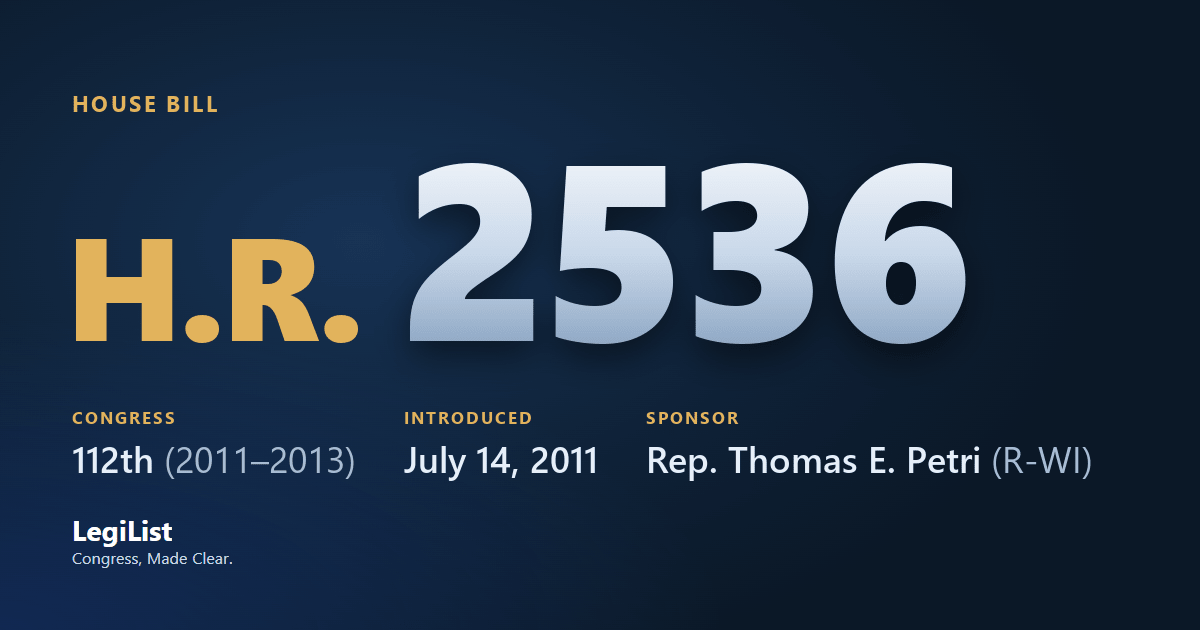
21st Century Readiness Act
Latest action · Sep 8, 2011 Referred to the Subcommittee on Early Childhood, Elementary, and Secondary Education.
Progress
Where this bill reached, and when. A stage with no date was not reached; one that failed a vote and later carried shows the date it carried.
- IntroducedJul 14, 2011
- Passed HouseNot reached
- Passed SenateNot reached
- To the PresidentNot reached
- Became lawNot reached
Summary
21st Century Readiness Act - Amends the Elementary and Secondary Education Act of 1965 (ESEA) to support 21st century readiness initiatives that fuse core academic subject knowledge and higher-order thinking skills (such as critical thinking and problem solving, communication, collaboration, creativity, and innovation) to ensure that students are prepared for postsecondary education and careers, upon graduation from secondary school.
Amends title I (Improving the Academic Achievement of the Disadvantaged) of the ESEA to require the Secretary of Education, as part of the national assessment of title I programs, to examine the extent to which such initiatives improve student readiness for postsecondary education and careers.
Includes 21st century readiness initiatives in comprehensive school reform programs and school dropout prevention and reentry programs under title I.
Amends title II (Preparing, Training, and Recruiting High Quality Teachers and Principals) of the ESEA to require high-quality professional development programs to incorporate an aligned system of teaching and learning that includes 21st century skills (such as critical thinking and problem solving, communication, collaboration, creativity, and innovation), standards, curriculum, instruction, and assessments.
Requires LEAs to use title II subgrants to enable educators to deliver instruction on higher-order thinking skills and use the latest available technology in doing so.
Amends title IV (21st Century Schools) of the ESEA to include 21st century readiness initiatives in 21st Century Community Learning Center activities. (21st Century Community Learning Centers provide students with before and after school programs to improve their academic performance.)
Amends title VI (Flexibility and Accountability) of the ESEA to allow assessment grants to be used by states to develop or improve assessments that use technology to measure core academic subject knowledge and higher-order thinking skills to ensure that students can apply a range of skill competencies alongside core academic subject knowledge, and do so in real-world contexts.
Cosponsors 25
Members who signed on, in the order they did. Signatures ran from Jul 14, 2011 to Sep 12, 2012; 1 is an original cosponsor, there from the day it was introduced.
| Seat | Cosponsor | Signed on | |
|---|---|---|---|
| D-IA | David Loebsack | Original | Jul 14, 2011 |
| D-WI | Gwen Moore | Oct 26, 2011 | |
| D-ME | Michael H. Michaud | Oct 26, 2011 | |
| R-NY | Richard L. Hanna | Nov 2, 2011 | |
| R-IL | Timothy V. Johnson | Nov 3, 2011 | |
| D-IL | Jesse L. Jackson, Jr. | Nov 14, 2011 | |
| D-IN | André Carson | Dec 6, 2011 | |
| D-FL | Kathy Castor | Dec 6, 2011 | |
| D-HI | Mazie K. Hirono | Dec 8, 2011 | |
| D-DC | Eleanor Holmes Norton | Dec 14, 2011 | |
| D-NY | Eliot L. Engel | Dec 14, 2011 | |
| D-VA | Gerald E. Connolly | Dec 14, 2011 | |
| R-PA | Glenn Thompson | Dec 15, 2011 | |
| R-PA | Jim Gerlach | Dec 15, 2011 | |
| R-IL | Aaron Schock | Dec 20, 2011 |
Committees 1
Where it was sent and what each committee and subcommittee did with it, in order.
| Chamber | Committee | What it did |
|---|---|---|
| House | Education and Workforce Committee | Referred Jul 14, 2011 |
| Early Childhood, Elementary, and Secondary Education Subcommittee | Referred Sep 8, 2011 |
Actions 4
Everything that happened, newest first.
- Sep 8, 2011Referred to the Subcommittee on Early Childhood, Elementary, and Secondary Education.
- Jul 14, 2011Introduced in House
- Jul 14, 2011Sponsor introductory remarks on measure. (CR E1322)
- Jul 14, 2011Referred to the House Committee on Education and the Workforce.
In the Congressional Record 1
Days the Record’s own index lists this bill, newest first, with the pages and the members it names. Pages starting H are the House, S the Senate, E Extensions of Remarks.
| Where | In the Record | Members | Date |
|---|---|---|---|
| Extensions | Debate and remarks E1322 | Thomas E. Petri R-WI | Jul 14, 2011 |
Research
What has been written about this bill: committee reports, cost estimates, the sponsor’s authority statement, printed hearings and the Congressional Research Service’s work.
Constitutional authority
The sponsor’s statement, as printed in the page H5086.
Printed hearings 1
Hearings whose printed record names this bill, newest first: hearings on it, and wider hearings where it came up.
| Number | Hearing | Committee | Held |
|---|---|---|---|
| S. Hrg. 112-875 | BEYOND NCLB: VIEWS ON THE ELEMENTARY AND SECONDARY EDUCATION REAUTHORIZATION ACT63 pages | Health, Education, Labor, and Pensions Committee | Nov 8, 2011 |
Related bills 1
Companion bills and other measures the record links to this one.
| Bill | Title | Relationship | Latest action |
|---|---|---|---|
| S 1175 | 21st Century Readiness Act | Identical bill | Jun 9, 2011 |
Titles 2
Every title it has carried, official and short, at each stage.
- Official Title as Introduced
- To provide, develop, and support 21st century readiness initiatives that assist students in acquiring the skills necessary to think critically and solve problems, be an effective communicator, collaborate with others, and learn to create and innovate.
- Short Titles as Introduced
- 21st Century Readiness Act
Subjects
Assigned by the Library of Congress. Policy area: Education.
Text 1
Each version as it was printed, newest first.
- Jul 14, 2011Introduced in House
Support LegiList
This page is free, carries no paywall, and is built and maintained by one person. If the record here is useful to you, a few dollars keeps it going.
Everything here is as published by Congress: the summary is the Congressional Research Service's, the action wording is the clerks', and the subjects are the Library of Congress's. How far it got is read from the actions themselves, taking the most recent one of each kind, so a bill that failed a vote and later passed is shown as having passed. Records come from this bill on Congress.gov and govinfo.gov; cost estimates are the Congressional Budget Office's, and the hearings are the printed hearings GovInfo publishes, which can appear months after the hearing.