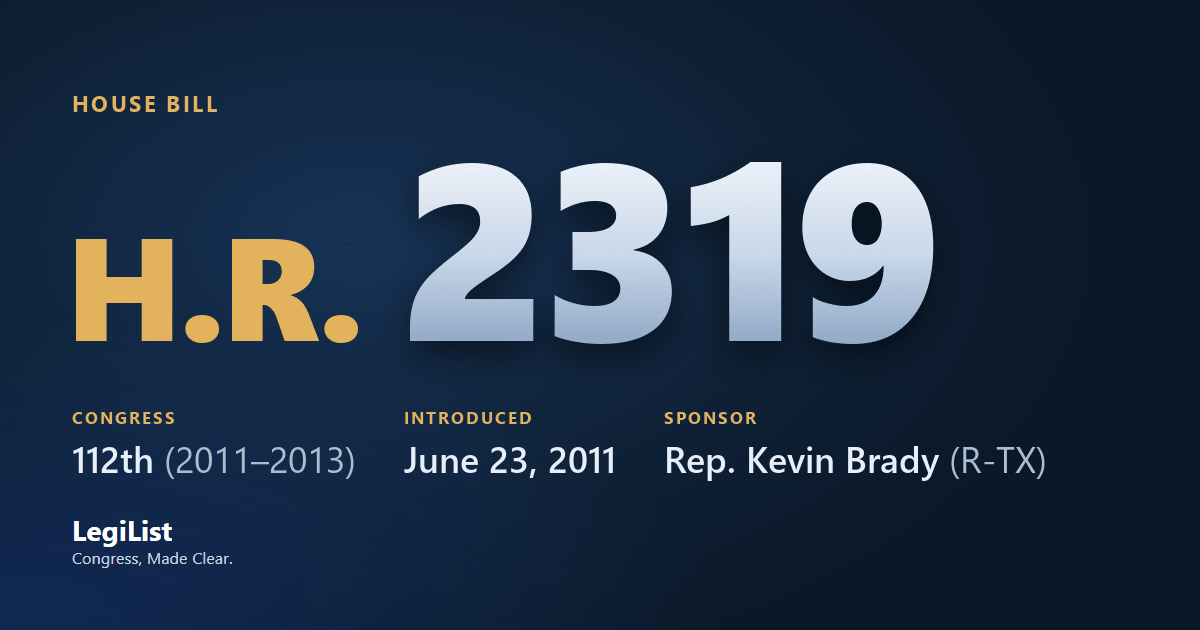
Maximizing America's Prosperity Act of 2011
Latest action · Jun 30, 2011 Referred to the Subcommittee on Government Organization, Efficiency, and Financial Management .
Progress
Where this bill reached, and when. A stage with no date was not reached; one that failed a vote and later carried shows the date it carried.
- IntroducedJun 23, 2011
- Passed HouseNot reached
- Passed SenateNot reached
- To the PresidentNot reached
- Became lawNot reached
Summary
Maximizing America's Prosperity Act of 2011 - Amends the Balanced Budget and Emergency Deficit Control Act of 1995 (Gramm-Rudman-Hollings Act) to require: (1) the Office of Management and Budget (OMB) to prepare a report comparing projected total spending in such Act and the total spending limits (for FY2013-FY2021 and ensuing fiscal years), to be included in the President's annual budget; and (2) the Congressional Budget Office (CBO) to prepare a similar report and include it in the CBO annual baseline and reestimate of the President's budget.
Requires the reports to be included in spending reduction orders.
Requires a specified reduction each fiscal year for unfunded federal mandates.
Amends the Congressional Budget Act of 1974 (CBA) to set aside for emergencies 1% of new budget authority and outlays allocated to the Committees on Appropriations for the first fiscal year of a concurrent budget resolution.
Amends the Gramm-Rudman-Hollings Act to prescribe requirements for CBO and OMB sequestration preview reports regarding discretionary and total spending limits.
Prescribes administrative procedures for spending reduction orders. Exempts from such orders: (1) payments for net interest, (2) obligated balances of budget authority carried over from prior fiscal years, (3) federal obligations required to be paid under the U.S. Constitution or legally contractual obligations, and (4) intragovernmental transfers.
Prohibits funding for a presidentially designated emergency program from being subjected to sequestration or counted for purposes of calculating a sequester.
Requires the President's annual budget to be in compliance with the statutory cap on total federal spending.
Requires the President's budget to include a plan to ensure that: (1) the Old Age Survivors Disability Insurance (OASDI) and Hospital Insurance (HI) Trust Funds will not be exhausted during the 75-year projection period, and (2) the trust fund ratios will not be declining at the end of such period if the report from the Actuaries indicates a shortfall in them.
Requires the President's budget also to prioritize non-exempt spending by ranking all federal programs, projects, and activities in five categories from the most essential, to essential, to somewhat essential, to less essential, to least essential, with not less than 12% of total non-exempt spending falling into any one category.
Amends the CBA to make it out of order in both chambers to consider any concurrent budget resolution that sets forth total federal outlays for any fiscal year in excess of those specified in this Act.
Legislative Line-Item Reduction Act of 2011 - Amends the Congressional Budget and Impoundment Control Act of 1974 to authorize the President to propose to Congress the rescission (line item reduction) of dollar amounts of discretionary budget authority and items of direct spending.
Dedicates all related spending reductions to deficit reduction.
Prescribes procedures for expedited consideration of legislation to approve such a proposal.
Authorizes the President to: (1) withhold discretionary budget authority temporarily from obligation, or (2) suspend temporarily direct spending.
Makes specified provisional (automatic) continuing appropriations in the event that any regular appropriation bill for a fiscal year does not become law before the beginning of such fiscal year, or a joint resolution making continuing appropriations is not in effect. (Thus prevents federal government shutdown.)
Amends the Social Security Act to require annual Social Security account statements to individuals to include: (1) estimated present value of taxes and benefits with respect to Social Security and Medicare, and (2) projected deficit-financed OASDI and Medicare benefits as a percentage of individual lifetime earnings.
Amends the CBA to require CBO spending and revenue estimates to include the effect on interest and on the federal debt.
Federal Sunset Act of 2011 - Establishes the Federal Agency Sunset Commission to: (1) submit to Congress a schedule for its review, at least once every 12 years, of each agency with a view to its possible abolishment; (2) review the efficiency and public need for each agency using specified criteria; (3) recommend whether each agency should be abolished or reorganized; and (4) report to Congress on all legislation introduced that would establish a new agency or a new program to be carried out by an existing agency.
Directs the Comptroller General and the Director of the Congressional Budget Office, in cooperation with the Director of the Congressional Research Service (CRS), to prepare an inventory of federal programs within each agency for the purpose of advising and assisting Congress and the Commission in carrying out the requirements of this Act.
Requires amounts appropriated to carry out this Act to be offset by a reduction in amounts appropriated to carry out other agencies' programs.
Cosponsors 3
Members who signed on, in the order they did. Signatures ran from Jul 22, 2011 to Nov 10, 2011.
| Seat | Cosponsor | Signed on | |
|---|---|---|---|
| R-CA | Darrell Issa | Jul 22, 2011 | |
| R-FL | Jeff Miller | Jul 22, 2011 | |
| R-TX | Sam Johnson | Nov 10, 2011 |
Committees 5
Where it was sent and what each committee and subcommittee did with it, in order.
| Chamber | Committee | What it did |
|---|---|---|
| House | Budget Committee | Referred Jun 23, 2011 |
| House | Rules Committee | Referred Jun 23, 2011 |
| House | Ways and Means Committee | Referred Jun 23, 2011 |
| House | Appropriations Committee | Referred Jun 23, 2011 |
| House | Oversight and Government Reform Committee | Referred Jun 23, 2011 |
| Government Operations Subcommittee | Referred Jun 30, 2011 |
Actions 3
Everything that happened, newest first.
- Jun 30, 2011Referred to the Subcommittee on Government Organization, Efficiency, and Financial Management .
- Jun 23, 2011Introduced in House
- Jun 23, 2011Referred to the Committee on the Budget, and in addition to the Committees on Rules, Ways and Means, Appropriations, and Oversight and Government Reform, for a period to be subsequently determined by the Speaker, in each case for consideration of such provisions as fall within the jurisdiction of the committee concerned.
Research
What has been written about this bill: committee reports, cost estimates, the sponsor’s authority statement, printed hearings and the Congressional Research Service’s work.
Constitutional authority
The sponsor’s statement, as printed in the page H4528.
Printed hearings 1
Hearings whose printed record names this bill, newest first: hearings on it, and wider hearings where it came up.
| Number | Hearing | Committee | Held |
|---|---|---|---|
| Serial No. 112-54 | FOSTERING QUALITY SCIENCE AT EPA: PERSPECTIVES ON COMMON SENSE REFORM (PART I AND PART II)209 pages | Science, Space, and Technology Committee | Nov 30, 2011–Feb 3, 2012 |
CRS reports 1
Congressional Research Service work that CRS links to this bill or the law it became, newest first.
Cite it 1
Products on other subjects that cite it, usually among other measures.
| Product | Title | Kind | Published |
|---|---|---|---|
| R41948 | Automatic Continuing Resolutions: Background and Overview of Recent Proposals Archived | Report | Aug 20, 2015 |
Related bills 4
Companion bills and other measures the record links to this one.
| Bill | Title | Relationship | Latest action |
|---|---|---|---|
| HR 339 | End the Lame Duck Act | Related bill | Jan 19, 2011 |
| S 784 | Preventing a Government Shutdown Act | Related bill | Apr 8, 2011 |
| S 3434 | End Government Shutdowns Act | Related bill | Jul 25, 2012 |
| HR 3583 | Government Shutdown Prevention Act of 2011 | Related bill | Dec 7, 2011 |
Titles 4
Every title it has carried, official and short, at each stage.
- Official Title as Introduced
- To cap noninterest Federal spending as a percentage of full employment GDP, to require that budgets and budget resolutions adhere to these caps, to enforce these caps, to increase financial transparency for mandatory programs, to provide for a line-item adjustment, to require the parings of significant spending increases and adjustments to the debt ceiling, and to provide for a Federal Sunset commission to assist Congress in eliminating Federal agencies and programs that no longer serve a public need or reforming those that are inefficient or ineffective in serving a public need, and for other purposes.
- Short Titles as Introduced
- Maximizing America's Prosperity Act of 2011
- Short Titles as Introduced for portions of this bill
- Federal Sunset Act of 2011
- Legislative Line Item Reduction Act of 2011
Subjects
Assigned by the Library of Congress. Policy area: Economics and Public Finance.
- Advisory bodies
- Appropriations
- Budget deficits and national debt
- Budget process
- Congressional oversight
- Economics and Public Finance
- Executive agency funding and structure
- Government information and archives
- Government trust funds
- House of Representatives
- Legislative rules and procedure
- Medicare
- Senate
- Social security and elderly assistance
Text 1
Each version as it was printed, newest first.
- Jun 23, 2011Introduced in House
Support LegiList
This page is free, carries no paywall, and is built and maintained by one person. If the record here is useful to you, a few dollars keeps it going.
Everything here is as published by Congress: the summary is the Congressional Research Service's, the action wording is the clerks', and the subjects are the Library of Congress's. How far it got is read from the actions themselves, taking the most recent one of each kind, so a bill that failed a vote and later passed is shown as having passed. Records come from this bill on Congress.gov and govinfo.gov; cost estimates are the Congressional Budget Office's, and the hearings are the printed hearings GovInfo publishes, which can appear months after the hearing.