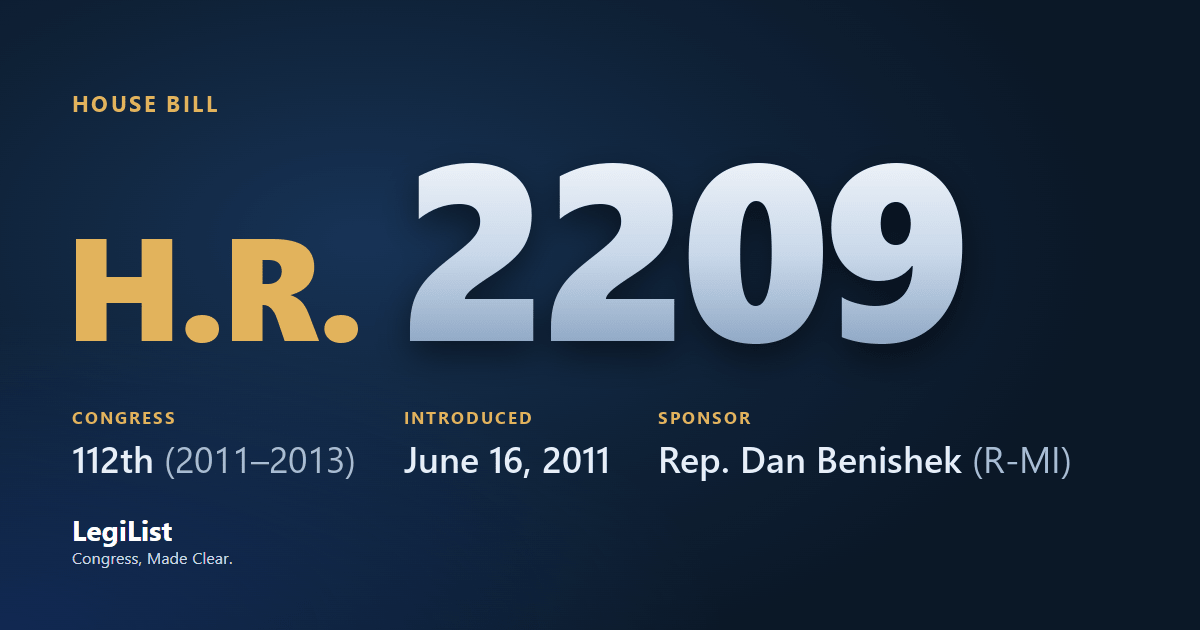
To replace the current Forest Service administrative appeals process with a pre-decisional administrative review process modeled after the successful approach used in the Healthy Forests Restoration Act of 2003, and for other purposes.
Latest action · Jun 27, 2011 Referred to the Subcommittee on Conservation, Energy, and Forestry.
Progress
Where this bill reached, and when. A stage with no date was not reached; one that failed a vote and later carried shows the date it carried.
- IntroducedJun 16, 2011
- Passed HouseNot reached
- Passed SenateNot reached
- To the PresidentNot reached
- Became lawNot reached
Summary
Forest Service Administrative Review Act - Directs the Secretary of Agriculture (USDA), through the Forest Service, to establish a pre-decisional administrative review process that will serve as the sole means by which persons can seek an administrative review regarding proposed actions of the Forest Service concerning projects and activities that implement land and resource management plans developed under the Forest and Rangeland Renewable Resources Planning Act of 1974.
Sets forth requirements for the pre-decisional administrative review process concerning the occurrence of the review period, eligibility of a participant in the process, and notice of the proposed decision.
Exempts from such process an emergency situation that exists for which immediate implementation of a proposed action is necessary.
Applies certain judicial review provisions of the Healthy Forests Restoration Act of 2003 with respect to: (1) the judicial review of an action challenging a proposed action under this Act, and (2) any request for an injunction regarding such an action.
Makes this Act non-applicable to: (1) an authorized hazardous fuel reduction project under such Act that has its own special administrative review process, and (2) a proposed action under this Act for which a categorical exclusion is provided.
Cosponsors
Members who signed on, in the order they did.
Committees 1
Where it was sent and what each committee and subcommittee did with it, in order.
| Chamber | Committee | What it did |
|---|---|---|
| House | Agriculture Committee | Referred Jun 16, 2011 |
| Forestry and Horticulture Subcommittee | Referred Jun 27, 2011 |
Actions 3
Everything that happened, newest first.
- Jun 27, 2011Referred to the Subcommittee on Conservation, Energy, and Forestry.
- Jun 16, 2011Introduced in House
- Jun 16, 2011Referred to the House Committee on Agriculture.
Research
What has been written about this bill: committee reports, cost estimates, the sponsor’s authority statement, printed hearings and the Congressional Research Service’s work.
Constitutional authority
The sponsor’s statement, as printed in the page H4328.
Titles 2
Every title it has carried, official and short, at each stage.
- Official Title as Introduced
- To replace the current Forest Service administrative appeals process with a pre-decisional administrative review process modeled after the successful approach used in the Healthy Forests Restoration Act of 2003, and for other purposes.
- Short Titles as Introduced for portions of this bill
- Forest Service Administrative Review Act
Subjects
Assigned by the Library of Congress. Policy area: Public Lands and Natural Resources.
Text 1
Each version as it was printed, newest first.
- Jun 16, 2011Introduced in House
Support LegiList
This page is free, carries no paywall, and is built and maintained by one person. If the record here is useful to you, a few dollars keeps it going.
Everything here is as published by Congress: the summary is the Congressional Research Service's, the action wording is the clerks', and the subjects are the Library of Congress's. How far it got is read from the actions themselves, taking the most recent one of each kind, so a bill that failed a vote and later passed is shown as having passed. Records come from this bill on Congress.gov and govinfo.gov; cost estimates are the Congressional Budget Office's, and the hearings are the printed hearings GovInfo publishes, which can appear months after the hearing.