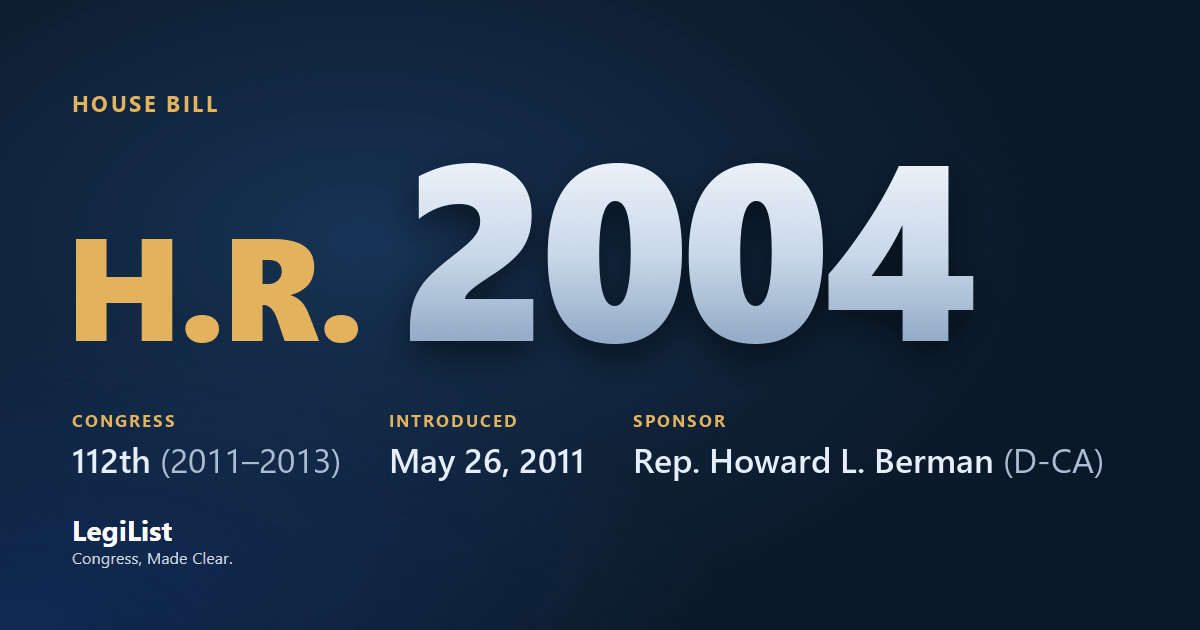
Technology Security and Antiboycott Act
Latest action · Jun 20, 2011 Referred to the Subcommittee on Technology, Information Policy, Intergovernmental Relations and Procurement Reform .
Progress
Where this bill reached, and when. A stage with no date was not reached; one that failed a vote and later carried shows the date it carried.
- IntroducedMay 26, 2011
- Passed HouseNot reached
- Passed SenateNot reached
- To the PresidentNot reached
- Became lawNot reached
Summary
Technology Security and Antiboycott Act - Technology Security Act - Directs the President to control the transfer of items (any goods, technology, software, and services) by U.S. persons and by foreign persons subject to U.S. jurisdiction in order to: (1) prevent the transfer of items that would pose a risk to U.S. national security or foreign policy; (2) secure the cooperation of other governments and multilateral organizations to impose similar controls; (3) maintain U.S. leadership in science, engineering, technology, and manufacturing; (4) sustain the viability of commercial firms, academic institutions, and research establishments; (5) sustain the domestic defense industrial base; and (6) enforce the controls through regulations, compliance requirements, controlled item lists, and lists of foreign persons who threaten U.S. national security or foreign policy.
Requires a license for the transfer of items to a country if: (1) such country has repeatedly provided support for acts of international terrorism; and (2) such items could make a significant contribution to such country's military potential, or could enhance its ability to support acts of international terrorism.
Requires congressional notification before any license may be issued.
Authorizes the President to establish a Transfer Policy Committee.
Sets forth criminal and civil penalties for violations of such control and license provisions.
Repeals the Export Administration Act of 1979.
Antiboycott Act - Directs the President to issue regulations prohibiting, with specified exceptions, any U.S. person from taking specified actions to support (or actions to evade such regulations) any foreign-imposed or -fostered boycott against a country that is friendly to the United States and is not itself the object of any form of U.S. boycott.
Sets forth civil penalties for violations of such regulations.
Directs the President to impose specified sanctions against a U.S. person that knowingly: (1) exports, transfers, or otherwise engages in the trade of controlled defense items or missiles or related technology; or (2) conspires to, or facilitates, such export, transfer, or trade.
Directs the President to impose procurement sanctions against a foreign person that knowingly and materially contributed to the efforts of a foreign country, project, or entity to use, develop, produce, or stockpile chemical or biological weapons through the export from: (1) the United States of any item that is subject to U.S. jurisdiction under this Act; or (2) any other country of any item that would be, if they were U.S. goods or technology, subject to such U.S. jurisdiction.
Applies such sanctions to: (1) a foreign country, project, or entity that after January 1, 1980 has used or made preparations to use, chemical or biological weapons in violation of international law or against its own nationals; or (2) a foreign country whose government has repeatedly provided support for acts of international terrorism.
Sets forth provisions regarding: (1) waiver or termination of sanctions, and (2) congressional notification.
Cosponsors 3
Members who signed on, in the order they did. All signed on Oct 4, 2011.
| Seat | Cosponsor | Signed on | |
|---|---|---|---|
| D-CT | Christopher Murphy | Oct 4, 2011 | |
| D-AS | Eni F. H. Faleomavaega | Oct 4, 2011 | |
| D-CT | Joe Courtney | Oct 4, 2011 |
Committees 2
Where it was sent and what each committee and subcommittee did with it, in order.
| Chamber | Committee | What it did |
|---|---|---|
| House | Foreign Affairs Committee | Referred May 26, 2011 |
| House | Oversight and Government Reform Committee | Referred May 26, 2011 |
| Technology, Information Policy, Intergovernmental Relations and Procurement Reform Subcommittee | Referred Jun 20, 2011 |
Actions 3
Everything that happened, newest first.
- Jun 20, 2011Referred to the Subcommittee on Technology, Information Policy, Intergovernmental Relations and Procurement Reform .
- May 26, 2011Introduced in House
- May 26, 2011Referred to the Committee on Foreign Affairs, and in addition to the Committee on Oversight and Government Reform, for a period to be subsequently determined by the Speaker, in each case for consideration of such provisions as fall within the jurisdiction of the committee concerned.
Research
What has been written about this bill: committee reports, cost estimates, the sponsor’s authority statement, printed hearings and the Congressional Research Service’s work.
Constitutional authority
The sponsor’s statement, as printed in the page H3756.
Printed hearings 1
Hearings whose printed record names this bill, newest first: hearings on it, and wider hearings where it came up.
| Number | Hearing | Committee | Held |
|---|---|---|---|
| Serial No. 112-127 | EXPORT CONTROLS, ARMS SALES, AND REFORM: BALANCING U.S. INTERESTS, PART II75 pages | Foreign Affairs Committee | Feb 7, 2012 |
Related bills 1
Companion bills and other measures the record links to this one.
| Bill | Title | Relationship | Latest action |
|---|---|---|---|
| HR 2589 | Antiboycott Act | Related bill | Oct 25, 2011 |
Titles 4
Every title it has carried, official and short, at each stage.
- Official Title as Introduced
- To authorize the President to control the transfer of goods, services, technology, and software to protect the national security, and to promote the foreign policy, of the United States, and for other purposes.
- Short Titles as Introduced
- Technology Security and Antiboycott Act
- Short Titles as Introduced for portions of this bill
- Antiboycott Act
- Technology Security Act
Subjects
Assigned by the Library of Congress. Policy area: International Affairs.
- Advanced technology and technological innovations
- Advisory bodies
- Arms control and nonproliferation
- Competitiveness, trade promotion, trade deficits
- Computers and information technology
- Congressional oversight
- Executive agency funding and structure
- Foreign and international corporations
- Government information and archives
- Homeland security
- International Affairs
- International law and treaties
- International organizations and cooperation
- Licensing and registrations
- Manufacturing
- Military procurement, research, weapons development
- Military readiness
- Presidents and presidential powers, Vice Presidents
- Public contracts and procurement
- Research and development
- Sanctions
- Technology transfer and commercialization
- Terrorism
- Trade agreements and negotiations
- Trade restrictions
Text 1
Each version as it was printed, newest first.
- May 26, 2011Introduced in House
Support LegiList
This page is free, carries no paywall, and is built and maintained by one person. If the record here is useful to you, a few dollars keeps it going.
Everything here is as published by Congress: the summary is the Congressional Research Service's, the action wording is the clerks', and the subjects are the Library of Congress's. How far it got is read from the actions themselves, taking the most recent one of each kind, so a bill that failed a vote and later passed is shown as having passed. Records come from this bill on Congress.gov and govinfo.gov; cost estimates are the Congressional Budget Office's, and the hearings are the printed hearings GovInfo publishes, which can appear months after the hearing.