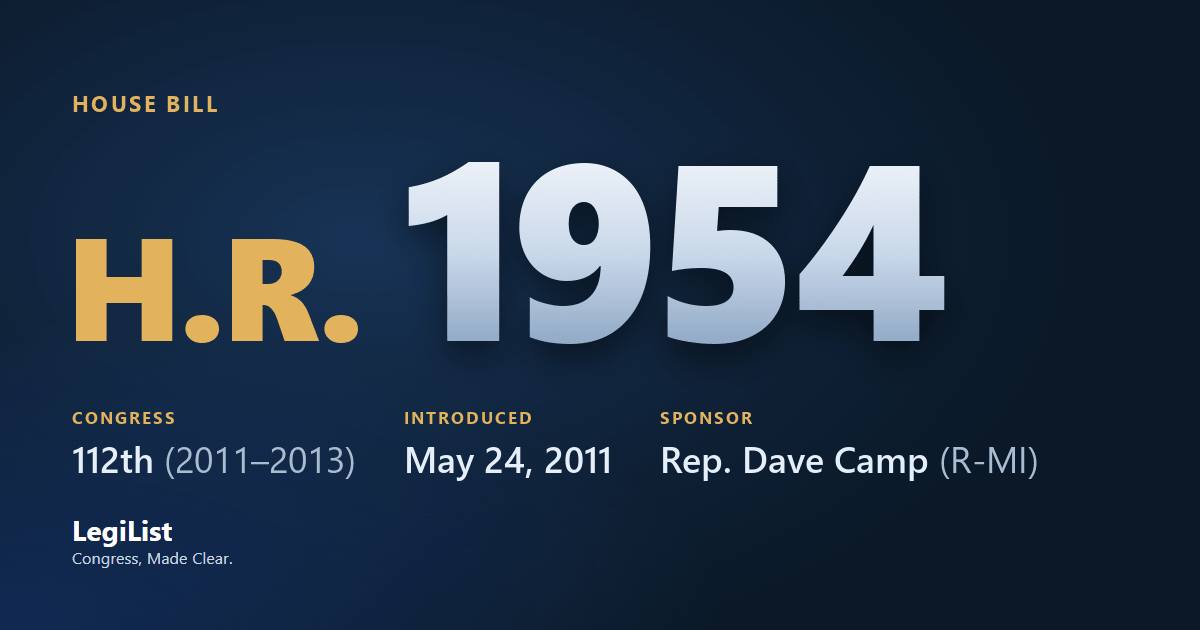
To implement the President's request to increase the statutory limit on the public debt.
Latest action · May 31, 2011 Motion to reconsider laid on the table Agreed to without objection.
Progress
Where this bill reached, and when. A stage with no date was not reached; one that failed a vote and later carried shows the date it carried.
- IntroducedMay 24, 2011
- Passed HouseNot reached
- Passed SenateNot reached
- To the PresidentNot reached
- Became lawNot reached
Summary
Increases the statutory limit on the public debt from $14.294 trillion to $16.7 trillion.
Recorded votes 1
Newest first. Open one to see how every member voted.
| Roll call | Question | Result | Date |
|---|---|---|---|
| House 379 | On Motion to Suspend the Rules and Pass | Failed97–318 | May 31, 2011 |
Cosponsors
Members who signed on, in the order they did.
Committees 1
Where it was sent and what each committee and subcommittee did with it, in order.
| Chamber | Committee | What it did |
|---|---|---|
| House | Ways and Means Committee | Referred May 24, 2011 |
Actions 9
Everything that happened, newest first.
- May 31, 2011Mr. Camp moved to suspend the rules and pass the bill.
- May 31, 2011Considered under suspension of the rules. (consideration: CR H3765-3775; text of measure as introduced: CR H3765-3766)
- May 31, 2011DEBATE - The House proceeded with forty minutes of debate on H.R. 1954.
- May 31, 2011At the conclusion of debate, the Yeas and Nays were demanded and ordered. Pursuant to the provisions of clause 8, rule XX, the Chair announced that further proceedings on the motion would be postponed.
- May 31, 2011Considered as unfinished business. (consideration: CR H3783-3784)
In the Congressional Record 8
Days the Record’s own index lists this bill, newest first, with the pages and the members it names. Pages starting H are the House, S the Senate, E Extensions of Remarks.
| Where | In the Record | Members | Date |
|---|---|---|---|
| House | Debate and remarks H4191 | Peter Welch D-VT | Jun 15, 2011 |
| House | Debate and remarks H4083 | Cliff Stearns R-FL | Jun 14, 2011 |
| Senate | Debate and remarks S3578 | Jeff Sessions R-AL | Jun 8, 2011 |
| Extensions | Debate and remarks E1057 | Martha Roby R-AL | Jun 7, 2011 |
| Extensions | Debate and remarks E1049 | Rush Holt D-NJ | Jun 3, 2011 |
Research
What has been written about this bill: committee reports, cost estimates, the sponsor’s authority statement, printed hearings and the Congressional Research Service’s work.
Congressional Budget Office cost estimate
- May 27, 2011H.R. 1954, A bill to implement the President's request to increase the statutory limit on the public debtCost estimate for the bill as introduced in the House of Representatives on May 24, 2011
Constitutional authority
The sponsor’s statement, as printed in the page H3410.
CRS reports 1
Congressional Research Service work that CRS links to this bill or the law it became, newest first.
Cite it 1
Products on other subjects that cite it, usually among other measures.
| Product | Title | Kind | Published |
|---|---|---|---|
| R43389 | The Debt Limit Since 2011 | Report | Dec 23, 2022 |
Related bills 3
Companion bills and other measures the record links to this one.
| Bill | Title | Relationship | Latest action |
|---|---|---|---|
| S 1326 | A bill to implement the President's request to increase the statutory limit on the public debt. | Identical bill | Jul 6, 2011 |
| HR 2544 | Don't Default on America's Debts and Destroy American Jobs Act of 2011 | Related bill | Jul 14, 2011 |
| HR 2663 | America Pays Its Bills Act of 2011 | Related bill | Jul 27, 2011 |
Titles 1
Every title it has carried, official and short, at each stage.
- Official Title as Introduced
- To implement the President's request to increase the statutory limit on the public debt.
Subjects
Assigned by the Library of Congress. Policy area: Economics and Public Finance.
Text 1
Each version as it was printed, newest first.
- May 24, 2011Introduced in House
Support LegiList
This page is free, carries no paywall, and is built and maintained by one person. If the record here is useful to you, a few dollars keeps it going.
Everything here is as published by Congress: the summary is the Congressional Research Service's, the action wording is the clerks', and the subjects are the Library of Congress's. How far it got is read from the actions themselves, taking the most recent one of each kind, so a bill that failed a vote and later passed is shown as having passed. Records come from this bill on Congress.gov and govinfo.gov; cost estimates are the Congressional Budget Office's, and the hearings are the printed hearings GovInfo publishes, which can appear months after the hearing.