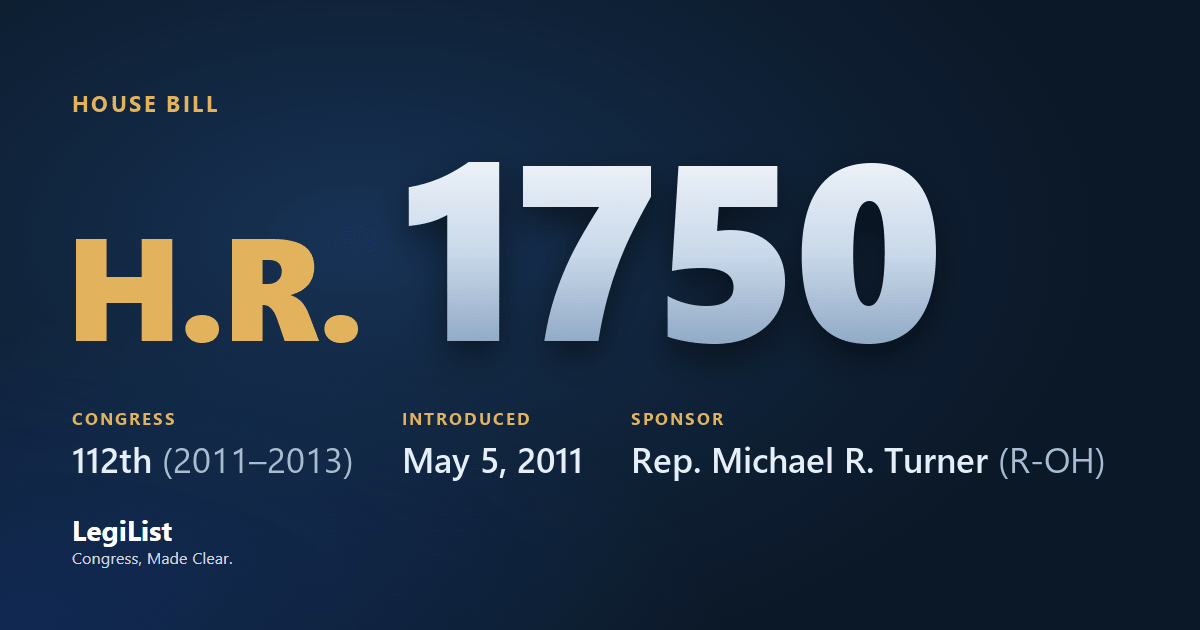
New START Treaty Implementation Act
Latest action · May 5, 2011 Referred to the Committee on Armed Services, and in addition to the Committee on Foreign Affairs, for a period to be subsequently determined by the Speaker, in each case for consideration of such provisions as fall within the jurisdiction of the committee concerned.
Progress
Where this bill reached, and when. A stage with no date was not reached; one that failed a vote and later carried shows the date it carried.
- IntroducedMay 5, 2011
- Passed HouseNot reached
- Passed SenateNot reached
- To the PresidentNot reached
- Became lawNot reached
Summary
New START Treaty Implementation Act - Authorizes FY2012 appropriations for the Department of Energy (DOE) for the National Nuclear Security Administration to carry out national security programs, including a set-aside for weapons activities.
Prohibits, with joint waiver authority, the Secretary of Defense (DOD) and the Secretary of Energy from obligating or expending FY2011-FY2017 amounts appropriated or otherwise made available to DOD or DOE to retire any covered U.S. nuclear system as required by the Treaty between the United States of America and the Russian Federation on Measures for the Further Reduction and Limitation of Strategic Offensive Arms (New START Treaty).
States that such provision shall not be construed to limit any action (including verification) required by the New START Treaty other than retiring any covered U.S. nuclear system.
Prohibits the Secretaries from obligating or expending amounts appropriated to DOD or DOE to retire, dismantle, or eliminate any non-deployed strategic or non-strategic nuclear weapon until 90 days after the Secretary of Energy certifies to Congress that certain uranium and plutonium facilities are fully functional.
Prohibits the President from: (1) unilaterally reducing U.S. deployed or non-deployed nuclear weapons below New START Treaty levels unless required by treaty or authorized by Congress, or (2) making changes to the U.S. nuclear employment strategy without reporting to Congress on such proposed changes.
Directs the Secretary of Defense to conduct a force analysis for Congress of current and proposed U.S. nuclear forces to determine whether such forces are capable of meeting U.S. nuclear deterrence and defense objectives in the context of current and anticipated nuclear and non-nuclear forces of the Russian Federation and other countries.
Requires specified officials to provide the Secretary of Defense and the Nuclear Weapons Council with an annual assessment of: (1) nuclear weapons delivery platforms, and (2) the nuclear command and control system.
States that any agreement with a country or international organization or amendment to the New START Treaty concerning the limitation of U.S. missile defense capabilities shall not be binding on the United States, and shall not enter into force with respect to the United States, unless it is: (1) approved with the advice and consent of the Senate, or (2) authorized by an Act of Congress.
Prohibits funds available to the Department of State or any other federal department or agency from being obligated for travel expenses related to treaty negotiations concerning the possible reduction of covered U.S. nuclear systems until the President certifies to Congress that such negotiations will not include restricting U.S. missile defense capabilities.
Directs the President to report annually on the plan for modernization of: (1) the nuclear weapons stockpile, (2) the nuclear weapons complex, and (3) the delivery systems.
Directs the Secretary of Energy to use specified funds to accelerate the design and construction of the: (1) Chemistry and Metallurgy Research Replacement nuclear facility, and (2) Uranium Procesing Facility.
States that it is U.S. policy: (1) that conventionally armed, strategic weapons systems not co-located with nuclear armed systems do not affect strategic stability between the United States and the Russian Federation, (2) to pursue negotiations with the Russian Federation aimed at the reduction of Russian deployed and non-deployed non-strategic nuclear forces, and (3) to maintain its commitment to extended nuclear defense with the North Atlantic Treaty Organization (NATO).
Prohibits the reduction, consolidation, or withdrawal of U.S. nuclear forces based in Europe unless: (1) requested by the government of the host nation, or (2) the President certifies that NATO supports such action and each NATO member state has separately concurred that the remaining U.S. nuclear forces in Europe provide a commensurate level of assurance.
Cosponsors 9
Members who signed on, in the order they did. Signatures ran from May 5, 2011 to Jun 22, 2011; 1 is an original cosponsor, there from the day it was introduced.
| Seat | Cosponsor | Signed on | |
|---|---|---|---|
| R-CA | Howard P. "Buck" McKeon | Original | May 5, 2011 |
| R-GA | Austin Scott | Jun 22, 2011 | |
| R-CO | Doug Lamborn | Jun 22, 2011 | |
| R-VA | E. Scott Rigell | Jun 22, 2011 | |
| R-LA | John Fleming | Jun 22, 2011 | |
| R-TX | Mac Thornberry | Jun 22, 2011 | |
| R-AL | Mike Rogers | Jun 22, 2011 | |
| R-AL | Mo Brooks | Jun 22, 2011 | |
| R-AZ | Trent Franks | Jun 22, 2011 |
Committees 2
Where it was sent and what each committee and subcommittee did with it, in order.
| Chamber | Committee | What it did |
|---|---|---|
| House | Armed Services Committee | Referred May 5, 2011 |
| House | Foreign Affairs Committee | Referred May 5, 2011 |
Actions 2
Everything that happened, newest first.
- May 5, 2011Introduced in House
- May 5, 2011Referred to the Committee on Armed Services, and in addition to the Committee on Foreign Affairs, for a period to be subsequently determined by the Speaker, in each case for consideration of such provisions as fall within the jurisdiction of the committee concerned.
Research
What has been written about this bill: committee reports, cost estimates, the sponsor’s authority statement, printed hearings and the Congressional Research Service’s work.
Constitutional authority
The sponsor’s statement, as printed in the page H3110.
Related bills 1
Companion bills and other measures the record links to this one.
| Bill | Title | Relationship | Latest action |
|---|---|---|---|
| S 1097 | New START Treaty Implementation Act | Related bill | May 26, 2011 |
Titles 2
Every title it has carried, official and short, at each stage.
- Official Title as Introduced
- To strengthen the strategic force posture of the United States by implementing and supplementing certain provisions of the New START Treaty and the Resolution of Ratification, and for other purposes.
- Short Titles as Introduced
- New START Treaty Implementation Act
Subjects
Assigned by the Library of Congress. Policy area: Armed Forces and National Security.
- Alliances
- Appropriations
- Armed Forces and National Security
- Arms control and nonproliferation
- Chemistry
- Congressional oversight
- Defense spending
- Department of Defense
- Department of Energy
- Europe
- Government studies and investigations
- International law and treaties
- Military assistance, sales, and agreements
- Military procurement, research, weapons development
- Military readiness
- Nuclear weapons
- Russia
Text 1
Each version as it was printed, newest first.
- May 5, 2011Introduced in House
Support LegiList
This page is free, carries no paywall, and is built and maintained by one person. If the record here is useful to you, a few dollars keeps it going.
Everything here is as published by Congress: the summary is the Congressional Research Service's, the action wording is the clerks', and the subjects are the Library of Congress's. How far it got is read from the actions themselves, taking the most recent one of each kind, so a bill that failed a vote and later passed is shown as having passed. Records come from this bill on Congress.gov and govinfo.gov; cost estimates are the Congressional Budget Office's, and the hearings are the printed hearings GovInfo publishes, which can appear months after the hearing.