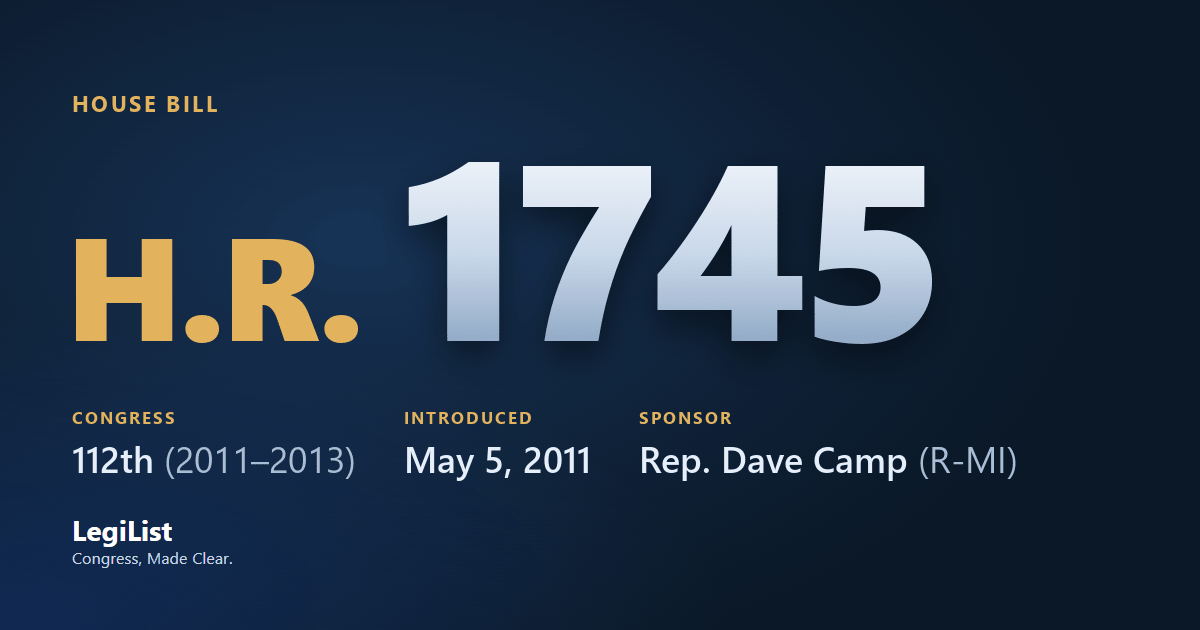
JOBS Act of 2011
Latest action · May 23, 2011 Placed on the Union Calendar, Calendar No. 48.
Progress
Where this bill reached, and when. A stage with no date was not reached; one that failed a vote and later carried shows the date it carried.
- IntroducedMay 5, 2011
- Passed HouseNot reached
- Passed SenateNot reached
- To the PresidentNot reached
- Became lawNot reached
Summary
Jobs, Opportunity, Benefits, and Services Act of 2011 or JOBS Act of 2011 - Title I: Reforms of Unemployment Compensation to Promote Work and Job Creation - (Sec. 101) Amends title III (Grants to States for Unemployment Compensation Administration) of the Social Security Act (SSA) to require state unemployment compensation (UC) laws to require, as a condition of eligibility for regular compensation for any week, that an UC claimant be able to work, available to work, and actively seeking work.
(Sec. 102) Requires a claimant to meet minimum educational requirements, that is, to: (1) have earned a high school diploma, (2) have earned the General Educational Development (GED) credential or other state-recognized equivalent (including by meeting recognized alternative standards for individuals with disabilities), or (3) be enrolled and making satisfactory progress in classes leading to satisfaction of the latter requirement.
Authorizes waiver of such requirements for an individual by a state agency if they would be unduly burdensome.
Amends the Internal Revenue Code to revise the requirement that the Secretary of Labor approve any state law prohibiting denial of compensation to an individual for any week in which the individual is in training with the approval of the state agency (or because of the application, to any such week in training, of state law relating to availability for work, active search for work, or refusal to accept work). Refers instead to any week in which the individual is enrolled and making satisfactory progress in education or, as under current law, training which has been previously approved by the state agency.
(Sec. 103) Authorizes the Secretary to enter into agreements with states to allow them to conduct demonstration projects to test and evaluate measures designed to: (1) expedite the reemployment of individuals who establish initial eligibility for UC under state law, or (2) improve the effectiveness of a state in carrying out its state law with respect to reemployment.
(Sec. 104) Amends SSA title XII (Repayment by States of Advances to State Unemployment Funds) to repeal the requirement that a state meet certain funding goals if no payment of interest shall be required with respect to any advances made to it out of the federal unemployment account during any calendar year. (Thus repeals the requirement for higher state taxes.)
(Sec. 105) Amends the Supplemental Appropriations Act, 2008 (SAA of 2008) to repeal the requirement (nonreduction rule) that makes a federal-state agreement inapplicable for a state upon a determination by the Secretary that the method governing the computation of regular compensation under state law has been modified to make the average weekly UC benefit paid less than what would have been paid before June 2, 2010.
(Sec. 106) Amends the SSA title IX (Miscellaneous Provisions Relating to Employment Security) to require the Secretary to designate standard data elements for any category of information required for data matching in the federal-state unemployment insurance system.
(Sec. 107) Amends the Internal Revenue Code and SSA title III to require states (which, currently, are merely authorized) to reduce current unemployment benefits to recover prior unemployment benefit overpayments.
Title III: Forward Funding of Remaining Federal Unemployment Compensation Funds - (Sec. 201) Amends the SSA to require the Secretary of the Treasury to makes special transfers, in FY2011-FY2012, from the extended unemployment compensation (EUC) account to each state's account in the Unemployment Trust Fund an amount determined by using a specified formula. Requires states to spend these funds: (1) to pay current federal EUC and emergency unemployment benefits; or (2) for regular unemployment benefits, for repaying federal unemployment loans, or for reemployment services, as specified by a state law passed after enactment of this Act.
(Sec. 202) Repeals requirements under the SAA of 2008 that federal payments to states cover 100% of EUC for a certain period of time.
Amends such Act to require the Secretary of the Treasury to transfer from the general fund of the Treasury to the EUC account any sums the Secretary of Labor estimates to be necessary to make payments to states because of certain amendments made by this Act.
(Sec. 203) Amends the Assistance for Unemployed Workers and Struggling Families Act to accelerate from January 4, 2012, to July 6, 2011, termination of the temporary requirement that federal payments to states cover 100% of EUC.
Amends the Federal-State Extended Unemployment Compensation Act of 1970 (FSEUCA-1970), as amended by the Tax Relief, Unemployment Insurance Reauthorization, and Job Creation Act of 2010 to accelerate similarly from December 31, 2011, to June 30, 2011, termination of the period during which a state may determine its "on" and "off" indicators according to specified temporary substitutions in its formula.
Declares that, in the case of any state law which, as of the date of enactment of this Act, has been amended in conformance with certain amendments to FSEUCA-1970 made by the Tax Relief, Unemployment Insurance Reauthorization, and Job Creation Act of 2010 and the Assistance for Unemployed Workers and Struggling Families Act, the acceleration for the termination of the period during which a state may determine its "on" and "off" indicators according to specified temporary substitutions in its formula shall be disregarded for purposes of any state law provision which provides for a state "off" indicator or which otherwise provides for the termination of an extended benefit period because of the cessation of full federal funding of sharable EUC or sharable regular compensation.
(Sec. 204) Designates the budgetary effects of this Act as an emergency requirement and necessary to meet emergency needs pursuant to the Statutory Pay-As-You-Go (PAYGO) Act of 2010.
Cosponsors 3
Members who signed on, in the order they did. Signatures ran from May 5, 2011 to May 23, 2011; 2 are original cosponsors, there from the day it was introduced.
| Seat | Cosponsor | Signed on | |
|---|---|---|---|
| R-KY | Geoff Davis | Original | May 5, 2011 |
| R-ND | Rick Berg | Original | May 5, 2011 |
| R-OH | Steve Stivers | May 23, 2011 |
Committees 2
Where it was sent and what each committee and subcommittee did with it, in order.
| Chamber | Committee | What it did |
|---|---|---|
| House | Ways and Means Committee | Referred May 5, 2011Markup May 11, 2011Reported May 23, 2011 |
| House | Budget Committee | Referred May 5, 2011Discharged May 23, 2011 |
Actions 7
Everything that happened, newest first.
- May 23, 2011Reported (Amended) by the Committee on Ways and Means. H. Rept. 112-87, Part I.
- May 23, 2011Committee on The Budget discharged.
- May 23, 2011Placed on the Union Calendar, Calendar No. 48.
- May 11, 2011Committee Consideration and Mark-up Session Held.
- May 11, 2011Ordered to be Reported (Amended) by the Yeas and Nays: 20 - 14.
In the Congressional Record 4
Days the Record’s own index lists this bill, newest first, with the pages and the members it names. Pages starting H are the House, S the Senate, E Extensions of Remarks.
| Where | In the Record | Members | Date |
|---|---|---|---|
| House | Debate and remarks H3926 | Payne, Donald M. | Jun 2, 2011 |
| House | Debate and remarks H3421 | James P. Moran D-VA | May 25, 2011 |
| House | Declaratory Statements H3411 | — | May 24, 2011 |
| House | Debate and remarks H3325, H3326 | Danny K. Davis D-IL, Robert C. "Bobby" Scott D-VA | May 23, 2011 |
Research
What has been written about this bill: committee reports, cost estimates, the sponsor’s authority statement, printed hearings and the Congressional Research Service’s work.
Committee report
Congressional Budget Office cost estimates 2
- May 23, 2011H.R. 1745, Jobs, Opportunity, Benefits, and Services Act of 2011Cost estimate for the bill as ordered reported by the House Committee on Ways and Means on May 11, 2011
- May 23, 2011H.R. 1745, Jobs, Opportunity, Benefits, and Services Act of 2011Cost estimate for the bill as ordered reported by the House Committee on Ways and Means on May 11, 2011, with an amendment in the nature of a substitute provided by the Committee on May 20, 2011
Constitutional authority
The sponsor’s statement, as printed in the page H3110.
CRS reports 1
Congressional Research Service work that CRS links to this bill or the law it became, newest first.
Cite it 1
Products on other subjects that cite it, usually among other measures.
| Product | Title | Kind | Published |
|---|---|---|---|
| R41662 | Unemployment Insurance: Legislative Issues in the 112th Congress Archived | Report | Jan 3, 2013 |
Related bills 4
Companion bills and other measures the record links to this one.
| Bill | Title | Relationship | Latest action |
|---|---|---|---|
| S 904 | JOBS Act of 2011 | Identical bill | May 5, 2011 |
| HR 2731 | HIRES Act | Related bill | Aug 5, 2011 |
| HR 2790 | Child and Family Services Extension and Enhancement Act | Related bill | Aug 5, 2011 |
| HR 3339 | Standard DATA Act | Related bill | Nov 10, 2011 |
Titles 5
Every title it has carried, official and short, at each stage.
- Official Title as Introduced
- To improve jobs, opportunity, benefits, and services for unemployed Americans, and for other purposes.
- Short Titles as Introduced
- JOBS Act of 2011
- Jobs, Opportunity, Benefits, and Services Act of 2011
- Short Titles as Reported to House
- JOBS Act of 2011
- Jobs, Opportunity, Benefits, and Services Act of 2011
Subjects
Assigned by the Library of Congress. Policy area: Labor and Employment.
- Administrative law and regulatory procedures
- Census and government statistics
- Department of Labor
- Government information and archives
- Government trust funds
- Intergovernmental relations
- Labor and Employment
- State and local finance
- State and local government operations
- State and local taxation
- Unemployment
Text 2
Each version as it was printed, newest first.
- May 23, 2011Reported in House
- May 5, 2011Introduced in House
Everything here is as published by Congress: the summary is the Congressional Research Service's, the action wording is the clerks', and the subjects are the Library of Congress's. How far it got is read from the actions themselves, taking the most recent one of each kind, so a bill that failed a vote and later passed is shown as having passed. Records come from this bill on Congress.gov and govinfo.gov; cost estimates are the Congressional Budget Office's, and the hearings are the printed hearings GovInfo publishes, which can appear months after the hearing.