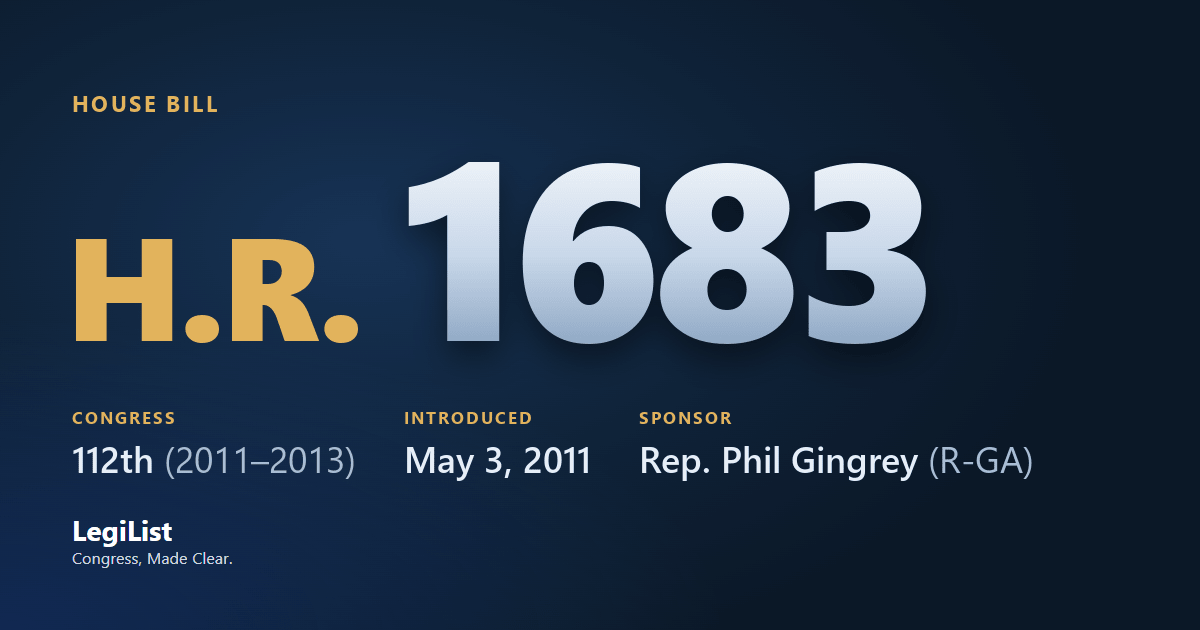
State Flexibility Act
Latest action · May 6, 2011 Referred to the Subcommittee on Health.
Progress
Where this bill reached, and when. A stage with no date was not reached; one that failed a vote and later carried shows the date it carried.
- IntroducedMay 3, 2011
- Passed HouseNot reached
- Passed SenateNot reached
- To the PresidentNot reached
- Became lawNot reached
Summary
State Flexibility Act - Amends the Patient Protection and Affordable Care Act (PPACA) and the American Recovery and Reinvestment Act of 2009 (ARRA) to repeal certain state Medicaid and State Children's Health Insurance Program (CHIP) maintenance of effort requirements under titles XIX and XXI of the Social Security Act.
(Under "maintenance of efforts" a state is prohibited from having eligibility standards, methodologies, or procedures under its state Medicaid or CHIP plan that are more restrictive than those in effect on on July 1, 2008, under ARRA or on March 23, 2010, under PPACA.)
Cosponsors 33
Members who signed on, in the order they did. Signatures ran from May 3, 2011 to Sep 20, 2011; 5 are original cosponsors, there from the day it was introduced.
| Seat | Cosponsor | Signed on | |
|---|---|---|---|
| R-WA | Cathy McMorris Rodgers | Original | May 3, 2011 |
| R-MI | Fred Upton | Original | May 3, 2011 |
| R-MS | Gregg Harper | Original | May 3, 2011 |
| R-PA | Joseph R. Pitts | Original | May 3, 2011 |
| R-NJ | Leonard Lance | Original | May 3, 2011 |
| R-IL | Aaron Schock | May 10, 2011 | |
| R-KY | Brett Guthrie | May 10, 2011 | |
| R-IN | Dan Burton | May 10, 2011 | |
| R-TN | David P. Roe | May 10, 2011 | |
| R-PA | Glenn Thompson | May 10, 2011 | |
| R-OR | Greg Walden | May 10, 2011 | |
| R-TX | Joe Barton | May 10, 2011 | |
| R-IN | Larry Bucshon | May 10, 2011 | |
| R-GA | Lynn A. Westmoreland | May 10, 2011 | |
| R-TN | Marsha Blackburn | May 10, 2011 |
Committees 1
Where it was sent and what each committee and subcommittee did with it, in order.
| Chamber | Committee | What it did |
|---|---|---|
| House | Energy and Commerce Committee | Referred May 3, 2011 |
| Health Subcommittee | Referred May 6, 2011 |
Actions 3
Everything that happened, newest first.
- May 6, 2011Referred to the Subcommittee on Health.
- May 3, 2011Introduced in House
- May 3, 2011Referred to the House Committee on Energy and Commerce.
Research
What has been written about this bill: committee reports, cost estimates, the sponsor’s authority statement, printed hearings and the Congressional Research Service’s work.
Congressional Budget Office cost estimate
- May 11, 2011H.R. 1683, State Flexibility ActCost estimate for the bill as introduced in the House of Representatives on May 3, 2011
Constitutional authority
The sponsor’s statement, as printed in the page H2999.
Related bills 3
Companion bills and other measures the record links to this one.
| Bill | Title | Relationship | Latest action |
|---|---|---|---|
| S 868 | State Flexibility Act | Identical bill | May 3, 2011 |
| HR 5652 | Sequester Replacement Reconciliation Act of 2012 | Related bill | May 15, 2012 |
| HR 6688 | Averting the Fiscal Cliff Act | Related bill | Dec 19, 2012 |
Titles 2
Every title it has carried, official and short, at each stage.
- Official Title as Introduced
- To restore the longstanding partnership between States and the Federal Government in managing the Medicaid program.
- Short Titles as Introduced
- State Flexibility Act
Subjects
Assigned by the Library of Congress. Policy area: Health.
Text 1
Each version as it was printed, newest first.
- May 3, 2011Introduced in House
Support LegiList
This page is free, carries no paywall, and is built and maintained by one person. If the record here is useful to you, a few dollars keeps it going.
Everything here is as published by Congress: the summary is the Congressional Research Service's, the action wording is the clerks', and the subjects are the Library of Congress's. How far it got is read from the actions themselves, taking the most recent one of each kind, so a bill that failed a vote and later passed is shown as having passed. Records come from this bill on Congress.gov and govinfo.gov; cost estimates are the Congressional Budget Office's, and the hearings are the printed hearings GovInfo publishes, which can appear months after the hearing.