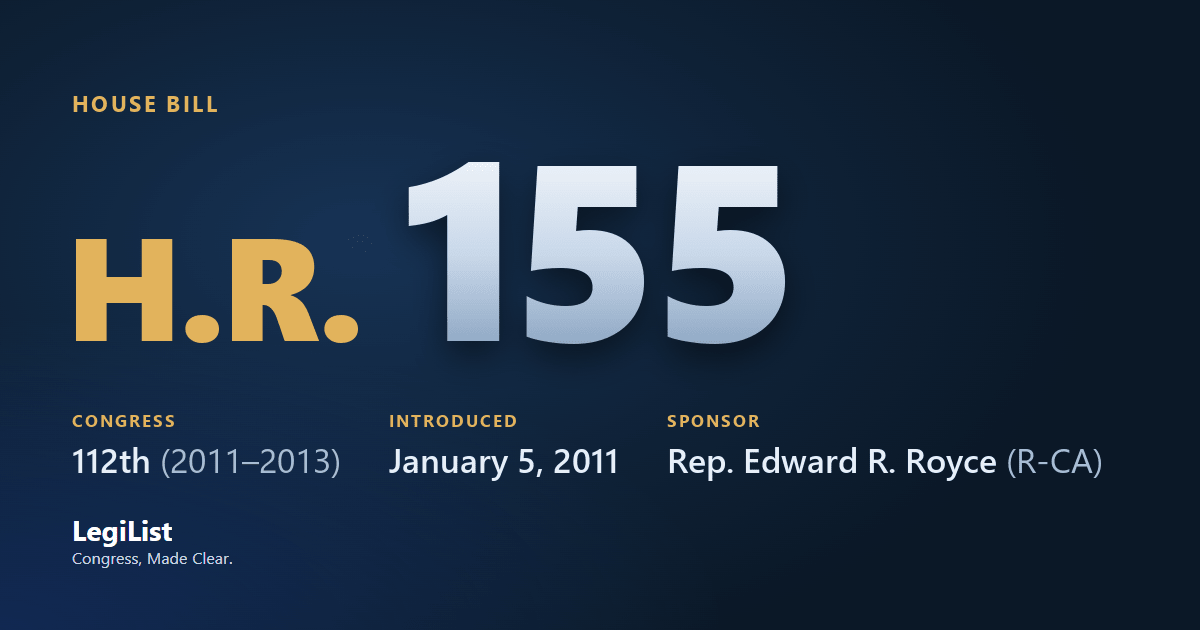
Government Reform Act of 2011
Latest action · Feb 8, 2011 Referred to the Subcommittee on Government Organization, Efficiency, and Financial Management .
Progress
Where this bill reached, and when. A stage with no date was not reached; one that failed a vote and later carried shows the date it carried.
- IntroducedJan 5, 2011
- Passed HouseNot reached
- Passed SenateNot reached
- To the PresidentNot reached
- Became lawNot reached
Summary
Government Reform Act of 2011 - Establishes a Government Reform Commission to: (1) examine the current configuration of executive agencies and investigate their duties and responsibilities; (2) review agency operational jurisdictions to determine whether areas of overlap exist and whether the mission of any agency has become obsolete; (3) review and report to the President and Congress on existing Government Accountability Office (GAO), Congressional Budget Office (CBO), and Inspector General reports, together with any other existing governmental and nongovernmental recommendations, including those offered by the President's Private Sector Survey on Cost Control, for reducing waste in executive agencies; (4) submit to the President and Congress a proposed reorganization plan which shall provide for the realignment or closure of executive agencies to reduce duplication of services and increase productivity; and (5) transmit a copy of the plan to the Director of the Office of Management and Budget (OMB), who shall issue a public report detailing the predicted savings in federal expenditures that would result from implementing such plan.
Sets forth separate provisions for presidential and congressional consideration of and actions on the proposed reorganization plan.
Cosponsors 6
Members who signed on, in the order they did. Signatures ran from Jan 6, 2011 to Feb 10, 2011.
| Seat | Cosponsor | Signed on | |
|---|---|---|---|
| R-NJ | Scott Garrett | Jan 6, 2011 | |
| R-WA | Cathy McMorris Rodgers | Jan 12, 2011 | |
| R-TN | Marsha Blackburn | Jan 12, 2011 | |
| R-TX | Sam Johnson | Jan 18, 2011 | |
| R-KS | Tim Huelskamp | Jan 18, 2011 | |
| R-VA | J. Randy Forbes | Feb 10, 2011 |
Committees 1
Where it was sent and what each committee and subcommittee did with it, in order.
| Chamber | Committee | What it did |
|---|---|---|
| House | Oversight and Government Reform Committee | Referred Jan 5, 2011 |
| Government Operations Subcommittee | Referred Feb 8, 2011 |
Actions 3
Everything that happened, newest first.
- Feb 8, 2011Referred to the Subcommittee on Government Organization, Efficiency, and Financial Management .
- Jan 5, 2011Introduced in House
- Jan 5, 2011Referred to the House Committee on Oversight and Government Reform.
Research
What has been written about this bill: committee reports, cost estimates, the sponsor’s authority statement, printed hearings and the Congressional Research Service’s work.
Constitutional authority
The sponsor’s statement, as printed in the page H46.
Titles 2
Every title it has carried, official and short, at each stage.
- Official Title as Introduced
- To create a national commission, modeled after the successful Defense Base Closure and Realignment Commission, to establish a timely, independent, and fair process for realigning or closing outdated, ineffective, or inefficient Executive agencies.
- Short Titles as Introduced
- Government Reform Act of 2011
Subjects
Assigned by the Library of Congress. Policy area: Government Operations and Politics.
Text 1
Each version as it was printed, newest first.
- Jan 5, 2011Introduced in House
Support LegiList
This page is free, carries no paywall, and is built and maintained by one person. If the record here is useful to you, a few dollars keeps it going.
Everything here is as published by Congress: the summary is the Congressional Research Service's, the action wording is the clerks', and the subjects are the Library of Congress's. How far it got is read from the actions themselves, taking the most recent one of each kind, so a bill that failed a vote and later passed is shown as having passed. Records come from this bill on Congress.gov and govinfo.gov; cost estimates are the Congressional Budget Office's, and the hearings are the printed hearings GovInfo publishes, which can appear months after the hearing.