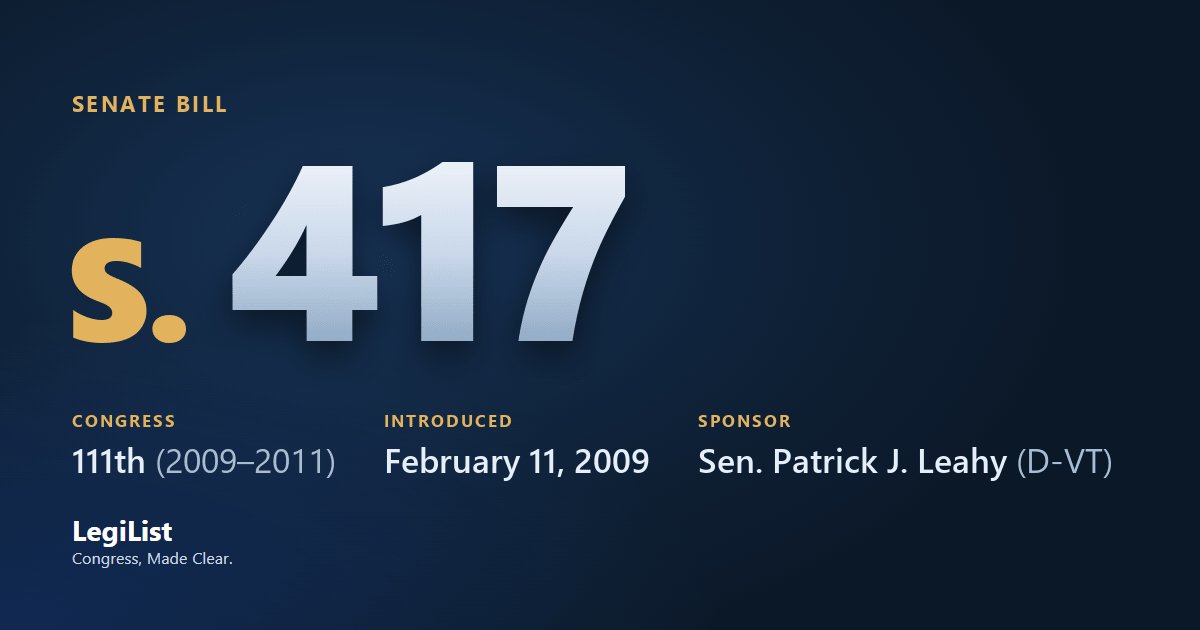
State Secrets Protection Act
Latest action · Feb 11, 2009 Read twice and referred to the Committee on the Judiciary. (text of measure as introduced: CR S2155-2157)
Progress
Where this bill reached, and when. A stage with no date was not reached; one that failed a vote and later carried shows the date it carried.
- IntroducedFeb 11, 2009
- Passed SenateNot reached
- Passed HouseNot reached
- To the PresidentNot reached
- Became lawNot reached
Summary
State Secrets Protection Act - Amends the federal judicial code to: (1) require a federal court to determine which filings, motions, and affidavits (or portions) submitted under this Act shall be submitted ex parte; (2) allow a federal court to order a party to provide a redacted, unclassified, or summary substitute of a filing, motion, or affidavit to other parties; and (3) require a federal court to make decisions under this Act, taking into consideration the interests of justice and national security.
Requires any hearing under this Act to be conducted in camera. Prohibits an in camera hearing, however, based on the assertion of the state secrets privilege, if the court determines that the hearing relates only to a question of law and does not present a risk of revealing state secrets.
Allows a federal court to conduct hearings (or portions) ex parte if the court determines, following in camera review of the evidence, that the interests of justice and national security cannot adequately be protected through attorney security clearances, protective orders, sealed opinions or orders, and special masters.
Authorizes a court, if the United States fails to provide an attorney or guardian ad litem with necessary security clearance in a reasonable period of time, to review in camera and ex parte the reasons for denying or delaying the clearance, in order to ensure that the United States is not withholding a security clearance from a particular attorney or class of attorneys for any reason other than protection of national security.
Authorizes the United States to intervene in any civil action in order to protect information that may be subject to the state secrets privilege. Declares, however, that the state secrets privilege shall not constitute grounds for dismissal of a case or claim.
Prescribes procedures for: (1) determining whether evidence is protected from disclosure by the state secrets privilege; and (2) when evidence protected by the state secrets privilege is necessary for adjudication of a claim or counterclaim.
Requires the court to give substantial weight to an assertion by the United States relating to why public disclosure of an item of evidence would be reasonably likely to cause significant harm to the national defense or foreign relations of the United States.
Grants courts of appeal jurisdiction of an appeal by any party from any interlocutory decision or order of a U.S. district court.
Requires the Attorney General within 30 days to report in writing to Congress on any case in which the United States asserts the state secrets privilege.
Applies this Act to civil cases pending on or after the enactment of this Act.
Cosponsors 9
Members who signed on, in the order they did. Signatures ran from Feb 11, 2009 to Jun 25, 2009; 5 are original cosponsors, there from the day it was introduced.
| Seat | Cosponsor | Signed on | |
|---|---|---|---|
| D-PA | Arlen Specter | Original | Feb 11, 2009 |
| D-MO | Claire McCaskill | Original | Feb 11, 2009 |
| D-MA | Edward M. Kennedy | Original | Feb 11, 2009 |
| D-WI | Russell D. Feingold | Original | Feb 11, 2009 |
| D-RI | Sheldon Whitehouse | Original | Feb 11, 2009 |
| D-MT | Jon Tester | Feb 12, 2009 | |
| D-MD | Benjamin L. Cardin | May 6, 2009 | |
| D-CT | Christopher J. Dodd | May 6, 2009 | |
| D-DE | Edward E. Kaufman | Jun 25, 2009 |
Committees 1
Where it was sent and what each committee and subcommittee did with it, in order.
| Chamber | Committee | What it did |
|---|---|---|
| Senate | Judiciary Committee | Referred Feb 11, 2009 |
Actions 3
Everything that happened, newest first.
- Feb 11, 2009Introduced in Senate
- Feb 11, 2009Sponsor introductory remarks on measure. (CR S2155)
- Feb 11, 2009Read twice and referred to the Committee on the Judiciary. (text of measure as introduced: CR S2155-2157)
In the Congressional Record 3
Days the Record’s own index lists this bill, newest first, with the pages and the members it names. Pages starting H are the House, S the Senate, E Extensions of Remarks.
| Where | In the Record | Members | Date |
|---|---|---|---|
| Senate | Debate and remarks S6438–S6440 | Orrin G. Hatch R-UT | Jun 10, 2009 |
| Senate | Debate and remarks S4996 | Patrick J. Leahy D-VT | Apr 30, 2009 |
| Senate | Debate and remarks S2155–S2159Text printed S2155–S2157 | Patrick J. Leahy D-VT (text), Russell D. Feingold D-WI | Feb 11, 2009 |
Research
What has been written about this bill: committee reports, cost estimates, the sponsor’s authority statement, printed hearings and the Congressional Research Service’s work.
Printed hearings 1
Hearings whose printed record names this bill, newest first: hearings on it, and wider hearings where it came up.
| Number | Hearing | Committee | Held |
|---|---|---|---|
| S. Hrg. 111-163 | NOMINATION OF DAVID S. KRIS TO BE ASSISTANT ATTORNEY GENERAL FOR NATIONAL SECURITY114 pages | Intelligence (Select) Committee | Mar 10, 2009 |
Titles 2
Every title it has carried, official and short, at each stage.
- Official Title as Introduced
- A bill to enact a safe, fair, and responsible state secrets privilege Act.
- Short Titles as Introduced
- State Secrets Protection Act
Subjects
Assigned by the Library of Congress. Policy area: Law.
Text 1
Each version as it was printed, newest first.
- Feb 11, 2009Introduced in Senate
Support LegiList
This page is free, carries no paywall, and is built and maintained by one person. If the record here is useful to you, a few dollars keeps it going.
Everything here is as published by Congress: the summary is the Congressional Research Service's, the action wording is the clerks', and the subjects are the Library of Congress's. How far it got is read from the actions themselves, taking the most recent one of each kind, so a bill that failed a vote and later passed is shown as having passed. Records come from this bill on Congress.gov and govinfo.gov; cost estimates are the Congressional Budget Office's, and the hearings are the printed hearings GovInfo publishes, which can appear months after the hearing.