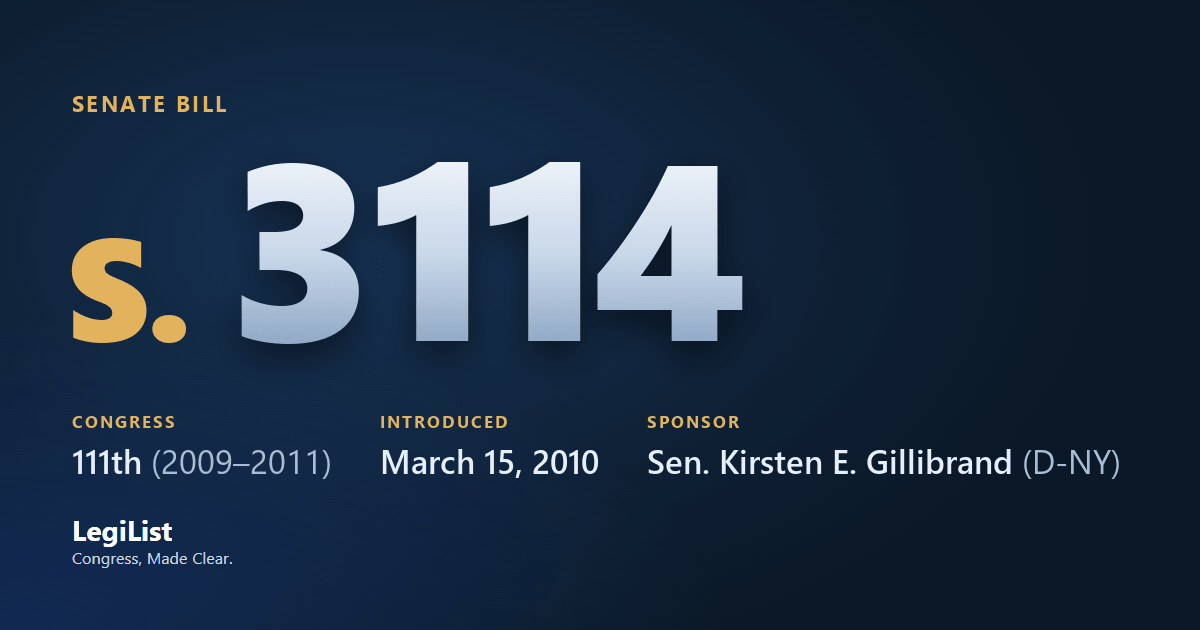
Consumer Recall Notification Act
Latest action · Mar 15, 2010 Read twice and referred to the Committee on Health, Education, Labor, and Pensions.
Progress
Where this bill reached, and when. A stage with no date was not reached; one that failed a vote and later carried shows the date it carried.
- IntroducedMar 15, 2010
- Passed SenateNot reached
- Passed HouseNot reached
- To the PresidentNot reached
- Became lawNot reached
Summary
Consumer Recall Notification Act - Directs the Secretary of Health and Human Services (HHS), acting through the Commissioner of Food and Drugs, to improve communication between state entities, state and local health departments, and facilities in order to provide consumers with more and timely notification of Class I recalls (situations in which there is a reasonable probability that the use of, or exposure to, a violative product will cause serious adverse health consequences or death) by: (1) developing and distributing national and regional advisories concerning Class I recalls; (2) developing standardized formats for such advisories to be used by health or food safety agencies; and (3) providing frontline health professionals with information about symptoms to document and tests that should be performed to diagnose foodborne illness in relation to specific regional outbreaks that may occur as a result of an adulterated product.
Requires a food facility that is subject to a Class I recall or a supplier that supplied products subject to such a recall to notify applicable retail establishments and restaurants within 24 hours of the public announcement of such recall.
Directs the Commissioner to: (1) share commercial or financial information and lists of registered facilities with federal, state, local, and foreign agencies, provided they assure confidentiality of the information; (2) publish on the Food and Drug Administration (FDA) website a list of retail establishments, restaurants, and locations that sell or have sold products that are subject to a Class I recall; and (3) require on-site notification of a recalled product by posting notification in the freezer case or shelving unit in the retail establishment where the product is sold.
Sets civil penalties for failure to notify retailers, restaurants, and customers.
Cosponsors
Members who signed on, in the order they did.
Committees 1
Where it was sent and what each committee and subcommittee did with it, in order.
| Chamber | Committee | What it did |
|---|---|---|
| Senate | Health, Education, Labor, and Pensions Committee | Referred Mar 15, 2010 |
Actions 2
Everything that happened, newest first.
- Mar 15, 2010Introduced in Senate
- Mar 15, 2010Read twice and referred to the Committee on Health, Education, Labor, and Pensions.
Related bills 1
Companion bills and other measures the record links to this one.
| Bill | Title | Relationship | Latest action |
|---|---|---|---|
| HR 1907 | Improving Communication with Consumers During Food Recall Act of 2009 | Related bill | Apr 21, 2009 |
Titles 2
Every title it has carried, official and short, at each stage.
- Official Title as Introduced
- A bill to improve communication to consumers when there is a food recall.
- Short Titles as Introduced
- Consumer Recall Notification Act
Subjects
Assigned by the Library of Congress. Policy area: Health.
Text 1
Each version as it was printed, newest first.
- Mar 15, 2010Introduced in Senate
Everything here is as published by Congress: the summary is the Congressional Research Service's, the action wording is the clerks', and the subjects are the Library of Congress's. How far it got is read from the actions themselves, taking the most recent one of each kind, so a bill that failed a vote and later passed is shown as having passed. Records come from this bill on Congress.gov and govinfo.gov; cost estimates are the Congressional Budget Office's, and the hearings are the printed hearings GovInfo publishes, which can appear months after the hearing.