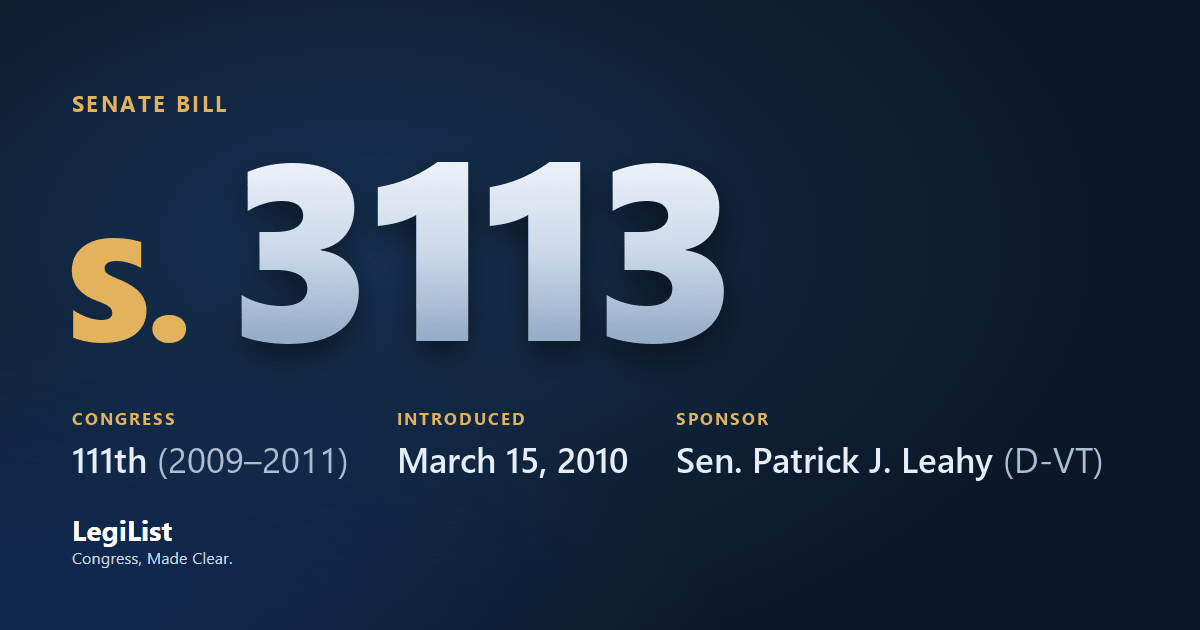
Refugee Protection Act of 2010
Latest action · May 19, 2010 Committee on the Judiciary. Hearings held.
Progress
Where this bill reached, and when. A stage with no date was not reached; one that failed a vote and later carried shows the date it carried.
- IntroducedMar 15, 2010
- Passed SenateNot reached
- Passed HouseNot reached
- To the PresidentNot reached
- Became lawNot reached
Summary
Refugee Protection Act of 2010 - Amends the Immigration and Nationality Act to eliminate the one-year time limit for filing an asylum claim.
Revises the definition of terrorist activity for purposes of alien inadmissibility. Excludes coerced activity from such definition.
Revises: (1) the definition of refugee; and (2) the criteria for granting asylum.
Authorizes the Attorney General to appoint counsel to represent an alien in a removal proceeding.
Prohibits an alien from being removed during the 30-day petition for review period unless the alien indicates in writing that he or she wishes to be removed before the expiration of such period.
Makes discretionary certain currently required detention provisions regarding arriving aliens who request asylum.
Directs the Secretary of Homeland Security (DHS) to: (1) establish a secure alternatives to detention program; (2) establish specified conditions of detention; (3) file notice of immigration charges with the court and the individual within 48 hours of detention; and (4) establish procedures to ensure the accuracy of statements taken by DHS employees exercising expedited removal authority.
Authorizes the United States Commission on International Religious Freedom to conduct a study to determine whether certain immigration officers are properly handling asylum and removal/detention authority with regard to aliens apprehended after entering the United States.
Eliminates the one-year waiting period before a refugee or asylee may petition for permanent legal resident status.
Exempts aliens under the age of 18 from certain restrictions on applying for asylum.
Permits applicants for refugee admission to simultaneously pursue other forms of admission.
Authorizes the spouse or child of a refugee or asylee to bring his or her accompanying or following child into the United States as a refugee or asylee.
States that if the President does not issue a refugee allocation determination before the beginning of a fiscal year the number of refugees that may be admitted in each quarter shall be 25% of the number of refugees admissible during the previous fiscal year.
Authorizes the Secretary of State to designate certain groups as eligible for expedited refugee adjudication.
Directs the Secretary of State to notify Congress regarding the amount of funds that will be provided in Reception and Placement Grants in the coming fiscal year.
Authorizes the Secretary of Health and Human Services (HHS) to make grants to nonprofit organizations to assist refugees in obtaining immigration benefits.
Sets forth protections for: (1) aliens interdicted at sea; and (2) stateless persons in the United States.
Cosponsors 4
Members who signed on, in the order they did. Signatures ran from Mar 15, 2010 to Mar 16, 2010; 1 is an original cosponsor, there from the day it was introduced.
| Seat | Cosponsor | Signed on | |
|---|---|---|---|
| D-MI | Carl Levin | Original | Mar 15, 2010 |
| D-HI | Daniel K. Akaka | Mar 16, 2010 | |
| D-IL | Richard J. Durbin | Mar 16, 2010 | |
| D-IL | Roland Burris | Mar 16, 2010 |
Committees 1
Where it was sent and what each committee and subcommittee did with it, in order.
| Chamber | Committee | What it did |
|---|---|---|
| Senate | Judiciary Committee | Referred Mar 15, 2010Hearings May 19, 2010 |
Actions 4
Everything that happened, newest first.
- May 19, 2010Committee on the Judiciary. Hearings held.
- Mar 15, 2010Introduced in Senate
- Mar 15, 2010Sponsor introductory remarks on measure. (CR S1518-1520)
- Mar 15, 2010Read twice and referred to the Committee on the Judiciary. (text of measure as introduced: CR S1521-1528)
In the Congressional Record 3
Days the Record’s own index lists this bill, newest first, with the pages and the members it names. Pages starting H are the House, S the Senate, E Extensions of Remarks.
| Where | In the Record | Members | Date |
|---|---|---|---|
| Senate | Debate and remarks S5432 | Patrick J. Leahy D-VT | Jun 24, 2010 |
| Senate | Debate and remarks S5104–S5106 | Carl Levin D-MI, Patrick J. Leahy D-VT | Jun 17, 2010 |
| Senate | Debate and remarks S1518–S1520Text printed S1521–S1528 | Patrick J. Leahy D-VT (text) | Mar 15, 2010 |
Research
What has been written about this bill: committee reports, cost estimates, the sponsor’s authority statement, printed hearings and the Congressional Research Service’s work.
Printed hearings 1
Hearings whose printed record names this bill, newest first: hearings on it, and wider hearings where it came up.
| Number | Hearing | Committee | Held |
|---|---|---|---|
| S. Hrg. 111-599 | REVIEWING AMERICA'S COMMITMENT TO THE REFUGEE CONVENTION: THE REFUGEE PROTECTION ACT OF 2010186 pages | Judiciary Committee | May 19, 2010 |
Titles 2
Every title it has carried, official and short, at each stage.
- Official Title as Introduced
- A bill to amend the Immigration and Nationality Act to reaffirm the United States' historic commitment to protecting refugees who are fleeing persecution or torture.
- Short Titles as Introduced
- Refugee Protection Act of 2010
Subjects
Assigned by the Library of Congress. Policy area: Immigration.
- Administrative law and regulatory procedures
- Administrative remedies
- Child safety and welfare
- Crime victims
- Department of Homeland Security
- Department of Justice
- Detention of persons
- Emergency medical services and trauma care
- Government studies and investigations
- Health care coverage and access
- Health information and medical records
- Health promotion and preventive care
- Human rights
- Immigrant health and welfare
- Immigration
- Immigration status and procedures
- Judicial review and appeals
- Lawyers and legal services
- Medical tests and diagnostic methods
- Mental health
- Refugees, asylum, displaced persons
- Religion
- Terrorism
- Visas and passports
Text 1
Each version as it was printed, newest first.
- Mar 15, 2010Introduced in Senate
Support LegiList
This page is free, carries no paywall, and is built and maintained by one person. If the record here is useful to you, a few dollars keeps it going.
Everything here is as published by Congress: the summary is the Congressional Research Service's, the action wording is the clerks', and the subjects are the Library of Congress's. How far it got is read from the actions themselves, taking the most recent one of each kind, so a bill that failed a vote and later passed is shown as having passed. Records come from this bill on Congress.gov and govinfo.gov; cost estimates are the Congressional Budget Office's, and the hearings are the printed hearings GovInfo publishes, which can appear months after the hearing.