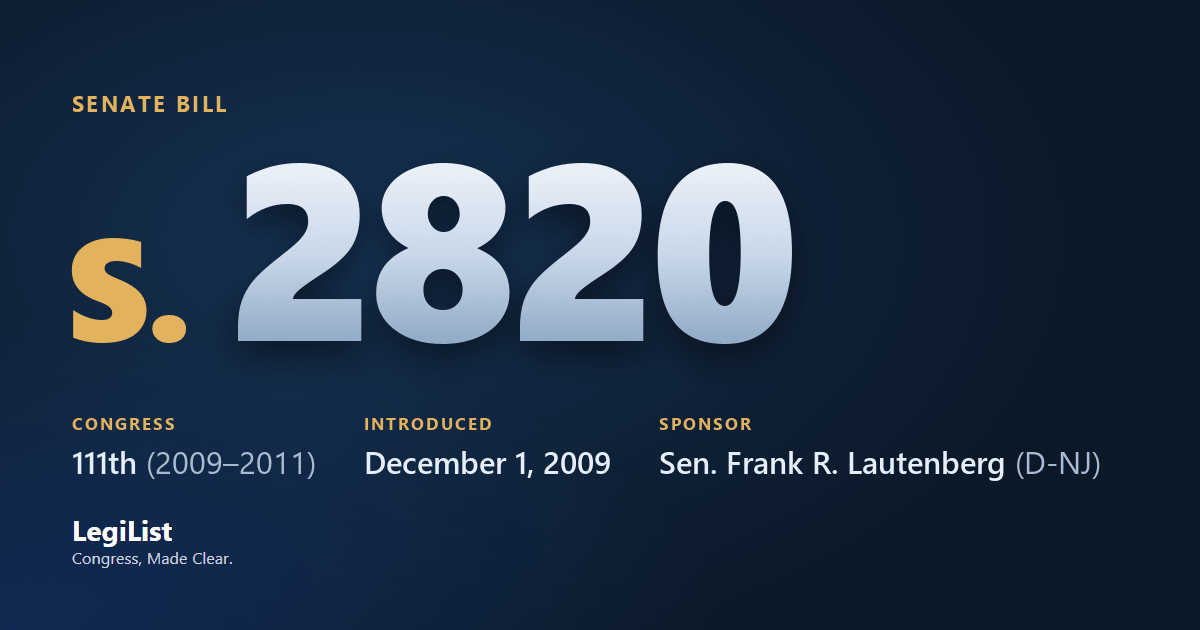
PROTECT Act of 2009
Latest action · Dec 1, 2009 Read twice and referred to the Committee on the Judiciary.
Progress
Where this bill reached, and when. A stage with no date was not reached; one that failed a vote and later carried shows the date it carried.
- IntroducedDec 1, 2009
- Passed SenateNot reached
- Passed HouseNot reached
- To the PresidentNot reached
- Became lawNot reached
Summary
Preserving Records of Terrorist & Criminal Transactions Act of 2009 or the PROTECT Act of 2009 - Amends the federal criminal code to require: (1) the retention for a minimum of 10 years of criminal background check records for known or suspected members of terrorist organizations who attempt to purchase firearms or apply for a state permit to possess, acquire, or carry firearms; and (2) the retention for at least 180 days of other criminal background check records relating to firearms purchases.
Repeals certain provisions that require the destruction within 24 hours of identifying information for individuals who legally purchase or possess firearms.
Cosponsors 6
Members who signed on, in the order they did. Signatures ran from Dec 1, 2009 to Dec 3, 2009; 5 are original cosponsors, there from the day it was introduced.
| Seat | Cosponsor | Signed on | |
|---|---|---|---|
| D-MI | Carl Levin | Original | Dec 1, 2009 |
| D-NY | Charles E. Schumer | Original | Dec 1, 2009 |
| D-CA | Dianne Feinstein | Original | Dec 1, 2009 |
| D-RI | Jack Reed | Original | Dec 1, 2009 |
| D-RI | Sheldon Whitehouse | Original | Dec 1, 2009 |
| I-CT | Joseph I. Lieberman | Dec 3, 2009 |
Committees 1
Where it was sent and what each committee and subcommittee did with it, in order.
| Chamber | Committee | What it did |
|---|---|---|
| Senate | Judiciary Committee | Referred Dec 1, 2009 |
Actions 2
Everything that happened, newest first.
- Dec 1, 2009Introduced in Senate
- Dec 1, 2009Read twice and referred to the Committee on the Judiciary.
In the Congressional Record 2
Days the Record’s own index lists this bill, newest first, with the pages and the members it names. Pages starting H are the House, S the Senate, E Extensions of Remarks.
| Where | In the Record | Members | Date |
|---|---|---|---|
| Senate | Debate and remarks S7741 | Carl Levin D-MI | Sep 29, 2010 |
| Senate | Debate and remarks S13871 | Carl Levin D-MI | Dec 23, 2009 |
Research
What has been written about this bill: committee reports, cost estimates, the sponsor’s authority statement, printed hearings and the Congressional Research Service’s work.
Printed hearings 1
Hearings whose printed record names this bill, newest first: hearings on it, and wider hearings where it came up.
| Number | Hearing | Committee | Held |
|---|---|---|---|
| S. Hrg. 111-1079 | TERRORISTS AND GUNS: THE NATURE OF THE THREAT AND PROPOSED REFORMS119 pages | Homeland Security and Governmental Affairs Committee | May 5, 2010 |
CRS reports 2
Congressional Research Service work that CRS links to this bill or the law it became, newest first.
Cite it 2
Products on other subjects that cite it, usually among other measures.
| Product | Title | Kind | Published |
|---|---|---|---|
| R42336 | Terrorist Watch List Screening and Background Checks for Firearms Archived | Report | May 1, 2013 |
| RL32842 | Gun Control Legislation Archived | Report | Nov 14, 2012 |
Titles 3
Every title it has carried, official and short, at each stage.
- Official Title as Introduced
- A bill to prevent the destruction of terrorist and criminal national instant criminal background check system records.
- Short Titles as Introduced
- Preserving Records of Terrorist & Criminal Transactions Act of 2009
- PROTECT Act of 2009
Subjects
Assigned by the Library of Congress. Policy area: Crime and Law Enforcement.
Text 1
Each version as it was printed, newest first.
- Dec 1, 2009Introduced in Senate
Everything here is as published by Congress: the summary is the Congressional Research Service's, the action wording is the clerks', and the subjects are the Library of Congress's. How far it got is read from the actions themselves, taking the most recent one of each kind, so a bill that failed a vote and later passed is shown as having passed. Records come from this bill on Congress.gov and govinfo.gov; cost estimates are the Congressional Budget Office's, and the hearings are the printed hearings GovInfo publishes, which can appear months after the hearing.