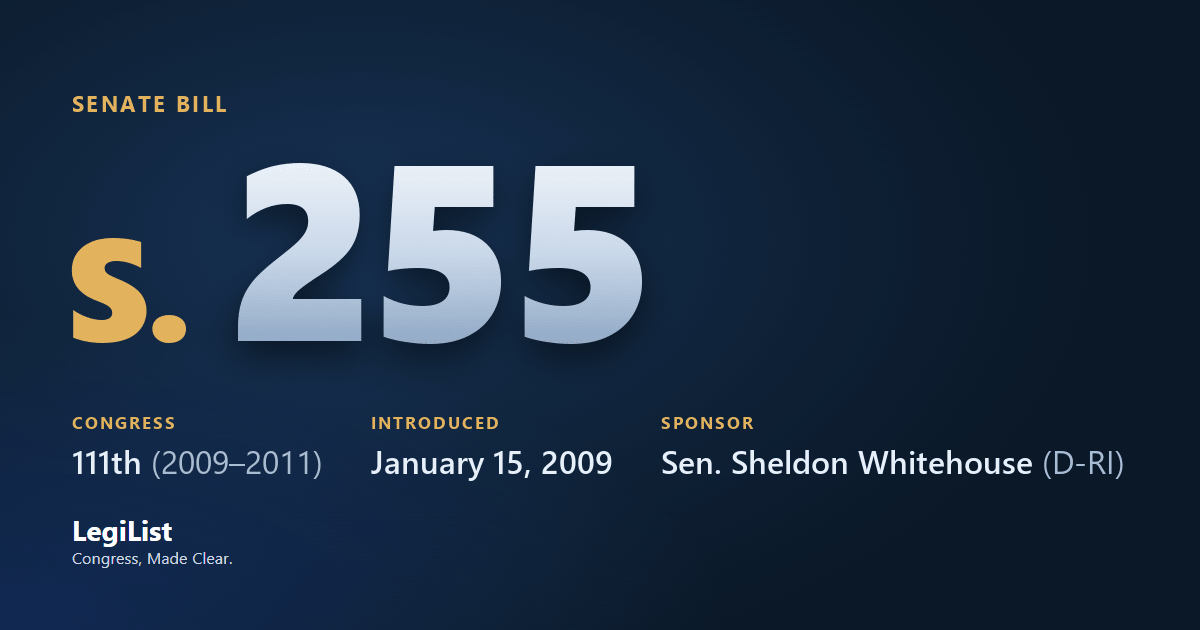
Empowering States' Right To Protect Consumers Act of 2009
Latest action · Jan 15, 2009 Read twice and referred to the Committee on Banking, Housing, and Urban Affairs.
Progress
Where this bill reached, and when. A stage with no date was not reached; one that failed a vote and later carried shows the date it carried.
- IntroducedJan 15, 2009
- Passed SenateNot reached
- Passed HouseNot reached
- To the PresidentNot reached
- Became lawNot reached
Summary
Empowering States' Right To Protect Consumers Act of 2009 - Amends the Truth In Lending Act to limit the annual percentage rate (APR) applicable to any consumer credit transaction (other than a residential mortgage transaction), including any associated fees, to the maximum rate permitted by the laws of the state in which the consumer resides.
Cosponsors 4
Members who signed on, in the order they did. Signatures ran from Jan 15, 2009 to Jun 4, 2009, with 1 there on the day it was introduced.
| Seat | Cosponsor | Signed on | |
|---|---|---|---|
| D-IL | Richard J. Durbin | Original | Jan 15, 2009 |
| I-VT | Bernard Sanders | May 11, 2009 | |
| D-OR | Jeff Merkley | May 21, 2009 | |
| D-MI | Carl Levin | Jun 4, 2009 |
Actions 2
Everything that happened, newest first.
- Jan 15, 2009Introduced in Senate
- Jan 15, 2009Read twice and referred to the Committee on Banking, Housing, and Urban Affairs.
Subjects
Assigned by the Library of Congress. Policy area: Finance and Financial Sector.
Text 1
Each version as it was printed, newest first.
- Jan 15, 2009Introduced in Senate
Everything here is as published by Congress: the summary is the Congressional Research Service's, the action wording is the clerks', and the subjects are the Library of Congress's. How far it got is read from the actions themselves, taking the most recent one of each kind, so a bill that failed a vote and later passed is shown as having passed. Records come from this bill on Congress.gov and govinfo.gov.