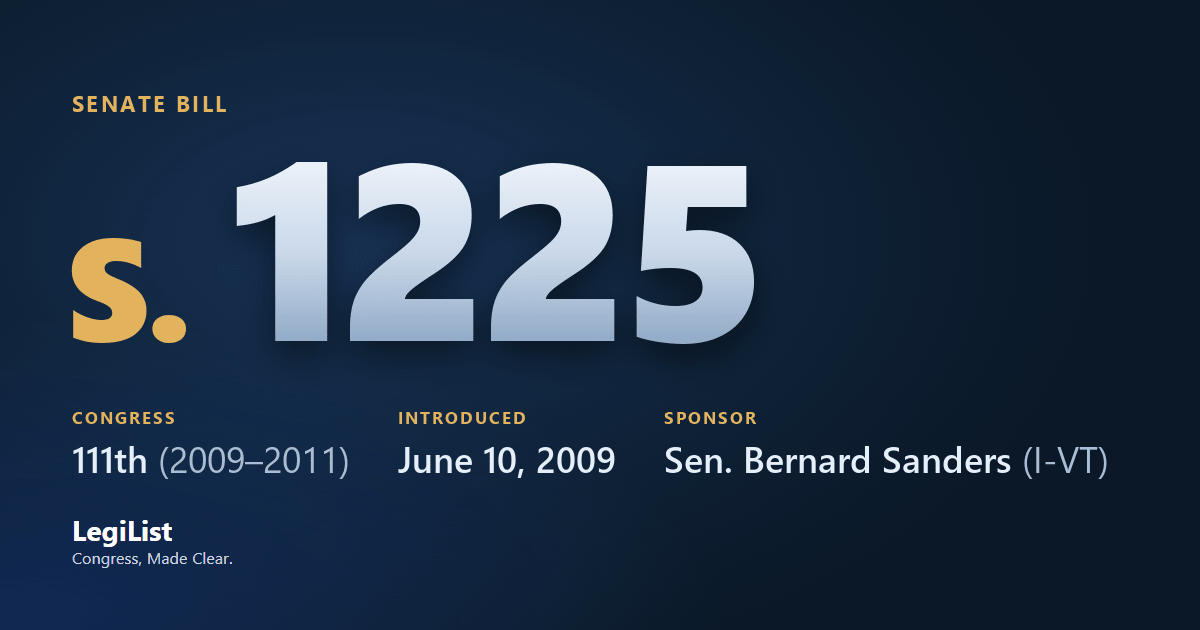
Energy Market Manipulation Prevention Act
Latest action · Jun 10, 2009 Read twice and referred to the Committee on Agriculture, Nutrition, and Forestry.
Progress
Where this bill reached, and when. A stage with no date was not reached; one that failed a vote and later carried shows the date it carried.
- IntroducedJun 10, 2009
- Passed SenateNot reached
- Passed HouseNot reached
- To the PresidentNot reached
- Became lawNot reached
Summary
Energy Market Manipulation Prevention Act - Directs the Commodity Futures Trading Commission (CFTC) to eliminate excessive speculation in energy contract markets, unwarranted energy price fluctuations, or other unlawful activities that prevent energy prices from accurately reflecting supply and demand.
Requires the Commission to: (1) classify immediately each bank holding company engaged in energy futures trading as a noncommercial participant subject to strict position limits; (2) require immediately hedge funds engaged in energy futures trading to register as noncommercial participants subject to strict speculation limits; (3) eliminate conflicts of interest in which one entity has a hand in predicting oil prices, operating oil assets, and buying or selling oil derivatives; and (4) revoke immediately each staff no-action letter that covers a foreign board of trade that has established trading terminals in this country to trade U.S. commodities to U.S. investors.
Cosponsors 2
Members who signed on, in the order they did. All signed on Jun 11, 2009.
| Seat | Cosponsor | Signed on | |
|---|---|---|---|
| D-FL | Bill Nelson | Jun 11, 2009 | |
| D-AK | Mark Begich | Jun 11, 2009 |
Committees 1
Where it was sent and what each committee and subcommittee did with it, in order.
| Chamber | Committee | What it did |
|---|---|---|
| Senate | Agriculture, Nutrition, and Forestry Committee | Referred Jun 10, 2009 |
Actions 3
Everything that happened, newest first.
- Jun 10, 2009Introduced in Senate
- Jun 10, 2009Sponsor introductory remarks on measure. (CR S6456-6457)
- Jun 10, 2009Read twice and referred to the Committee on Agriculture, Nutrition, and Forestry.
In the Congressional Record 2
Days the Record’s own index lists this bill, newest first, with the pages and the members it names. Pages starting H are the House, S the Senate, E Extensions of Remarks.
| Where | In the Record | Members | Date |
|---|---|---|---|
| Senate | Debate and remarks S6758 | Bill Nelson D-FL | Jun 18, 2009 |
| Senate | Debate and remarks S6456, S6457 | Bernard Sanders I-VT | Jun 10, 2009 |
Research
What has been written about this bill: committee reports, cost estimates, the sponsor’s authority statement, printed hearings and the Congressional Research Service’s work.
CRS reports 1
Congressional Research Service work that CRS links to this bill or the law it became, newest first.
Cite it 1
Products on other subjects that cite it, usually among other measures.
| Product | Title | Kind | Published |
|---|---|---|---|
| R40646 | Derivatives Regulation and Legislation Through the 111th Congress Archived | Report | Jan 30, 2012 |
Related bills 1
Companion bills and other measures the record links to this one.
| Bill | Title | Relationship | Latest action |
|---|---|---|---|
| HR 2869 | Energy Market Manipulation Prevention Act | Identical bill | Jun 22, 2010 |
Titles 2
Every title it has carried, official and short, at each stage.
- Official Title as Introduced
- A bill to require the Commodity Futures Trading Commission to take certain actions to prevent the manipulation of energy markets, and for other purposes.
- Short Titles as Introduced
- Energy Market Manipulation Prevention Act
Subjects
Assigned by the Library of Congress. Policy area: Finance and Financial Sector.
Text 1
Each version as it was printed, newest first.
- Jun 10, 2009Introduced in Senate
Support LegiList
This page is free, carries no paywall, and is built and maintained by one person. If the record here is useful to you, a few dollars keeps it going.
Everything here is as published by Congress: the summary is the Congressional Research Service's, the action wording is the clerks', and the subjects are the Library of Congress's. How far it got is read from the actions themselves, taking the most recent one of each kind, so a bill that failed a vote and later passed is shown as having passed. Records come from this bill on Congress.gov and govinfo.gov; cost estimates are the Congressional Budget Office's, and the hearings are the printed hearings GovInfo publishes, which can appear months after the hearing.