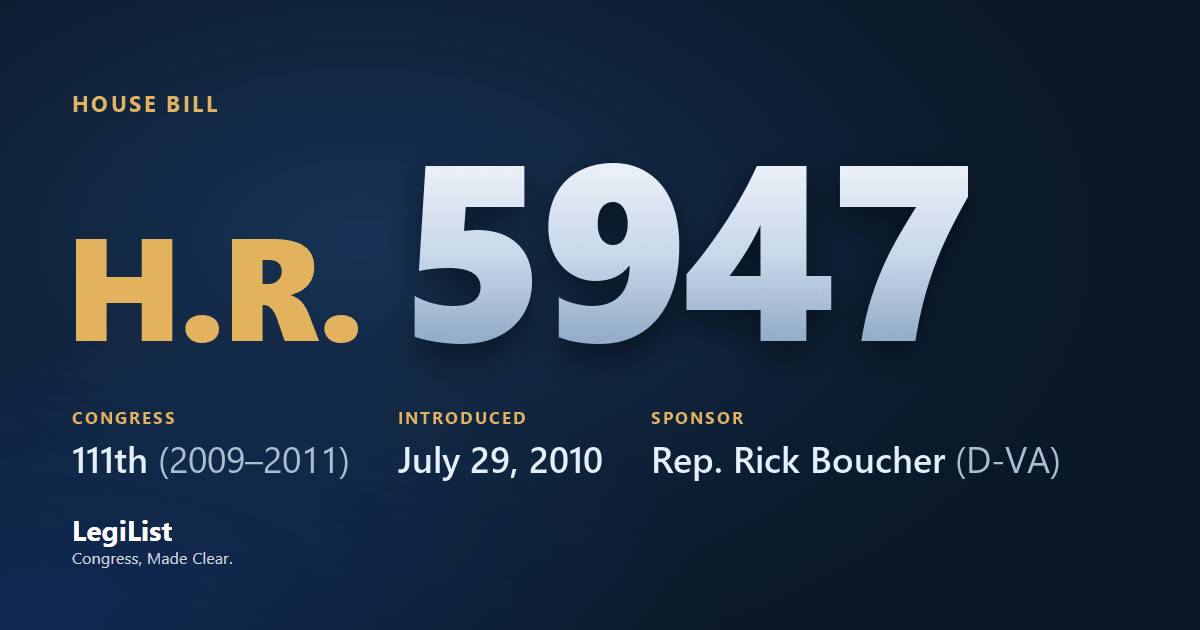
Voluntary Incentive Auctions Act of 2010
Latest action · Jul 29, 2010 Referred to the House Committee on Energy and Commerce.
Progress
Where this bill reached, and when. A stage with no date was not reached; one that failed a vote and later carried shows the date it carried.
- IntroducedJul 29, 2010
- Passed HouseNot reached
- Passed SenateNot reached
- To the PresidentNot reached
- Became lawNot reached
Summary
Voluntary Incentive Auctions Act of 2010 - Amends the Communications Act of 1934 to provide that, if consistent with the public interest for a licensee to voluntarily relinquish some or all of its spectrum usage rights in order to permit the assignment of new initial licenses or the allocation of spectrum for unlicensed use, the proceeds from the use of a competitive bidding system may be shared with any licensee who agreed to voluntarily relinquish such usage rights.
Prohibits the Federal Communications Commission (FCC) from reclaiming frequencies of broadcast television licensees or any other licensees on an involuntary basis for certain licensing purposes.
Cosponsors 1
Members who signed on, in the order they did. All signed on Jul 29, 2010.
| Seat | Cosponsor | Signed on | |
|---|---|---|---|
| R-FL | Cliff Stearns | Original | Jul 29, 2010 |
Actions 3
Everything that happened, newest first.
- Jul 29, 2010Introduced in House
- Jul 29, 2010Referred to the House Committee on Energy and Commerce.
- Jul 29, 2010Sponsor introductory remarks on measure. (CR E1471)
Related bills 1
Companion bills and other measures the record links to this one.
| Bill | Title | Relationship | Latest action |
|---|---|---|---|
| S 3610 | Spectrum Measurement and Policy Reform Act | Related bill | Jul 19, 2010 |
Subjects
Assigned by the Library of Congress. Policy area: Science, Technology, Communications.
Text 1
Each version as it was printed, newest first.
- Jul 29, 2010Introduced in House
Everything here is as published by Congress: the summary is the Congressional Research Service's, the action wording is the clerks', and the subjects are the Library of Congress's. How far it got is read from the actions themselves, taking the most recent one of each kind, so a bill that failed a vote and later passed is shown as having passed. Records come from this bill on Congress.gov and govinfo.gov.