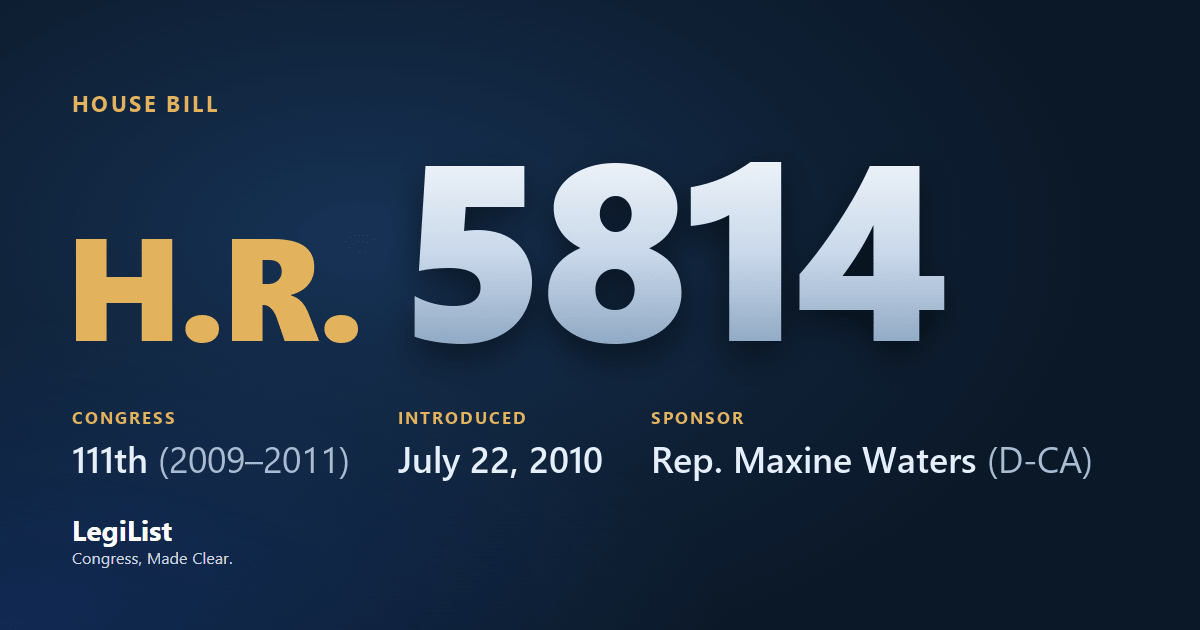
Public Housing Reinvestment and Tenant Protection Act of 2010
Latest action · Jul 27, 2010 Ordered to be Reported (Amended) by the Yeas and Nays: 42 - 27.
Progress
Where this bill reached, and when. A stage with no date was not reached; one that failed a vote and later carried shows the date it carried.
- IntroducedJul 22, 2010
- Passed HouseNot reached
- Passed SenateNot reached
- To the PresidentNot reached
- Became lawNot reached
Summary
Public Housing Reinvestment and Tenant Protection Act of 2010 - Choice Neighborhoods Initiative Act of 2010 - Requires the Secretary of Housing and Urban Development (HUD) to make competitive grants to local governments, public housing agencies (PHAs), or nonprofit entities owning a major housing project to implement transformational programs in eligible neighborhoods with a concentration of extreme poverty and severely distressed housing.
Public Housing One-for-One Replacement and Tenant Protection Act of 2010 - Amends the United States Housing Act of 1937 with respect to: (1) demolition, disposition, or both pursuant to conversion of any public housing unit; and (2) the taking of public housing units through the use of eminent domain.
Exempts from specified requirements for demolition and disposition of public housing any public housing projects removed from a PHA inventory under the program for conversion of demolished or distressed public housing dwelling units to tenant-based assistance.
Public Housing Preservation and Rehabilitation Act of 2010 - Authorizes the Secretary to guarantee notes or other obligations issued by PHAs to finance: (1) the rehabilitation of PHA public housing; or (2) the modernization of such housing through energy efficiency improvements.
Prescribes requirements for PHAs that utilize housing tax credits under the Internal Revenue Code for rental housing units.
Removes a specified limitation on the use of amounts from the public housing Capital Fund or Operation Fund by a PHA to construct new public housing units. Permits a PHA to use amounts from the Capital Fund for public housing units not included in the regular formula for determining the amount of assistance, subject to certain conditions.
Authorizes the Secretary to make grants to PHAs for conversion of public housing projects to assisted living.
Together We Care Act of 2010 - Requires the Secretary to establish a competitive grant pilot program for eligible entities to train public housing residents as home health aides and as providers of home-based health services for residents of public housing or federally-assisted rental housing who are elderly, disabled, or both.
Cosponsors 2
Members who signed on, in the order they did. All signed on Jul 22, 2010.
| Seat | Cosponsor | Signed on | |
|---|---|---|---|
| D-MA | Barney Frank | Original | Jul 22, 2010 |
| D-NY | Nydia M. Velázquez | Original | Jul 22, 2010 |
Committees 1
Where it was sent and what each committee and subcommittee did with it, in order.
| Chamber | Committee | What it did |
|---|---|---|
| House | Financial Services Committee | Referred Jul 22, 2010Markup Jul 27, 2010 |
Actions 4
Everything that happened, newest first.
- Jul 27, 2010Committee Consideration and Mark-up Session Held.
- Jul 27, 2010Ordered to be Reported (Amended) by the Yeas and Nays: 42 - 27.
- Jul 22, 2010Introduced in House
- Jul 22, 2010Referred to the House Committee on Financial Services.
Research
What has been written about this bill: committee reports, cost estimates, the sponsor’s authority statement, printed hearings and the Congressional Research Service’s work.
Congressional Budget Office cost estimates 2
- Oct 28, 2010H.R. 5814, Public Housing Reinvestment and Tenant Protection Act of 2010<p>Cost estimate for the bill as ordered reported by the House Committee on Financial Services on July 27, 2010</p>
- Oct 28, 2010H.R. 5814, Public Housing Reinvestment and Tenant Protection Act of 2010Cost estimate for the bill as ordered reported by the House Committee on Financial Services on July 27, 2010
Printed hearings 1
Hearings whose printed record names this bill, newest first: hearings on it, and wider hearings where it came up.
| Number | Hearing | Committee | Held |
|---|---|---|---|
| Serial No. 111-4 | LIBEL TOURISM239 pages | Judiciary Committee | Feb 12, 2009 |
CRS reports 3
Congressional Research Service work that CRS links to this bill or the law it became, newest first.
Cite it 3
Products on other subjects that cite it, usually among other measures.
| Product | Title | Kind | Published |
|---|---|---|---|
| R41616 | Housing Issues in the 111th Congress Archived | Report | Jan 10, 2012 |
| RL32236 | HOPE VI Public Housing Revitalization Program: Background, Funding, and Issues Archived | Report | Jan 6, 2012 |
| R41233 | The Department of Housing and Urban Development (HUD): FY2011 Appropriations Archived | Report | Jun 24, 2011 |
Related bills 3
Companion bills and other measures the record links to this one.
| Bill | Title | Relationship | Latest action |
|---|---|---|---|
| S 118 | Section 202 Supportive Housing for the Elderly Act of 2010 | Related bill | Jan 4, 2011 |
| HR 2876 | Rural Housing Preservation Act of 2009 | Related bill | Jun 15, 2009 |
| S 4059 | Choice Neighborhoods Initiative Act of 2010 | Related bill | Dec 22, 2010 |
Titles 6
Every title it has carried, official and short, at each stage.
- Official Title as Introduced
- To transform neighborhoods of extreme poverty by revitalizing distressed housing, to reform public housing demolition and disposition rules to require one for one replacement and tenant protections, to provide public housing agencies with additional resources and flexibility to preserve public housing units, and to create a pilot program to train public housing residents to provide home-based health services.
- Short Titles as Introduced
- Public Housing Reinvestment and Tenant Protection Act of 2010
- Short Titles as Introduced for portions of this bill
- Public Housing Preservation and Rehabilitation Act of 2010
- Choice Neighborhoods Initiative Act of 2010
- Public Housing One-for-One Replacement and Tenant Protection Act of 2010
- Together We Care Act of 2010
Subjects
Assigned by the Library of Congress. Policy area: Housing and Community Development.
- Allied health services
- Energy efficiency and conservation
- Government trust funds
- Home and outpatient care
- Housing and Community Development
- Housing and community development funding
- Housing for the elderly and disabled
- Income tax credits
- Medical education
- Property rights
- Public housing
- Residential rehabilitation and home repair
Text 1
Each version as it was printed, newest first.
- Jul 22, 2010Introduced in House
Support LegiList
This page is free, carries no paywall, and is built and maintained by one person. If the record here is useful to you, a few dollars keeps it going.
Everything here is as published by Congress: the summary is the Congressional Research Service's, the action wording is the clerks', and the subjects are the Library of Congress's. How far it got is read from the actions themselves, taking the most recent one of each kind, so a bill that failed a vote and later passed is shown as having passed. Records come from this bill on Congress.gov and govinfo.gov; cost estimates are the Congressional Budget Office's, and the hearings are the printed hearings GovInfo publishes, which can appear months after the hearing.