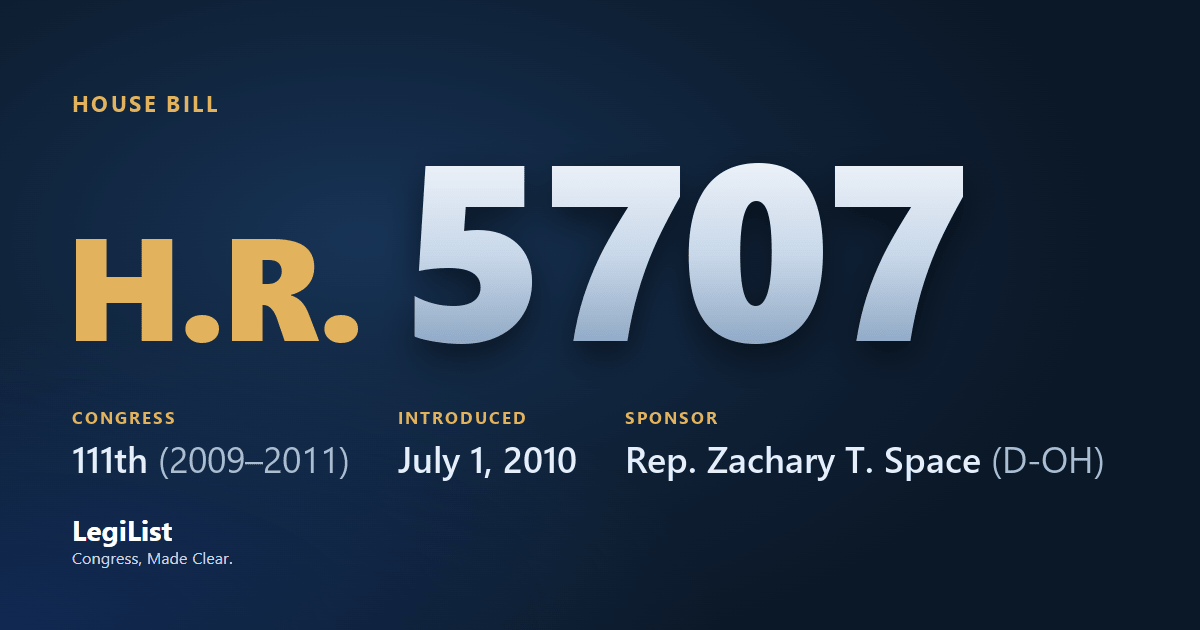
Restore Online Shoppers' Confidence Act
Latest action · Jul 1, 2010 Referred to the House Committee on Energy and Commerce.
Progress
Where this bill reached, and when. A stage with no date was not reached; one that failed a vote and later carried shows the date it carried.
- IntroducedJul 1, 2010
- Passed HouseNot reached
- Passed SenateNot reached
- To the PresidentNot reached
- Became lawNot reached
Summary
Restore Online Shoppers' Confidence Act - Defines "post-transaction third party seller" as a person that: (1) sells, or offers for sale, any good or service on the Internet; (2) solicits purchases on the Internet through an initial merchant after the consumer has initiated a transaction with the initial merchant; and (3) is not a subsidiary or corporate affiliate of the initial merchant.
Makes it unlawful for any post-transaction third party seller to charge or attempt to charge any consumer's credit card, debit card, bank account, or other financial account in an Internet-based transaction, unless: (1) before obtaining the consumer's billing information, the seller has disclosed all material terms, including the fact that the seller is not affiliated with the initial merchant; and (2) the seller has received the express informed consent.
Makes it unlawful for an initial merchant to disclose such financial account number or other billing information to any such seller (sometimes referred to as a data-pass).
Makes it unlawful, subject to exception, for any person to charge or attempt to charge a consumer for goods or services sold in an Internet-based transaction through a "negative option feature." Defines "negative option feature" as a provision under which the customer's failure to take an affirmative action to reject goods or services or to cancel the agreement is interpreted by the seller as acceptance of the offer.
Prohibits construing this Act to supersede or otherwise affect the Electronic Fund Transfer Act or any regulation thereunder.
Treats a violation of this Act or any regulation thereunder as an unfair or deceptive act or practice. Requires the Federal Trade Commission (FTC) to enforce this Act.
Authorizes any state attorney general to bring an action on behalf of the state's residents to enjoin further violation, to compel compliance with this Act, to obtain damages, or to obtain other appropriate relief.
Cosponsors
Members who signed on, in the order they did.
Committees 1
Where it was sent and what each committee and subcommittee did with it, in order.
| Chamber | Committee | What it did |
|---|---|---|
| House | Energy and Commerce Committee | Referred Jul 1, 2010 |
Actions 2
Everything that happened, newest first.
- Jul 1, 2010Introduced in House
- Jul 1, 2010Referred to the House Committee on Energy and Commerce.
Related bills 1
Companion bills and other measures the record links to this one.
| Bill | Title | Relationship | Latest action |
|---|---|---|---|
| S 3386 | Restore Online Shoppers' Confidence Act | Related bill | Dec 29, 2010 |
Titles 2
Every title it has carried, official and short, at each stage.
- Official Title as Introduced
- To protect consumers from certain aggressive sales tactics on the Internet.
- Short Titles as Introduced
- Restore Online Shoppers' Confidence Act
Subjects
Assigned by the Library of Congress. Policy area: Commerce.
Text 1
Each version as it was printed, newest first.
- Jul 1, 2010Introduced in House
Support LegiList
This page is free, carries no paywall, and is built and maintained by one person. If the record here is useful to you, a few dollars keeps it going.
Everything here is as published by Congress: the summary is the Congressional Research Service's, the action wording is the clerks', and the subjects are the Library of Congress's. How far it got is read from the actions themselves, taking the most recent one of each kind, so a bill that failed a vote and later passed is shown as having passed. Records come from this bill on Congress.gov and govinfo.gov; cost estimates are the Congressional Budget Office's, and the hearings are the printed hearings GovInfo publishes, which can appear months after the hearing.