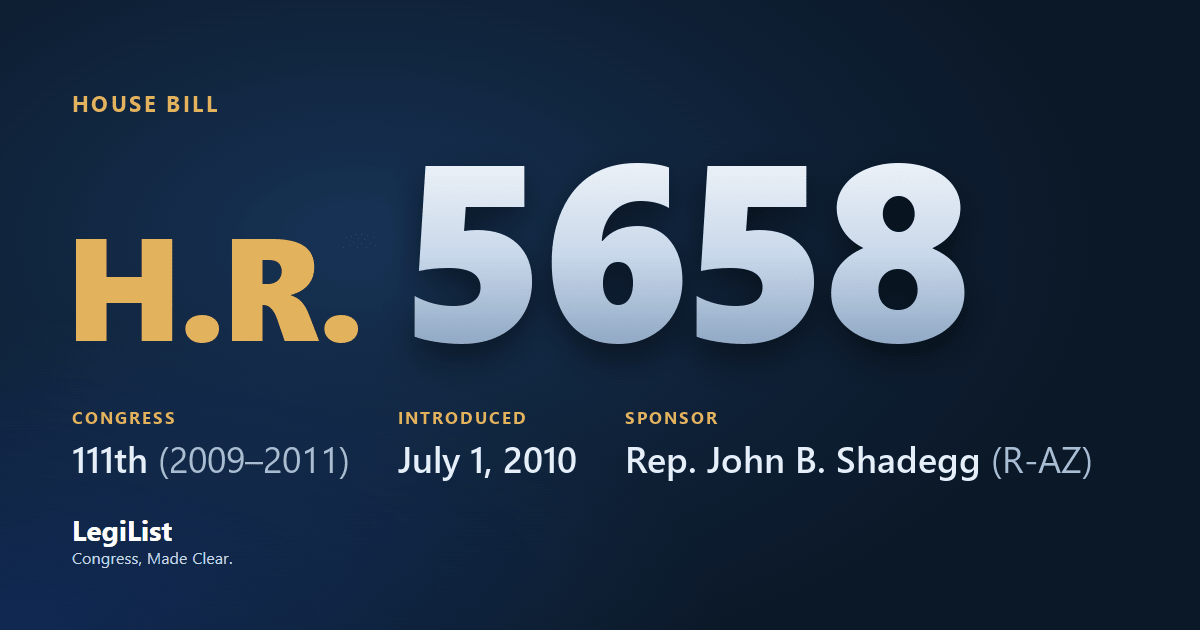
SKIL Act of 2010
Latest action · Jul 1, 2010 Referred to the House Committee on the Judiciary.
Progress
Where this bill reached, and when. A stage with no date was not reached; one that failed a vote and later carried shows the date it carried.
- IntroducedJul 1, 2010
- Passed HouseNot reached
- Passed SenateNot reached
- To the PresidentNot reached
- Became lawNot reached
Summary
Securing Knowledge, Innovation, and Leadership Act of 2010 or the SKIL Act of 2010 - Amends the Immigration and Nationality Act to exempt from the annual H-1B (specialty occupation) visa cap an alien who has: (1) earned a master's or higher degree from an accredited U.S. university; or (2) been awarded a medical specialty certification based on post-doctoral training and experience in the United States.
Increases the annual H-1B cap, with a 20% increase for the following year if the previous year's quota is reached.
Exempts from worldwide immigration caps an alien who: (1) has earned a master's or higher degree from an accredited U.S. university; (2) has been awarded medical specialty certification based on postdoctoral training and experience in the United States; (3) will work in shortage occupations; (4) has earned a master's degree or higher in science, technology, engineering, or math and has been working in a related field in the United States during the three-year period preceding his or her immigrant visa application; (5) has extraordinary ability or received a national interest waiver; or (6) is the spouse or minor child of an employment-based immigrant.
Increases the annual immigrant visa cap.
Revises student visa provisions.
Authorizes an L-1 (intracompany transfer) visa extension beyond the fifth or seventh year if the individual has a immigrant application pending.
Permits an alien with an approved labor certification to apply for permanent resident status adjustment if there is no visa immediately available by paying a $500 supplemental fee.
Directs the Secretary of Homeland Security (DHS) to establish a pre-certification procedure for employers who file multiple employment petitions.
Revises certain labor certification provisions.
Prohibits immigration application approval until background and security checks have been completed and any fraud allegations have been resolved.
Authorizes temporary workers (E, H, I, L O, or P visas) who have not violated their status to renew their same category visa from within the United States.
Cosponsors 1
Members who signed on, in the order they did. All signed on Jul 1, 2010.
| Seat | Cosponsor | Signed on | |
|---|---|---|---|
| R-HI | Charles K. Djou | Original | Jul 1, 2010 |
Committees 1
Where it was sent and what each committee and subcommittee did with it, in order.
| Chamber | Committee | What it did |
|---|---|---|
| House | Judiciary Committee | Referred Jul 1, 2010 |
Actions 2
Everything that happened, newest first.
- Jul 1, 2010Introduced in House
- Jul 1, 2010Referred to the House Committee on the Judiciary.
Research
What has been written about this bill: committee reports, cost estimates, the sponsor’s authority statement, printed hearings and the Congressional Research Service’s work.
Printed hearings 2
Hearings whose printed record names this bill, newest first: hearings on it, and wider hearings where it came up.
| Number | Hearing | Committee | Held |
|---|---|---|---|
| Serial No. 111-64 | LEGISLATIVE HEARING ON H.R. 3257, H.R. 3484, H.R. 3579, H.R. 3813, H.R. 3948, H.R. 3976, H.R. 4079, H.R. 4203, H.R. 4359, H.R. 4469, AND H.R. 4592107 pages | Veterans' Affairs Committee | Feb 25, 2010 |
| H.A.S.C. No. 111-26 | MEDICAL INFRASTRUCTURE: ARE HEALTH AFFAIRS/TRICARE MANAGEMENT ACTIVITY PRIORITIES ALIGNED WITH SERVICE REQUIREMENTS?94 pages | Armed Services Committee | Mar 18, 2009 |
Titles 3
Every title it has carried, official and short, at each stage.
- Official Title as Introduced
- To amend the Immigration and Nationality Act to increase competitiveness in the United States, and for other purposes.
- Short Titles as Introduced
- Securing Knowledge, Innovation, and Leadership Act of 2010
- SKIL Act of 2010
Subjects
Assigned by the Library of Congress. Policy area: Immigration.
- Administrative law and regulatory procedures
- Administrative remedies
- Criminal justice information and records
- Department of Homeland Security
- Family relationships
- Foreign labor
- Fraud offenses and financial crimes
- Health personnel
- Higher education
- Immigration
- Immigration status and procedures
- Science and engineering education
- Temporary and part-time employment
- Visas and passports
Text 1
Each version as it was printed, newest first.
- Jul 1, 2010Introduced in House
Support LegiList
This page is free, carries no paywall, and is built and maintained by one person. If the record here is useful to you, a few dollars keeps it going.
Everything here is as published by Congress: the summary is the Congressional Research Service's, the action wording is the clerks', and the subjects are the Library of Congress's. How far it got is read from the actions themselves, taking the most recent one of each kind, so a bill that failed a vote and later passed is shown as having passed. Records come from this bill on Congress.gov and govinfo.gov; cost estimates are the Congressional Budget Office's, and the hearings are the printed hearings GovInfo publishes, which can appear months after the hearing.