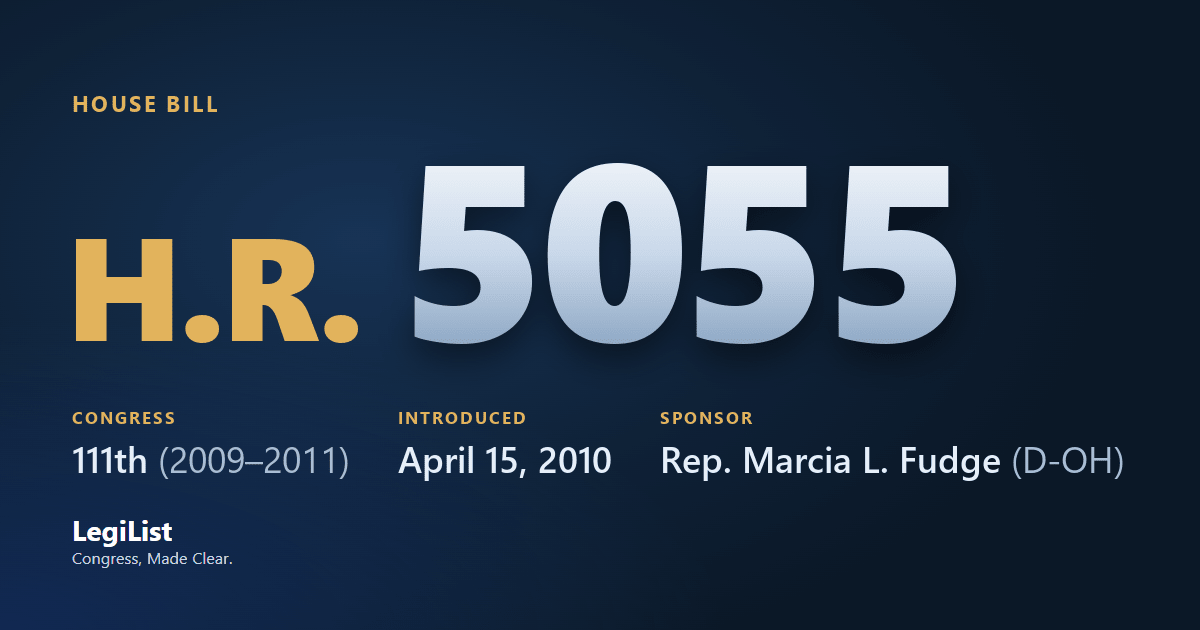
College Debt Swap Act of 2010
Latest action · Apr 30, 2010 Referred to the Subcommittee on Higher Education, Lifelong Learning, and Competitiveness.
Progress
Where this bill reached, and when. A stage with no date was not reached; one that failed a vote and later carried shows the date it carried.
- IntroducedApr 15, 2010
- Passed HouseNot reached
- Passed SenateNot reached
- To the PresidentNot reached
- Became lawNot reached
Summary
College Debt Swap Act of 2010 - Amends title IV (Student Assistance) of the Higher Education Act of 1965 to allow certain borrowers to consolidate their private education loans as Direct Consolidation Loans.
Limits such borrowers to those who: (1) are not in default on a loan made, insured, or guaranteed under title IV, except in certain instances of economic hardship; (2) were enrolled, between July 1, 1994, and July 1, 2010, as students eligible for unsubsidized Stafford loans or PLUS loans under the Federal Family Education Loan or Direct Loan programs; (3) borrowed at least one private education loan during such enrollment period; (4) are repaying their private education loan or are in a grace period preceding such repayment; (5) do not have an adverse credit history; and (6) have not previously obtained a Direct Consolidated Loan under title IV.
Makes the program applicable only to private education loans disbursed to borrowers between July 1, 1994, and July 1, 2010.
Directs the Secretary of Education to inform and educate students and their families about this loan consolidation program.
Terminates the authority to make Consolidation loans under such program on June 30, 2012.
Authorizes and appropriates additional funds for Pell Grant increases for FY2011-FY2012.
Cosponsors 4
Members who signed on, in the order they did. Signatures ran from Apr 15, 2010 to May 6, 2010; 3 are original cosponsors, there from the day it was introduced.
| Seat | Cosponsor | Signed on | |
|---|---|---|---|
| D-IL | Bobby L. Rush | Original | Apr 15, 2010 |
| D-NY | Edolphus Towns | Original | Apr 15, 2010 |
| D-GA | Henry C. "Hank" Johnson, Jr. | Original | Apr 15, 2010 |
| D-DC | Eleanor Holmes Norton | May 6, 2010 |
Committees 1
Where it was sent and what each committee and subcommittee did with it, in order.
| Chamber | Committee | What it did |
|---|---|---|
| House | Education and Workforce Committee | Referred Apr 15, 2010 |
| Higher Education and Workforce Development Subcommittee | Referred Apr 30, 2010 |
Actions 3
Everything that happened, newest first.
- Apr 30, 2010Referred to the Subcommittee on Higher Education, Lifelong Learning, and Competitiveness.
- Apr 15, 2010Introduced in House
- Apr 15, 2010Referred to the House Committee on Education and Labor.
In the Congressional Record 1
Days the Record’s own index lists this bill, newest first, with the pages and the members it names. Pages starting H are the House, S the Senate, E Extensions of Remarks.
| Where | In the Record | Members | Date |
|---|---|---|---|
| House | Debate and remarks H3732 | Marcia L. Fudge D-OH | May 24, 2010 |
Titles 2
Every title it has carried, official and short, at each stage.
- Official Title as Introduced
- To provide funds for Pell Grants by amending title IV of the Higher Education Act of 1965.
- Short Titles as Introduced
- College Debt Swap Act of 2010
Subjects
Assigned by the Library of Congress. Policy area: Education.
Text 1
Each version as it was printed, newest first.
- Apr 15, 2010Introduced in House
Support LegiList
This page is free, carries no paywall, and is built and maintained by one person. If the record here is useful to you, a few dollars keeps it going.
Everything here is as published by Congress: the summary is the Congressional Research Service's, the action wording is the clerks', and the subjects are the Library of Congress's. How far it got is read from the actions themselves, taking the most recent one of each kind, so a bill that failed a vote and later passed is shown as having passed. Records come from this bill on Congress.gov and govinfo.gov; cost estimates are the Congressional Budget Office's, and the hearings are the printed hearings GovInfo publishes, which can appear months after the hearing.