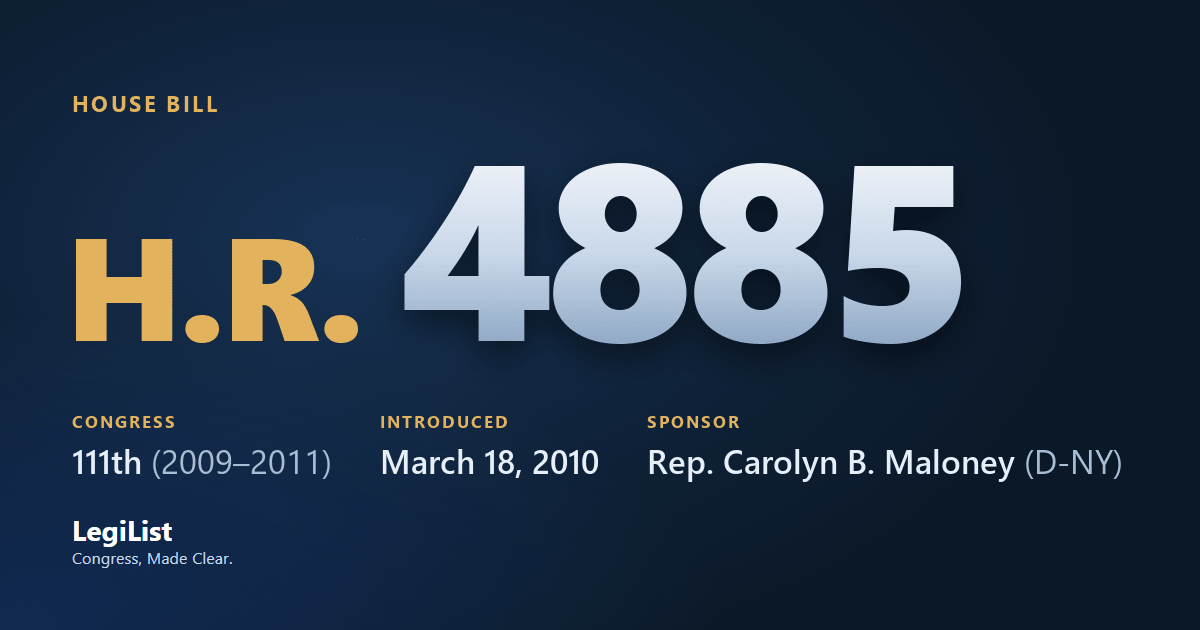
To protect the civil rights of victims of gender-motivated violence and to promote public safety, health, and regulate activities affecting interstate commerce by creating employer liability for negligent conduct that results in an individual's committing a gender-motivated crime of violence against another individual on premises controlled by the employer, and for other purposes.
Latest action · Jul 26, 2010 Referred to the Subcommittee on Courts and Competition Policy.
Progress
Where this bill reached, and when. A stage with no date was not reached; one that failed a vote and later carried shows the date it carried.
- IntroducedMar 18, 2010
- Passed HouseNot reached
- Passed SenateNot reached
- To the PresidentNot reached
- Became lawNot reached
Summary
Makes an employer liable to a party injured in a crime of violence motivated by gender if: (1) the employer's business is in or affects interstate or foreign commerce; and (2) the employer's negligent conduct results in the perpetration of a gender-motivated crime of violence against an individual on premises under the employer's control.
Prohibits anything in this Act from being construed as: (1) entitling a person to a cause of action for random acts of violence unrelated to gender or for acts that cannot be demonstrated to be motivated by gender; or (2) requiring a prior criminal complaint, prosecution, or conviction to establish the elements of a cause of action.
Gives federal and state courts concurrent jurisdiction over actions brought pursuant to this Act.
Directs the Equal Employment Opportunity Commission (EEOC) to create and provide to employers materials regarding personnel policies and safety standards to assist them in avoiding liability under this Act.
Cosponsors
Members who signed on, in the order they did.
Committees 2
Where it was sent and what each committee and subcommittee did with it, in order.
| Chamber | Committee | What it did |
|---|---|---|
| House | Education and Workforce Committee | Referred Mar 18, 2010 |
| Health, Employment, Labor, and Pensions Subcommittee | Referred Apr 30, 2010 | |
| House | Judiciary Committee | Referred Mar 18, 2010 |
| Constitution and Limited Government Subcommittee | Referred Jul 26, 2010 | |
| Courts, Intellectual Property, Artificial Intelligence, and the Internet Subcommittee | Referred Jul 26, 2010 |
Actions 8
Everything that happened, newest first.
- Jul 26, 2010Referred to the Subcommittee on the Constitution, Civil Rights, and Civil Liberties.
- Jul 26, 2010Referred to the Subcommittee on Courts and Competition Policy.
- Apr 30, 2010Referred to the Subcommittee on Health, Employment, Labor, and Pensions.
- Mar 18, 2010Introduced in House
- Mar 18, 2010Sponsor introductory remarks on measure. (CR E411-412)
In the Congressional Record 1
Days the Record’s own index lists this bill, newest first, with the pages and the members it names. Pages starting H are the House, S the Senate, E Extensions of Remarks.
| Where | In the Record | Members | Date |
|---|---|---|---|
| Extensions | Debate and remarks E411 | Carolyn B. Maloney D-NY | Mar 18, 2010 |
Titles 1
Every title it has carried, official and short, at each stage.
- Official Title as Introduced
- To protect the civil rights of victims of gender-motivated violence and to promote public safety, health, and regulate activities affecting interstate commerce by creating employer liability for negligent conduct that results in an individual's committing a gender-motivated crime of violence against another individual on premises controlled by the employer, and for other purposes.
Subjects
Assigned by the Library of Congress. Policy area: Labor and Employment.
Text 1
Each version as it was printed, newest first.
- Mar 18, 2010Introduced in House
Support LegiList
This page is free, carries no paywall, and is built and maintained by one person. If the record here is useful to you, a few dollars keeps it going.
Everything here is as published by Congress: the summary is the Congressional Research Service's, the action wording is the clerks', and the subjects are the Library of Congress's. How far it got is read from the actions themselves, taking the most recent one of each kind, so a bill that failed a vote and later passed is shown as having passed. Records come from this bill on Congress.gov and govinfo.gov; cost estimates are the Congressional Budget Office's, and the hearings are the printed hearings GovInfo publishes, which can appear months after the hearing.