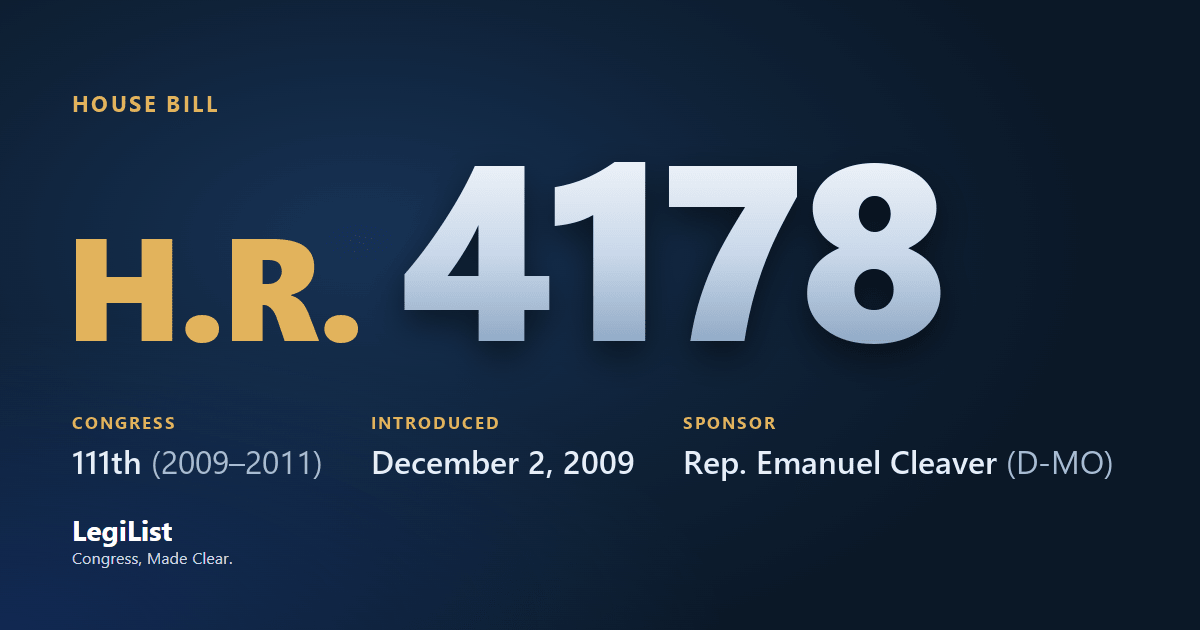
Deposit Restricted Qualified Tuition Programs Act of 2010
Latest action · Apr 22, 2010 Received in the Senate and Read twice and referred to the Committee on Banking, Housing, and Urban Affairs.
Progress
Where this bill reached, and when. A stage with no date was not reached; one that failed a vote and later carried shows the date it carried.
- IntroducedDec 2, 2009
- Passed HouseApr 20, 2010
- Passed SenateNot reached
- To the PresidentNot reached
- Became lawNot reached
Summary
Deposit Restricted Qualified Tuition Programs Act of 2010 - Amends the Federal Deposit Insurance Act to prescribe requirements for deposit restricted qualified tuition programs which are exempt from federal income tax.
Defines such a program as one in which: (1) the cash provided to it by a contributor may be invested only in deposits insured by the Federal Deposit Insurance Corporation (FDIC); (2) the contributor may become a participant in the program by depositing funds through the program into an account at a depository institution participating in the program; and (3) the program may include multiple depository institutions.
Deems a deposit restricted qualified tuition program to be an identified banking product for purposes of the Securities Exchange Act of 1934.
Denies treatment as a security under the Securities Act of 1933, the Securities Exchange Act of 1934, or the Investment Company Act of 1940 of: (1) the investment of cash in deposits at an insured depository institution through a deposit restricted qualified tuition program; (2) any certificate of deposit or other instrument evidencing any such deposit; or (3) any participation by a contributor to a deposit restricted qualified tuition program.
Declares that in no event shall a deposit restricted qualified tuition program, the state entity designated by statute to oversee such program, or the administrator appointed to operate it on behalf of the state or a participating depository institution, be deemed to be an issuer of a security or an investment company.
Declares that the budgetary effects of this Act, for the purpose of complying with the Statutory Pay-As-You-Go Act of 2010, shall be determined by reference to the latest statement titled `Budgetary Effects of PAYGO Legislation' for this Act, submitted for printing in the Congressional Record by the Chairman of the Committee on the Budget of the House of Representatives, provided that such statement has been submitted prior to the vote on passage.
Cosponsors 12
Members who signed on, in the order they did. Signatures ran from Dec 2, 2009 to Apr 20, 2010; 8 are original cosponsors, there from the day it was introduced.
| Seat | Cosponsor | Signed on | |
|---|---|---|---|
| D-MA | Barney Frank | Original | Dec 2, 2009 |
| D-KS | Dennis Moore | Original | Dec 2, 2009 |
| R-TX | Kenny Marchant | Original | Dec 2, 2009 |
| D-NC | Melvin L. Watt | Original | Dec 2, 2009 |
| R-TX | Ron Paul | Original | Dec 2, 2009 |
| R-WV | Shelley Moore Capito | Original | Dec 2, 2009 |
| R-AL | Spencer Bachus | Original | Dec 2, 2009 |
| R-MI | Thaddeus G. McCotter | Original | Dec 2, 2009 |
| R-KS | Lynn Jenkins | Dec 16, 2009 | |
| D-MO | Wm. Lacy Clay | Apr 14, 2010 | |
| D-TX | Al Green | Apr 20, 2010 | |
| R-PA | Jim Gerlach | Apr 20, 2010 |
Committees 2
Where it was sent and what each committee and subcommittee did with it, in order.
| Chamber | Committee | What it did |
|---|---|---|
| House | Financial Services Committee | Referred Dec 2, 2009 |
| Senate | Banking, Housing, and Urban Affairs Committee | Referred Apr 22, 2010 |
Actions 8
Everything that happened, newest first.
- Apr 22, 2010Received in the Senate and Read twice and referred to the Committee on Banking, Housing, and Urban Affairs.
- Apr 20, 2010Mr. Cleaver moved to suspend the rules and pass the bill, as amended.
- Apr 20, 2010Considered under suspension of the rules. (consideration: CR H2651-2654)
- Apr 20, 2010DEBATE - The House proceeded with forty minutes of debate on H.R. 4178.
- Apr 20, 2010Passed/agreed to in House: On motion to suspend the rules and pass the bill, as amended Agreed to by voice vote. (text: CR H2651)
In the Congressional Record 1
Days the Record’s own index lists this bill, newest first, with the pages and the members it names. Pages starting H are the House, S the Senate, E Extensions of Remarks.
| Where | In the Record | Members | Date |
|---|---|---|---|
| House | Tables H2693Pay-as-you-go effects of H.R. 4178, Deposit Restricted Qualified Tuition Programs Act | John M. Spratt, Jr. D-SC | Apr 20, 2010 |
Research
What has been written about this bill: committee reports, cost estimates, the sponsor’s authority statement, printed hearings and the Congressional Research Service’s work.
Congressional Budget Office cost estimates 2
- Apr 20, 2010H.R. 4178, Deposit Restricted Qualified Tuition Programs Act of 2009<p>Pay-as-you-go estimate for the bill as introduced on December 2, 2009, and amended on April 20, 2010</p>
- Apr 20, 2010H.R. 4178, Deposit Restricted Qualified Tuition Programs Act of 2009Pay-as-you-go estimate for the bill as introduced on December 2, 2009, and amended on April 20, 2010
Printed hearings 1
Hearings whose printed record names this bill, newest first: hearings on it, and wider hearings where it came up.
| Number | Hearing | Committee | Held |
|---|---|---|---|
| Serial No. 111-147 | MONETARY POLICY AND THE STATE OF THE ECONOMY, PART I133 pages | Financial Services Committee | Jul 22, 2010 |
Related bills 1
Companion bills and other measures the record links to this one.
| Bill | Title | Relationship | Latest action |
|---|---|---|---|
| HR 3599 | Deposit Restricted Qualified Tuition Programs Act of 2009 | Related bill | Sep 17, 2009 |
Titles 3
Every title it has carried, official and short, at each stage.
- Official Title as Introduced
- To amend the Federal Deposit Insurance Act to provide for deposit restricted qualified tuition programs, and for other purposes.
- Short Titles as Introduced
- Deposit Restricted Qualified Tuition Programs Act of 2009
- Short Titles as Passed House
- Deposit Restricted Qualified Tuition Programs Act of 2010
Subjects
Assigned by the Library of Congress. Policy area: Finance and Financial Sector.
Text 3
Each version as it was printed, newest first.
- Apr 22, 2010Referred in Senate
- Apr 20, 2010Engrossed in House
- Dec 2, 2009Introduced in House
Everything here is as published by Congress: the summary is the Congressional Research Service's, the action wording is the clerks', and the subjects are the Library of Congress's. How far it got is read from the actions themselves, taking the most recent one of each kind, so a bill that failed a vote and later passed is shown as having passed. Records come from this bill on Congress.gov and govinfo.gov; cost estimates are the Congressional Budget Office's, and the hearings are the printed hearings GovInfo publishes, which can appear months after the hearing.