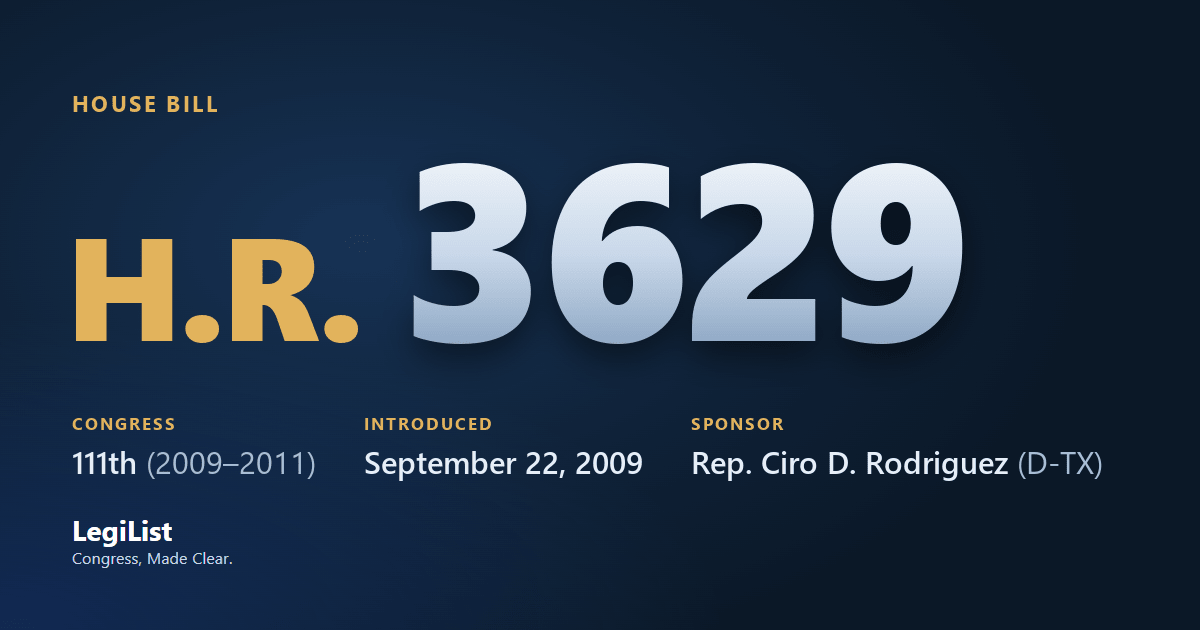
Healthy Borderlands Act of 2009
Latest action · Oct 6, 2009 Referred to the Subcommittee on Border, Maritime, and Global Counterterrorism.
Progress
Where this bill reached, and when. A stage with no date was not reached; one that failed a vote and later carried shows the date it carried.
- IntroducedSep 22, 2009
- Passed HouseNot reached
- Passed SenateNot reached
- To the PresidentNot reached
- Became lawNot reached
Summary
Healthy Borderlands Act of 2009 - Directs the Secretary of Homeland Security to develop and implement a comprehensive mitigation plan to address the ecological and environmental impacts of border security infrastructure, measures, and activities along the international land borders of the United States.
Requires the plan to include measures to address and mitigate the full range of such impacts, including: (1) preserving, maintaining, and restoring wildlife migration corridors, key habitats, and the ecologically functional connectivity among key habitats sufficient to ensure that species remain viable and are able to adapt to the impacts of climate change; (2) addressing control of invasive species; (3) maintaining hydrological functionality; and (5) protection of cultural and historical resources.
Authorizes the Secretary to carry out the plan on any federal, state, private, or tribal lands, provided that activities are carried out in full consultation with, and with the concurrence of, the owner or entity with principal responsibility for the management of such lands.
Authorizes the Secretary to transfer funds of the Department of Homeland Security (DHS) to other federal agencies for: (1) expenditure under programs of such agencies that are designed to fund conservation-related activities on nonfederal lands; and (2) mitigation activities on federal lands managed by such agencies.
Cosponsors 1
Members who signed on, in the order they did. All signed on Sep 22, 2009.
| Seat | Cosponsor | Signed on | |
|---|---|---|---|
| D-AZ | Raúl M. Grijalva | Original | Sep 22, 2009 |
Committees 2
Where it was sent and what each committee and subcommittee did with it, in order.
| Chamber | Committee | What it did |
|---|---|---|
| House | Natural Resources Committee | Referred Sep 22, 2009 |
| House | Homeland Security Committee | Referred Sep 22, 2009 |
| Border Security and Enforcement Subcommittee | Referred Oct 6, 2009 |
Actions 5
Everything that happened, newest first.
- Oct 6, 2009Referred to the Subcommittee on Border, Maritime, and Global Counterterrorism.
- Sep 22, 2009Introduced in House
- Sep 22, 2009Referred to House Natural Resources
- Sep 22, 2009Referred to the Committee on Natural Resources, and in addition to the Committee on Homeland Security, for a period to be subsequently determined by the Speaker, in each case for consideration of such provisions as fall within the jurisdiction of the committee concerned.
- Sep 22, 2009Referred to House Homeland Security
Titles 2
Every title it has carried, official and short, at each stage.
- Official Title as Introduced
- To require the Secretary of Homeland Security to develop and implement a mitigation plan to address the ecological impacts of border security measures and activities, and for other purposes.
- Short Titles as Introduced
- Healthy Borderlands Act of 2009
Subjects
Assigned by the Library of Congress. Policy area: Public Lands and Natural Resources.
- Border security and unlawful immigration
- Environmental assessment, monitoring, research
- Federal preemption
- Historical and cultural resources
- Hydrology and hydrography
- Land transfers
- Land use and conservation
- Public Lands and Natural Resources
- Water quality
- Water use and supply
- Wildlife conservation and habitat protection
Text 1
Each version as it was printed, newest first.
- Sep 22, 2009Introduced in House
Support LegiList
This page is free, carries no paywall, and is built and maintained by one person. If the record here is useful to you, a few dollars keeps it going.
Everything here is as published by Congress: the summary is the Congressional Research Service's, the action wording is the clerks', and the subjects are the Library of Congress's. How far it got is read from the actions themselves, taking the most recent one of each kind, so a bill that failed a vote and later passed is shown as having passed. Records come from this bill on Congress.gov and govinfo.gov; cost estimates are the Congressional Budget Office's, and the hearings are the printed hearings GovInfo publishes, which can appear months after the hearing.