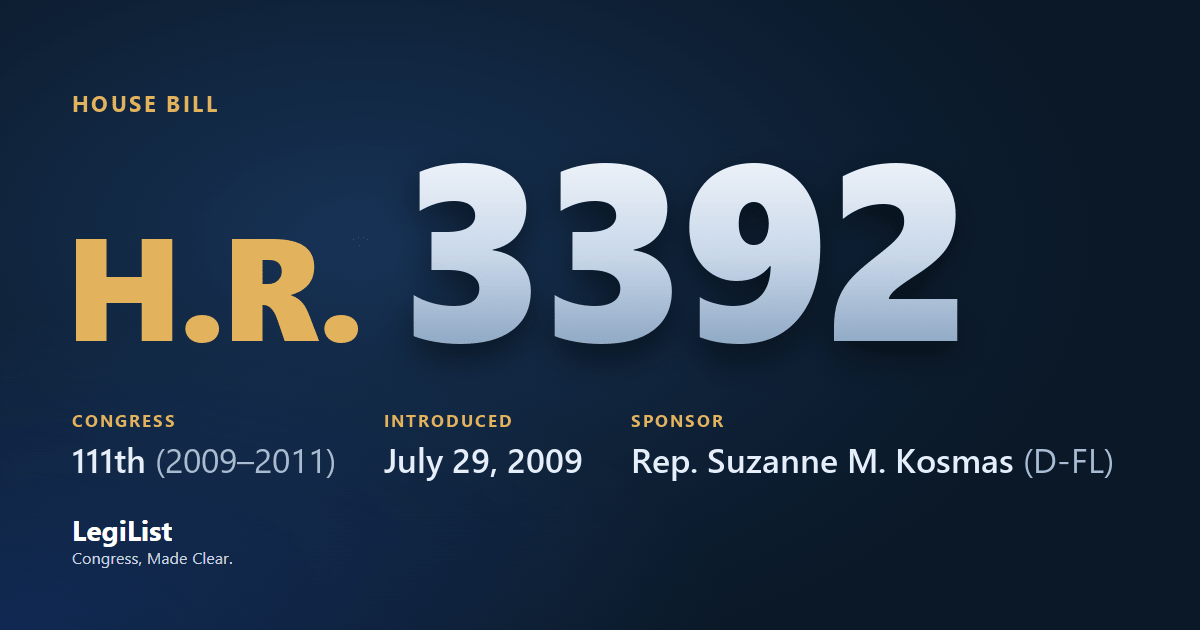
Fair and Cost Effective Federal Travel Act of 2009
Latest action · Oct 23, 2009 Referred to the Subcommittee on Government Management, Organization, and Procurement.
Progress
Where this bill reached, and when. A stage with no date was not reached; one that failed a vote and later carried shows the date it carried.
- IntroducedJul 29, 2009
- Passed HouseNot reached
- Passed SenateNot reached
- To the PresidentNot reached
- Became lawNot reached
Summary
Fair and Cost Effective Federal Travel Act of 2009 - Prohibits any federal department or agency from establishing a travel or conference policy that takes into account the perception of a location as a resort or vacation destination in determining the location for an event.
Cosponsors 8
Members who signed on, in the order they did. Signatures ran from Jul 29, 2009 to Jul 31, 2009, with 6 there on the day it was introduced.
| Seat | Cosponsor | Signed on | |
|---|---|---|---|
| D-FL | Alan Grayson | Original | Jul 29, 2009 |
| R-FL | Bill Posey | Original | Jul 29, 2009 |
| D-FL | Corrine Brown | Original | Jul 29, 2009 |
| D-NV | Dina Titus | Original | Jul 29, 2009 |
| R-FL | John L. Mica | Original | Jul 29, 2009 |
| D-FL | Ron Klein | Original | Jul 29, 2009 |
| R-NV | Dean Heller | Jul 31, 2009 | |
| D-NV | Shelley Berkley | Jul 31, 2009 |
Actions 3
Everything that happened, newest first.
- Oct 23, 2009Referred to the Subcommittee on Government Management, Organization, and Procurement.
- Jul 29, 2009Introduced in House
- Jul 29, 2009Referred to the House Committee on Oversight and Government Reform.
Subjects
Assigned by the Library of Congress. Policy area: Government Operations and Politics.
Text 1
Each version as it was printed, newest first.
- Jul 29, 2009Introduced in House
Everything here is as published by Congress: the summary is the Congressional Research Service's, the action wording is the clerks', and the subjects are the Library of Congress's. How far it got is read from the actions themselves, taking the most recent one of each kind, so a bill that failed a vote and later passed is shown as having passed. Records come from this bill on Congress.gov and govinfo.gov.