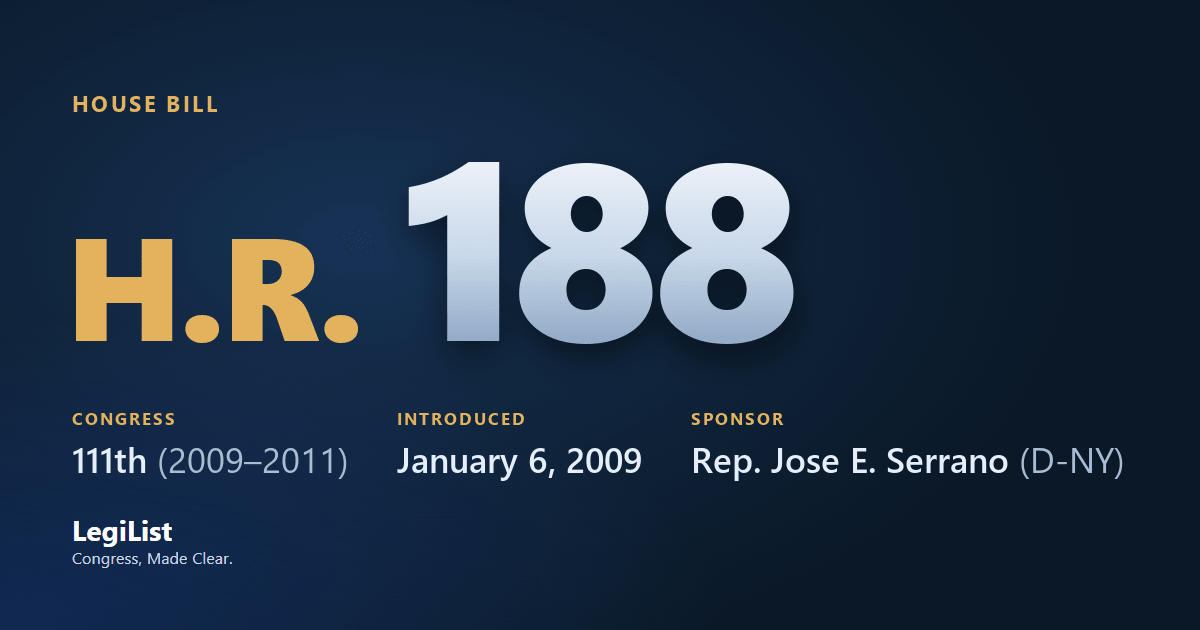
Cuba Reconciliation Act
Latest action · Jan 14, 2009 Referred to the Subcommittee on Communications, Technology, and the Internet.
Progress
Where this bill reached, and when. A stage with no date was not reached; one that failed a vote and later carried shows the date it carried.
- IntroducedJan 6, 2009
- Passed HouseNot reached
- Passed SenateNot reached
- To the PresidentNot reached
- Became lawNot reached
Summary
Amends the Internal Revenue Code to declare the denial of foreign tax credit inapplicable to Cuba.
Permits: (1) installation and maintenance of telecommunications equipment and facilities in Cuba, including telecommunications services between the United States and Cuba; and (2) travel to and from Cuba by U.S. citizens or residents.
Requires the U.S. Postal Service to provide direct mail service to and from Cuba.
Cosponsors 1
Members who signed on, in the order they did. All signed on Jun 2, 2009.
| Seat | Cosponsor | Signed on | |
|---|---|---|---|
| D-CA | Sam Farr | Jun 2, 2009 |
Committees 7
Where it was sent and what each committee and subcommittee did with it, in order.
| Chamber | Committee | What it did |
|---|---|---|
| House | Foreign Affairs Committee | Referred Jan 6, 2009 |
| House | Ways and Means Committee | Referred Jan 6, 2009 |
| House | Energy and Commerce Committee | Referred Jan 6, 2009 |
| Commerce, Manufacturing, and Trade Subcommittee | Referred Jan 14, 2009 | |
| Communications and Technology Subcommittee | Referred Jan 14, 2009 | |
| House | Judiciary Committee | Referred Jan 6, 2009 |
| House | Financial Services Committee | Referred Jan 6, 2009 |
| House | Oversight and Government Reform Committee | Referred Jan 6, 2009 |
| House | Agriculture Committee | Referred Jan 6, 2009 |
Actions 11
Everything that happened, newest first.
- Jan 14, 2009Referred to the Subcommittee on Commerce, Trade and Consumer Protection.
- Jan 14, 2009Referred to the Subcommittee on Communications, Technology, and the Internet.
- Jan 6, 2009Introduced in House
- Jan 6, 2009Referred to House Foreign Affairs
- Jan 6, 2009Referred to the Committee on Foreign Affairs, and in addition to the Committees on Ways and Means, Energy and Commerce, the Judiciary, Financial Services, Oversight and Government Reform, and Agriculture, for a period to be subsequently determined by the Speaker, in each case for consideration of such provisions as fall within the jurisdiction of the committee concerned.
- Jan 6, 2009Referred to House Ways and Means
- Jan 6, 2009Referred to House Energy and Commerce
- Jan 6, 2009Referred to House Judiciary
- Jan 6, 2009Referred to House Financial Services
- Jan 6, 2009Referred to House Oversight and Government Reform
- Jan 6, 2009Referred to House Agriculture
Research
What has been written about this bill: committee reports, cost estimates, the sponsor’s authority statement, printed hearings and the Congressional Research Service’s work.
CRS reports 2
Congressional Research Service work that CRS links to this bill or the law it became, newest first.
Cite it 2
Products on other subjects that cite it, usually among other measures.
| Product | Title | Kind | Published |
|---|---|---|---|
| RL31139 | Cuba: U.S. Restrictions on Travel and Remittances Archived | Report | Dec 15, 2022 |
| R40567 | Defense: FY2010 Authorization and Appropriations Archived | Report | Dec 23, 2009 |
Titles 2
Every title it has carried, official and short, at each stage.
- Official Title as Introduced
- To lift the trade embargo on Cuba, and for other purposes.
- Short Titles as Introduced
- Cuba Reconciliation Act
Subjects
Assigned by the Library of Congress. Policy area: International Affairs.
- Agricultural trade
- Caribbean area
- Cuba
- Foreign and international banking
- Income tax credits
- Intellectual property
- International Affairs
- International exchange and broadcasting
- Latin America
- Postal service
- Sanctions
- Taxation of foreign income
- Trade restrictions
- Travel and tourism
- U.S. and foreign investments
- Visas and passports
Text 1
Each version as it was printed, newest first.
- Jan 6, 2009Introduced in House
Everything here is as published by Congress: the summary is the Congressional Research Service's, the action wording is the clerks', and the subjects are the Library of Congress's. How far it got is read from the actions themselves, taking the most recent one of each kind, so a bill that failed a vote and later passed is shown as having passed. Records come from this bill on Congress.gov and govinfo.gov; cost estimates are the Congressional Budget Office's, and the hearings are the printed hearings GovInfo publishes, which can appear months after the hearing.