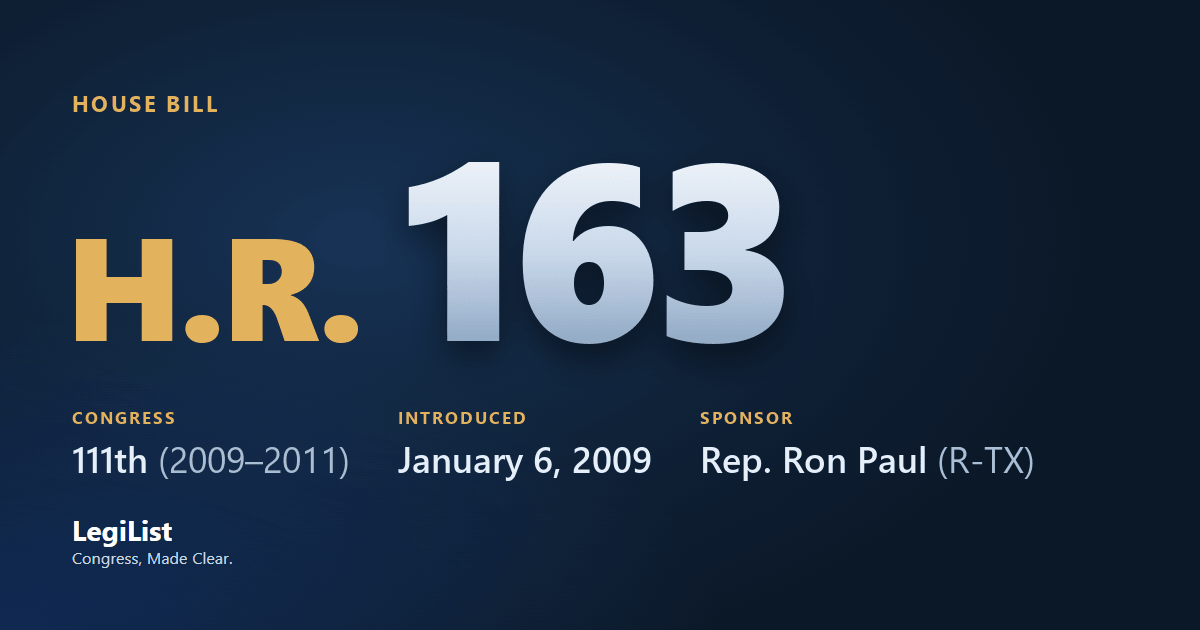
Prescription Drug Affordability Act
Latest action · Jan 14, 2009 Referred to the Subcommittee on Health.
Progress
Where this bill reached, and when. A stage with no date was not reached; one that failed a vote and later carried shows the date it carried.
- IntroducedJan 6, 2009
- Passed HouseNot reached
- Passed SenateNot reached
- To the PresidentNot reached
- Became lawNot reached
Summary
Prescription Drug Affordability Act - Amends the Internal Revenue Code to allow a nonrefundable tax credit for 80 percent of the amount paid for a prescribed drug during the taxable year (and not compensated for by insurance or otherwise) by a taxpayer who has attained social security retirement age.
Amends the Federal Food, Drug, and Cosmetic Act (FFDCA) to repeal provisions restricting the importation of prescription drugs. Allows a person who meets applicable legal requirements to be an importer of prescription drugs upon application to the Secretary of Health and Human Services. Requires the Secretary to approve such an application if the drug meets all FFDCA requirements for admission into the United States, including that the drug has been approved by the Food and Drug Administration (FDA) and is not adulterated or misbranded.
Prohibits the Secretary from taking any action against any of the persons involved with the interstate sale of a prescription drug through an Internet site if: (1) the sale was made in compliance with FFDCA, the Controlled Substances Act, and applicable state laws; and (2) accurate information regarding compliance with such laws is posted on the Internet site.
Cosponsors 1
Members who signed on, in the order they did. All signed on Sep 8, 2009.
| Seat | Cosponsor | Signed on | |
|---|---|---|---|
| D-MS | Bennie G. Thompson | Sep 8, 2009 |
Committees 2
Where it was sent and what each committee and subcommittee did with it, in order.
| Chamber | Committee | What it did |
|---|---|---|
| House | Energy and Commerce Committee | Referred Jan 6, 2009 |
| Health Subcommittee | Referred Jan 14, 2009 | |
| House | Ways and Means Committee | Referred Jan 6, 2009 |
Actions 6
Everything that happened, newest first.
- Jan 14, 2009Referred to the Subcommittee on Health.
- Jan 6, 2009Introduced in House
- Jan 6, 2009Sponsor introductory remarks on measure. (CR E5)
- Jan 6, 2009Referred to House Energy and Commerce
- Jan 6, 2009Referred to the Committee on Energy and Commerce, and in addition to the Committee on Ways and Means, for a period to be subsequently determined by the Speaker, in each case for consideration of such provisions as fall within the jurisdiction of the committee concerned.
- Jan 6, 2009Referred to House Ways and Means
In the Congressional Record 1
Days the Record’s own index lists this bill, newest first, with the pages and the members it names. Pages starting H are the House, S the Senate, E Extensions of Remarks.
Titles 2
Every title it has carried, official and short, at each stage.
- Official Title as Introduced
- To amend the Internal Revenue Code of 1986 with respect to the purchase of prescription drugs by individuals who have attained retirement age, and to amend the Federal Food, Drug, and Cosmetic Act with respect to the importation of prescription drugs and the sale of such drugs through Internet sites.
- Short Titles as Introduced
- Prescription Drug Affordability Act
Subjects
Assigned by the Library of Congress. Policy area: Health.
- Administrative law and regulatory procedures
- Administrative remedies
- Department of Health and Human Services
- Drug safety, medical device, and laboratory regulation
- Health
- Income tax credits
- Internet and video services
- Internet, web applications, social media
- Licensing and registrations
- Prescription drugs
- Trade restrictions
Text 1
Each version as it was printed, newest first.
- Jan 6, 2009Introduced in House
Support LegiList
This page is free, carries no paywall, and is built and maintained by one person. If the record here is useful to you, a few dollars keeps it going.
Everything here is as published by Congress: the summary is the Congressional Research Service's, the action wording is the clerks', and the subjects are the Library of Congress's. How far it got is read from the actions themselves, taking the most recent one of each kind, so a bill that failed a vote and later passed is shown as having passed. Records come from this bill on Congress.gov and govinfo.gov; cost estimates are the Congressional Budget Office's, and the hearings are the printed hearings GovInfo publishes, which can appear months after the hearing.