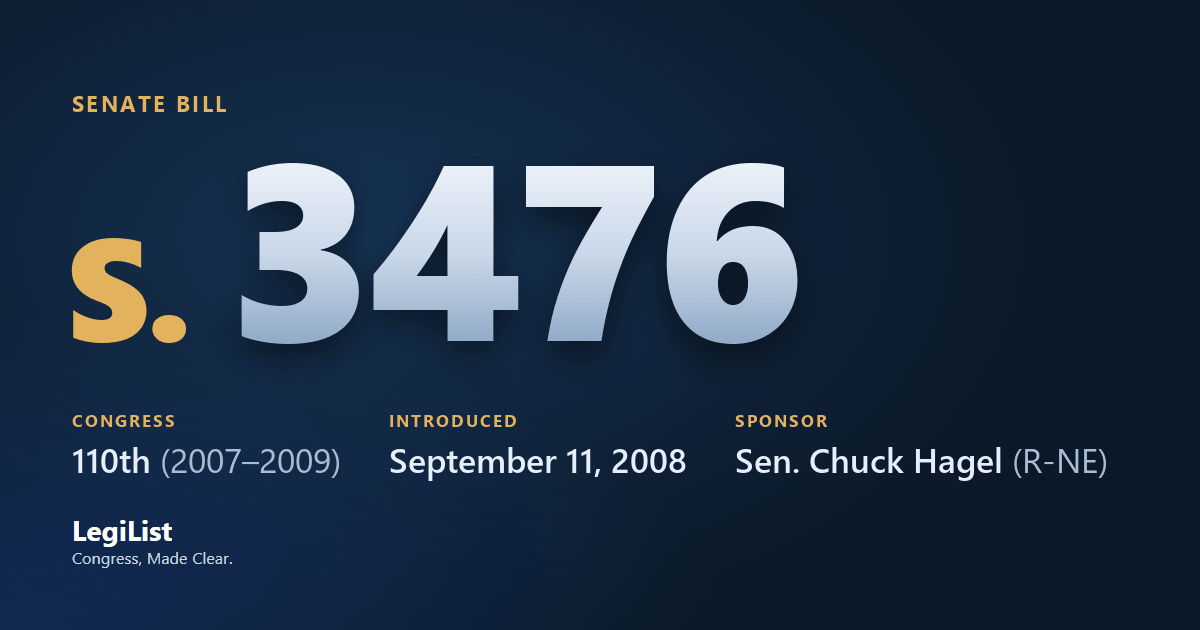
National Integrated Public Health Surveillance Systems and Reportable Conditions Act
Latest action · Sep 11, 2008 Read twice and referred to the Committee on Health, Education, Labor, and Pensions.
Progress
Where this bill reached, and when. A stage with no date was not reached; one that failed a vote and later carried shows the date it carried.
- IntroducedSep 11, 2008
- Passed SenateNot reached
- Passed HouseNot reached
- To the PresidentNot reached
- Became lawNot reached
Summary
National Integrated Public Health Surveillance Systems and Reportable Conditions Act - Amends the Public Health Service Act to require the Secretary of Health and Human Services, acting through the Director of the Centers for Disease Control and Prevention (CDC), to: (1) establish the Epidemiology and Laboratory Capacity Grant Program to assist public health agencies in improving surveillance for, and response to, infectious diseases and other conditions of public health importance; and (2) issue guidelines for public health entities relating to information systems to receive, monitor, and report infectious diseases and other such conditions.
Authorizes the Secretary, acting through the Director, to: (1) address documented workforce shortages in state and local health departments in applied public health epidemiology and public health laboratory science and informatics; and (2) provide for the expansion of applied epidemiology training programs.
Requires the Director, upon request, to assist the Council of State and Territorial Epidemiologists in developing or improving a process for states to conduct surveillance and submit reports to the Director on nationally notifiable diseases and conditions.
Requires the Secretary to adopt and use guidelines to develop improved standards and protocols for binational epidemiology, surveillance, laboratory analyses, and control of infectious diseases between the United States and Mexico.
Requires the Secretary, acting through the Director, to establish a committee to: (1) evaluate best practices in public health surveillance; and (2) assess systems needed for improving coordination among public health surveillance and monitoring systems.
Cosponsors 1
Members who signed on, in the order they did. All signed on Sep 11, 2008.
| Seat | Cosponsor | Signed on | |
|---|---|---|---|
| D-NM | Jeff Bingaman | Original | Sep 11, 2008 |
Committees 1
Where it was sent and what each committee and subcommittee did with it, in order.
| Chamber | Committee | What it did |
|---|---|---|
| Senate | Health, Education, Labor, and Pensions Committee | Referred Sep 11, 2008 |
Actions 2
Everything that happened, newest first.
- Sep 11, 2008Introduced in Senate
- Sep 11, 2008Read twice and referred to the Committee on Health, Education, Labor, and Pensions.
Related bills 1
Companion bills and other measures the record links to this one.
| Bill | Title | Relationship | Latest action |
|---|---|---|---|
| HR 6905 | National Integrated Public Health Surveillance Systems and Reportable Conditions Act | Related bill | Sep 15, 2008 |
Titles 2
Every title it has carried, official and short, at each stage.
- Official Title as Introduced
- A bill to amend the Public Health Service Act to improve the Nation's surveillance and reporting for diseases and conditions, and for other purposes.
- Short Titles as Introduced
- National Integrated Public Health Surveillance Systems and Reportable Conditions Act
Subjects
Assigned by the Library of Congress. Policy area: Health.
- Animal diseases
- Animals
- Communicable diseases
- Dairy industry
- Economics and Public Finance
- Education
- Epidemiology
- Federal aid to health facilities
- Federal-state relations
- Government Operations and Politics
- Health
- Health information systems
- Health surveys
- Higher education
- Latin America
- Medical education
- Medical laboratories
- Medical personnel
- Mexico
- Public health administration
Text 1
Each version as it was printed, newest first.
- Sep 11, 2008Introduced in Senate
Support LegiList
This page is free, carries no paywall, and is built and maintained by one person. If the record here is useful to you, a few dollars keeps it going.
Everything here is as published by Congress: the summary is the Congressional Research Service's, the action wording is the clerks', and the subjects are the Library of Congress's. How far it got is read from the actions themselves, taking the most recent one of each kind, so a bill that failed a vote and later passed is shown as having passed. Records come from this bill on Congress.gov and govinfo.gov; cost estimates are the Congressional Budget Office's, and the hearings are the printed hearings GovInfo publishes, which can appear months after the hearing.