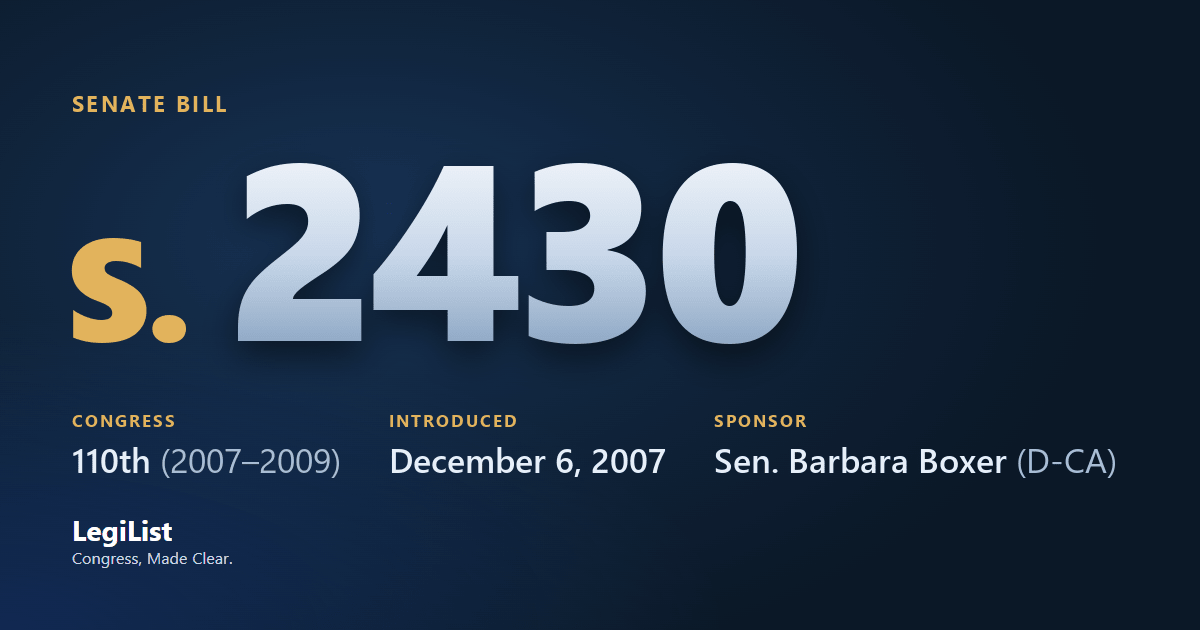
Maritime Emergency Prevention Act of 2007
Latest action · Dec 6, 2007 Read twice and referred to the Committee on Commerce, Science, and Transportation.
Progress
Where this bill reached, and when. A stage with no date was not reached; one that failed a vote and later carried shows the date it carried.
- IntroducedDec 6, 2007
- Passed SenateNot reached
- Passed HouseNot reached
- To the PresidentNot reached
- Became lawNot reached
Summary
Maritime Emergency Prevention Act of 2007 - Authorizes the Secretary of the department in which the Coast Guard is operating to command, using the Vessel Traffic Service (VTS), the pilot of a vessel to modify the speed or direction of a vessel in an emergency or hazardous conditions as determined by the local Coast Guard (CG) VTS director. Prohibits the filing of a civil action for damages against the Secretary or any officer in the exercise of their authority under this Act in any federal or state court.
Requires a federally licensed pilot of a vessel to carry and use a laptop computer equipped with a navigation system in cases where state or local pilotage authorities determine that the use of such computer is practical and necessary.
Cosponsors 1
Members who signed on, in the order they did. All signed on Dec 6, 2007.
| Seat | Cosponsor | Signed on | |
|---|---|---|---|
| D-CA | Dianne Feinstein | Original | Dec 6, 2007 |
Actions 2
Everything that happened, newest first.
- Dec 6, 2007Introduced in Senate
- Dec 6, 2007Read twice and referred to the Committee on Commerce, Science, and Transportation.
Subjects
Assigned by the Library of Congress. Policy area: Transportation and Public Works.
Text 1
Each version as it was printed, newest first.
- Dec 6, 2007Introduced in Senate
Everything here is as published by Congress: the summary is the Congressional Research Service's, the action wording is the clerks', and the subjects are the Library of Congress's. How far it got is read from the actions themselves, taking the most recent one of each kind, so a bill that failed a vote and later passed is shown as having passed. Records come from this bill on Congress.gov and govinfo.gov.