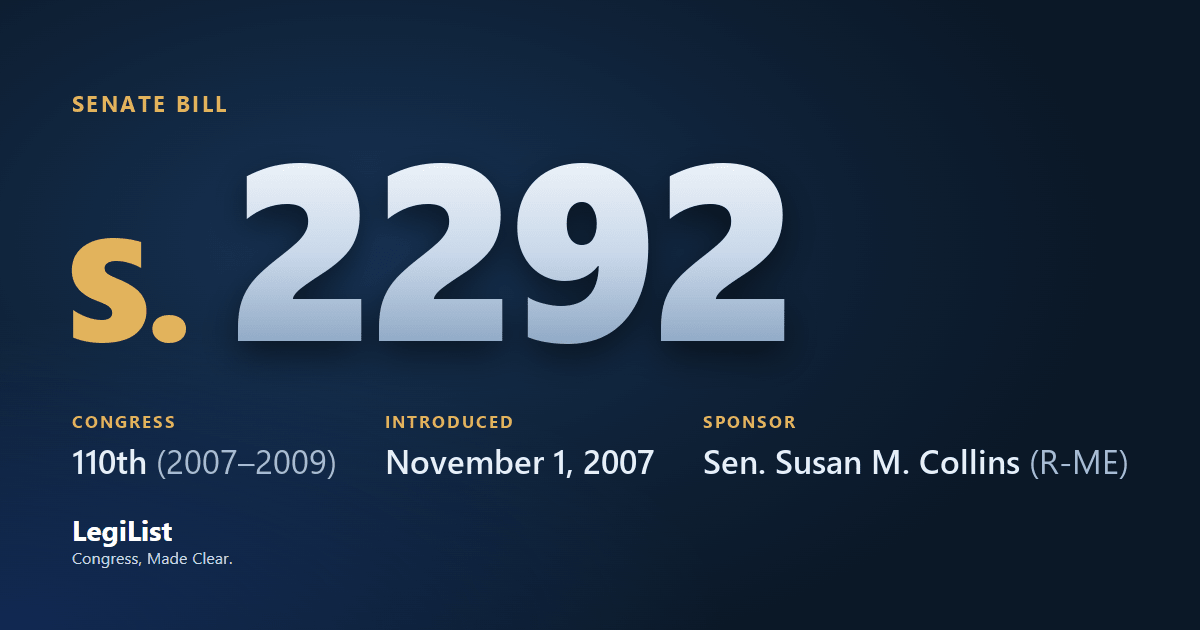
National Bombing Prevention Act of 2007
Latest action · Sep 23, 2008 Placed on Senate Legislative Calendar under General Orders. Calendar No. 1043.
Progress
Where this bill reached, and when. A stage with no date was not reached; one that failed a vote and later carried shows the date it carried.
- IntroducedNov 1, 2007
- Passed SenateNot reached
- Passed HouseNot reached
- To the PresidentNot reached
- Became lawNot reached
Summary
National Bombing Prevention Act of 2007 - Amends the Homeland Security Act of 2002 to establish an Office for Bombing Prevention in the Department of Homeland Security's (DHS's) Office of Infrastructure Protection. Assigns the Office primary responsibility for enhancing the ability and coordinating the efforts of the nation to deter, detect, prevent, protect against, and respond to terrorist explosive attacks.
Directs the Office to: (1) serve as the lead agency of DHS for ensuring that programs designed to counter terrorist explosive attacks nationwide function together efficiently to meet the evolving threat from explosives and improvised explosive devices (IEDs); (2) coordinate national and intergovernmental bombing prevention activities; (3) analyze requirements necessary for state and local governments to protect against and respond to terrorist explosive attacks by maintaining a national analysis database on the capabilities of bomb squads, explosive detection canine teams, tactics teams, and public safety dive teams and applying the analysis in evaluating progress toward closing gaps relating to national strategic goals and standards and informing decisions relating to homeland security policy, assistance, training, research, development efforts, and testing and evaluation requirements; (4) promote secure information sharing of sensitive material relating to terrorist explosives and security awareness; (5) assist state and local governments in developing multijurisdictional IEDs security plans for high-risk jurisdictions; (6) help to ensure the identification and availability of effective technology applications through field pilot testing and the acquisition of such applications by federal, state, and local governments to prevent andrespond to terrorist explosive attacks; (7) coordinate the efforts of DHS regarding, and assist in developing and implementing, national explosives detection canine training, certification, and performance standards; (8) ensure the implementation of any recommendations contained the the national strategy to prevent and prepare for terrorist attacks using explosives; and (9) develop programmatic guidance and permitted uses for bombing prevention activities funded by homeland security assistance administered by DHS. Authorizes appropriations.
Directs the President to: (1) develop and periodically update a national strategy to prevent and prepare for terrorist attacks using explosives or IEDs in the United States; and (2) report to the House and Senate homeland security committees within six months after submitting the report regarding each quadrennial homeland security review.
(Sec. 3) Directs the Secretary of Homeland Security, acting through the Under Secretary for Science and Technology, to: (1) coordinate federal nonmilitary research, development, testing, and evaluation activities relating to the detection and prevention of, protection against, and response to explosive attacks within the United States and the development of bomb squad tools and technologies necessary to neutralize and disable explosive devices; (2) coordinate with the Secretary of Defense and the heads of other relevant federal departments to ensure that military information and related activities are applied to nonmilitary uses; (3) establish a technology transfer program to facilitate the identification, modification, and commercialization of technology and equipment for use by state and local governmental agencies, emergency response providers, and the private sector against such attacks; and (4) establish a working group to advise and assist in the identification of military technologies developed by the Department of Defense (DOD) or the private sector to protect against and respond to explosive attacks.
Cosponsors 3
Members who signed on, in the order they did. Signatures ran from Nov 1, 2007 to Jan 23, 2008; 1 is an original cosponsor, there from the day it was introduced.
| Seat | Cosponsor | Signed on | |
|---|---|---|---|
| I-CT | Joseph I. Lieberman | Original | Nov 1, 2007 |
| R-ID | Larry E. Craig | Jan 23, 2008 | |
| R-ID | Mike Crapo | Jan 23, 2008 |
Committees 1
Where it was sent and what each committee and subcommittee did with it, in order.
| Chamber | Committee | What it did |
|---|---|---|
| Senate | Homeland Security and Governmental Affairs Committee | Referred Nov 1, 2007Markup Nov 14, 2007Reported Sep 23, 2008 |
Actions 6
Everything that happened, newest first.
- Sep 23, 2008Committee on Homeland Security and Governmental Affairs. Reported by Senator Lieberman with an amendment in the nature of a substitute. With written report No. 110-481.
- Sep 23, 2008Placed on Senate Legislative Calendar under General Orders. Calendar No. 1043.
- Nov 14, 2007Committee on Homeland Security and Governmental Affairs. Ordered to be reported with an amendment in the nature of a substitute favorably.
- Nov 1, 2007Introduced in Senate
- Nov 1, 2007Sponsor introductory remarks on measure. (CR S13692-13693)
In the Congressional Record 1
Days the Record’s own index lists this bill, newest first, with the pages and the members it names. Pages starting H are the House, S the Senate, E Extensions of Remarks.
| Where | In the Record | Members | Date |
|---|---|---|---|
| Senate | Debate and remarks S13693 | Joseph I. Lieberman I-CT, Susan M. Collins R-ME | Nov 1, 2007 |
Research
What has been written about this bill: committee reports, cost estimates, the sponsor’s authority statement, printed hearings and the Congressional Research Service’s work.
Committee report
Congressional Budget Office cost estimates 2
- Jan 14, 2008S. 2292, National Bombing Prevention Act of 2007<p>Cost estimate for the bill as ordered reported by the Senate Committee on Homeland Security and Governmental Affairs on November 14, 2007</p>
- Jan 14, 2008S. 2292, National Bombing Prevention Act of 2007Cost estimate for the bill as ordered reported by the Senate Committee on Homeland Security and Governmental Affairs on November 14, 2007
Related bills 1
Companion bills and other measures the record links to this one.
| Bill | Title | Relationship | Latest action |
|---|---|---|---|
| HR 4749 | National Bombing Prevention Act of 2008 | Related bill | Sep 26, 2008 |
Titles 3
Every title it has carried, official and short, at each stage.
- Official Title as Introduced
- A bill to amend the Homeland Security Act of 2002, to establish the Office for Bombing Prevention, to address terrorist explosive threats, and for other purposes.
- Short Titles as Introduced
- National Bombing Prevention Act of 2007
- Short Titles as Reported to Senate
- National Bombing Prevention Act of 2007
Subjects
Assigned by the Library of Congress. Policy area: Emergency Management.
- Armed Forces and National Security
- Bombings
- Bombs
- Commercialization
- Crime and Law Enforcement
- Department of Homeland Security
- Emergency Management
- Executive reorganization
- Explosives
- Federal advisory bodies
- Government Operations and Politics
- Military research
- Research and development
- Science, Technology, Communications
- Technology transfer
- Terrorism
Text 2
Each version as it was printed, newest first.
- Sep 23, 2008Reported to Senate
- Nov 1, 2007Introduced in Senate
Support LegiList
This page is free, carries no paywall, and is built and maintained by one person. If the record here is useful to you, a few dollars keeps it going.
Everything here is as published by Congress: the summary is the Congressional Research Service's, the action wording is the clerks', and the subjects are the Library of Congress's. How far it got is read from the actions themselves, taking the most recent one of each kind, so a bill that failed a vote and later passed is shown as having passed. Records come from this bill on Congress.gov and govinfo.gov; cost estimates are the Congressional Budget Office's, and the hearings are the printed hearings GovInfo publishes, which can appear months after the hearing.