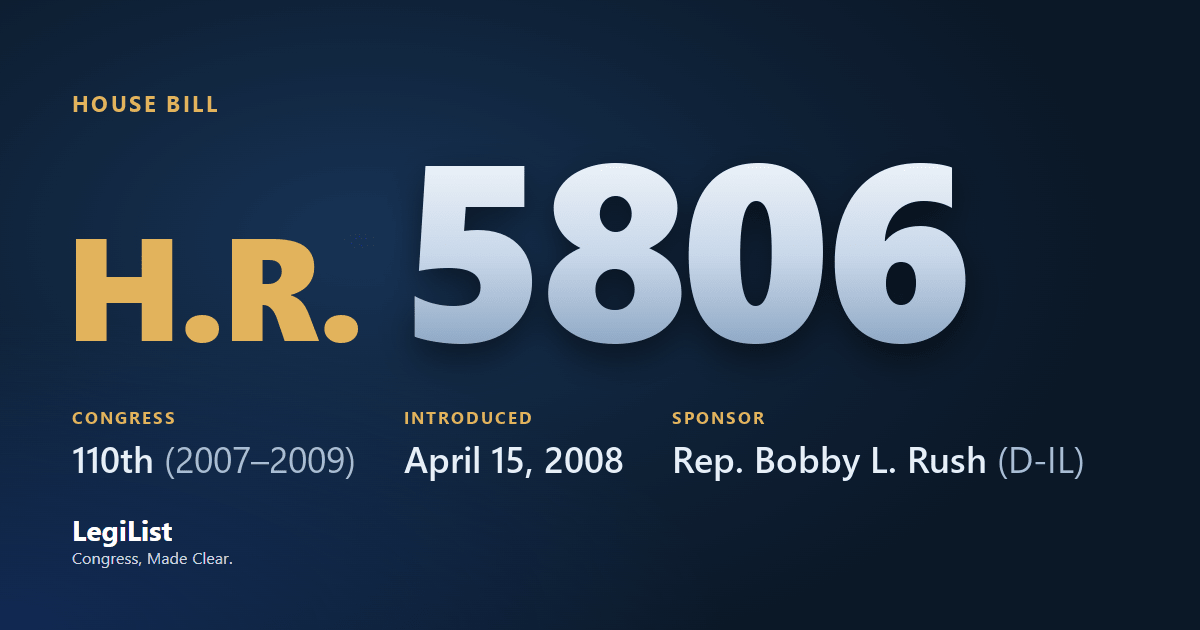
School Emergency Notification Deployment Act
Latest action · Apr 16, 2008 Referred to the Subcommittee on Telecommunications and the Internet.
Progress
Where this bill reached, and when. A stage with no date was not reached; one that failed a vote and later carried shows the date it carried.
- IntroducedApr 15, 2008
- Passed HouseNot reached
- Passed SenateNot reached
- To the PresidentNot reached
- Became lawNot reached
Summary
School Emergency Notification Deployment Act - Amends the Communications Act of 1934 to require the Federal Communications Commission (FCC) to establish competitively neutral rules to permit universal service support to public and nonprofit elementary and secondary schools to be used for a communications service or system that can be used by school administrators and other public officials to deliver emergency messages to students and their parents, faculty, and staff, and their designated emergency contacts, via messages carried over telecommunications and information services, including those transmitted by providers of commercial mobile service.
Cosponsors 9
Members who signed on, in the order they did. Signatures ran from Apr 15, 2008 to May 1, 2008; 1 is an original cosponsor, there from the day it was introduced.
| Seat | Cosponsor | Signed on | |
|---|---|---|---|
| R-MI | Fred Upton | Original | Apr 15, 2008 |
| D-VI | Donna M. Christensen | Apr 22, 2008 | |
| D-NY | Edolphus Towns | Apr 22, 2008 | |
| D-MA | James P. McGovern | Apr 22, 2008 | |
| D-VA | James P. Moran | Apr 22, 2008 | |
| D-CA | Barbara Lee | Apr 24, 2008 | |
| D-IN | André Carson | May 1, 2008 | |
| D-NC | Bob Etheridge | May 1, 2008 | |
| D-LA | William J. Jefferson | May 1, 2008 |
Committees 1
Where it was sent and what each committee and subcommittee did with it, in order.
| Chamber | Committee | What it did |
|---|---|---|
| House | Energy and Commerce Committee | Referred Apr 15, 2008 |
| Communications and Technology Subcommittee | Referred Apr 16, 2008 |
Actions 3
Everything that happened, newest first.
- Apr 16, 2008Referred to the Subcommittee on Telecommunications and the Internet.
- Apr 15, 2008Introduced in House
- Apr 15, 2008Referred to the House Committee on Energy and Commerce.
Research
What has been written about this bill: committee reports, cost estimates, the sponsor’s authority statement, printed hearings and the Congressional Research Service’s work.
CRS reports 1
Congressional Research Service work that CRS links to this bill or the law it became, newest first.
Cite it 1
Products on other subjects that cite it, usually among other measures.
| Product | Title | Kind | Published |
|---|---|---|---|
| RL33979 | Universal Service Fund: Background and Options for Reform Archived | Report | Oct 25, 2011 |
Titles 2
Every title it has carried, official and short, at each stage.
- Official Title as Introduced
- To permit universal service support to schools under the Communications Act of 1934 to be used for enhanced emergency notification services.
- Short Titles as Introduced
- School Emergency Notification Deployment Act
Subjects
Assigned by the Library of Congress. Policy area: Science, Technology, Communications.
- Administrative procedure
- Education
- Elementary and secondary education
- Elementary education
- Emergency communication systems
- Emergency Management
- Federal Communications Commission
- Government Operations and Politics
- Independent regulatory commissions
- Law
- School security
- Science, Technology, Communications
- Secondary education
- Telecommunication rates
- Wireless communication
Text 1
Each version as it was printed, newest first.
- Apr 15, 2008Introduced in House
Support LegiList
This page is free, carries no paywall, and is built and maintained by one person. If the record here is useful to you, a few dollars keeps it going.
Everything here is as published by Congress: the summary is the Congressional Research Service's, the action wording is the clerks', and the subjects are the Library of Congress's. How far it got is read from the actions themselves, taking the most recent one of each kind, so a bill that failed a vote and later passed is shown as having passed. Records come from this bill on Congress.gov and govinfo.gov; cost estimates are the Congressional Budget Office's, and the hearings are the printed hearings GovInfo publishes, which can appear months after the hearing.