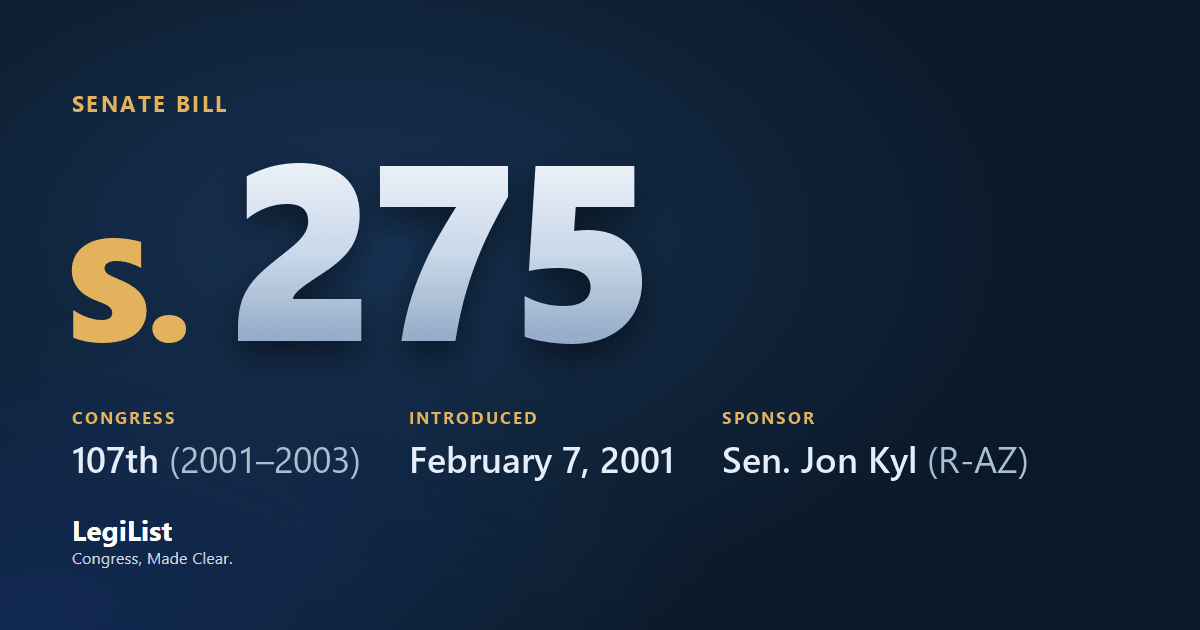
Estate Tax Elimination Act of 2001
Latest action · Mar 15, 2001 Committee on Finance. Hearings held.
Progress
Where this bill reached, and when. A stage with no date was not reached; one that failed a vote and later carried shows the date it carried.
- IntroducedFeb 7, 2001
- Passed SenateNot reached
- Passed HouseNot reached
- To the PresidentNot reached
- Became lawNot reached
Summary
States that the basis for carryover basis property (as defined by this Act) shall be determined under the provision respecting the basis of property acquired by gifts or transfers in trust (section 1015). Describes noncarryover basis property. Directs an executor to provide the Secretary of the Treasury with related information.
Cosponsors 14
Members who signed on, in the order they did. Signatures ran from Feb 7, 2001 to Jul 31, 2001; 4 are original cosponsors, there from the day it was introduced.
| Seat | Cosponsor | Signed on | |
|---|---|---|---|
| D-AR | Blanche L. Lincoln | Original | Feb 7, 2001 |
| D-IN | Evan Bayh | Original | Feb 7, 2001 |
| D-LA | John B. Breaux | Original | Feb 7, 2001 |
| R-TX | Phil Gramm | Original | Feb 7, 2001 |
| R-WY | Craig Thomas | Feb 14, 2001 | |
| R-VA | George Allen | Feb 14, 2001 | |
| D-OR | Ron Wyden | Feb 28, 2001 | |
| R-AR | Tim Hutchinson | Feb 28, 2001 | |
| D-GA | Max Cleland | Mar 14, 2001 | |
| R-ME | Susan M. Collins | Mar 14, 2001 | |
| R-ME | Olympia J. Snowe | May 3, 2001 | |
| D-FL | Bill Nelson | May 17, 2001 | |
| R-OR | Gordon H. Smith | Jul 31, 2001 | |
| R-ID | Larry E. Craig | Jul 31, 2001 |
Committees 1
Where it was sent and what each committee and subcommittee did with it, in order.
| Chamber | Committee | What it did |
|---|---|---|
| Senate | Finance Committee | Referred Feb 7, 2001Hearings Mar 15, 2001 |
Actions 5
Everything that happened, newest first.
- Mar 15, 2001Committee on Finance. Hearings held.
- Feb 15, 2001Sponsor introductory remarks on measure. (CR S1442-1445)
- Feb 7, 2001Introduced in Senate
- Feb 7, 2001Sponsor introductory remarks on measure. (CR S1131)
- Feb 7, 2001Read twice and referred to the Committee on Finance.
In the Congressional Record 2
Days the Record’s own index lists this bill, newest first, with the pages and the members it names. Pages starting H are the House, S the Senate, E Extensions of Remarks.
Research
What has been written about this bill: committee reports, cost estimates, the sponsor’s authority statement, printed hearings and the Congressional Research Service’s work.
Printed hearings 2
Hearings whose printed record names this bill, newest first: hearings on it, and wider hearings where it came up.
| Number | Hearing | Committee | Held |
|---|---|---|---|
| Serial No. 107-78 | MODELING THE ECONOMIC EFFECT OF CHANGES IN TAX POLICY48 pages | Ways and Means Committee | May 7, 2002 |
| Serial No. 107-6 | PRESIDENT'S TAX RELIEF PROPOSALS: TAX PROPOSALS AFFECTING INDIVIDUALS179 pages | Ways and Means Committee | Mar 21, 2001 |
Titles 3
Every title it has carried, official and short, at each stage.
- Official Title as Introduced
- A bill to amend the Internal Revenue Code of 1986 to repeal the Federal estate and gift taxes and the tax on generation-skipping transfers, to preserve a step up in basis of certain property acquired from a decedent, and for other purposes.
- Short Titles as Introduced
- Estate Tax Elimination Act of 2001
- Popular Titles
- Estate Tax Phase Out bill
Subjects
Assigned by the Library of Congress. Policy area: Taxation.
- Administrative procedure
- Art objects
- Arts, Culture, Religion
- Capital gains tax
- Charitable contributions
- Copyright
- Cost of living adjustments
- Department of the Treasury
- Economics and Public Finance
- Estate tax
- Estates (Law)
- Finance and Financial Sector
- Gift tax
- Government Operations and Politics
- Housing and Community Development
- Income tax
- Indexing (Economic policy)
- Inheritance tax
- Intellectual property
- Law
- Personal income tax
- Real estate appraisal
- Tax cuts
- Tax deductions
- Tax returns
- Taxation
- Valuation
Text 1
Each version as it was printed, newest first.
- Feb 7, 2001Introduced in Senate
Everything here is as published by Congress: the summary is the Congressional Research Service's, the action wording is the clerks', and the subjects are the Library of Congress's. How far it got is read from the actions themselves, taking the most recent one of each kind, so a bill that failed a vote and later passed is shown as having passed. Records come from this bill on Congress.gov and govinfo.gov; cost estimates are the Congressional Budget Office's, and the hearings are the printed hearings GovInfo publishes, which can appear months after the hearing.