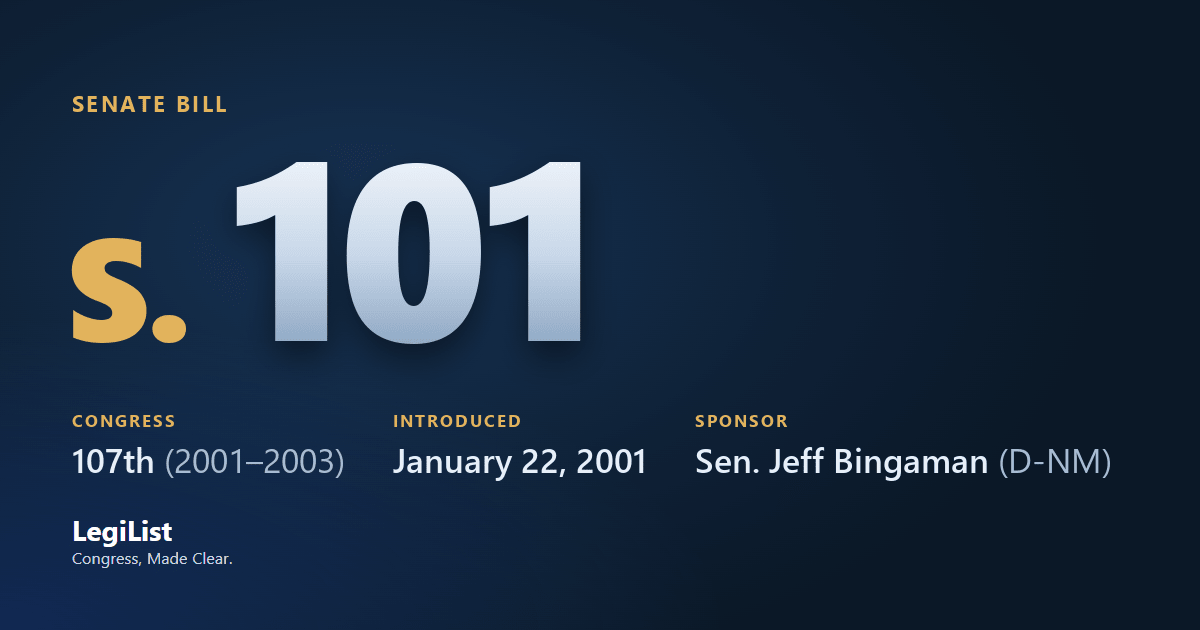
Quality Teachers for All Act
Latest action · Jan 22, 2001 Read twice and referred to the Committee on Health, Education, Labor, and Pensions. (text of measure as introduced: CR S370-372)
Progress
Where this bill reached, and when. A stage with no date was not reached; one that failed a vote and later carried shows the date it carried.
- IntroducedJan 22, 2001
- Passed SenateNot reached
- Passed HouseNot reached
- To the PresidentNot reached
- Became lawNot reached
Summary
Revises requirements for State plans under ESEA title I (Helping Disadvantaged Students Meet High Standards) part A (Improving Basic Programs Operated by State and Local Educational Agencies) to add teacher quality requirements.
Eliminates certain part A professional development requirements with respect to instructional aides.
Establishes an ESEA title I part A program of grants by the Secretary of Education to provide a Fully Qualified Teacher in Every Classroom. Authorizes States and LEAs, in order to meet the goal of a qualified teacher in every classroom, to carry out specified activities with such grants and also use for the same purpose funds received under: (1) ESEA title II (Dwight D. Eisenhower Professional Development Program); (2) ESEA title VI (Innovative Education Program Strategies); (3) title II (Teacher Quality Enhancement Grants for States and Partnerships) of the Higher Education Act of 1965; or (5) the Goals 2000: Educate America Act.
Establishes a certification grants program. Authorizes the Secretary to make such grants to SEAs, LEAs, or schools that receive part A assistance, to pay for one-half of the cost of providing financial assistance to teachers in such schools who obtain certification from the National Board of Professional Teaching Standards.
Prohibits the use of any ESEA funds for any professional development services for a teacher that are not directly related to the curriculum and content areas in which the teacher provides instruction.
Cosponsors
Members who signed on, in the order they did.
Committees 1
Where it was sent and what each committee and subcommittee did with it, in order.
| Chamber | Committee | What it did |
|---|---|---|
| Senate | Health, Education, Labor, and Pensions Committee | Referred Jan 22, 2001 |
Actions 3
Everything that happened, newest first.
- Jan 22, 2001Introduced in Senate
- Jan 22, 2001Sponsor introductory remarks on measure. (CR S369-370)
- Jan 22, 2001Read twice and referred to the Committee on Health, Education, Labor, and Pensions. (text of measure as introduced: CR S370-372)
In the Congressional Record 1
Days the Record’s own index lists this bill, newest first, with the pages and the members it names. Pages starting H are the House, S the Senate, E Extensions of Remarks.
| Where | In the Record | Members | Date |
|---|---|---|---|
| Senate | Debate and remarks S369Text printed S370–S372 | Jeff Bingaman D-NM (text) | Jan 22, 2001 |
Titles 2
Every title it has carried, official and short, at each stage.
- Official Title as Introduced
- A bill to improve teacher quality, and for other purposes.
- Short Titles as Introduced
- Quality Teachers for All Act
Subjects
Assigned by the Library of Congress. Policy area: Education.
- Academic performance
- Civics education
- College costs
- Dismissal of employees
- Economics and Public Finance
- Education
- Educational accountability
- Educational innovations
- Educational planning
- Elementary and secondary education
- Elementary education
- Employment tests
- Families
- Federal aid to education
- Federal aid to higher education
- Fringe benefits
- Government Operations and Politics
- Higher education
- Interstate relations
- Labor and Employment
- Language arts
- Law
- Licenses
- Mathematics
- Paraprofessional school personnel
- Parent-school relationships
- Pension portability
- Reading
- Recruiting of employees
- Scholarships
- Science, Technology, Communications
- Scientific education
- Secondary education
- Standards
- Teacher education
- Teacher salaries
- Teacher supply and demand
- Teachers
Text 1
Each version as it was printed, newest first.
- Jan 22, 2001Introduced in Senate
Everything here is as published by Congress: the summary is the Congressional Research Service's, the action wording is the clerks', and the subjects are the Library of Congress's. How far it got is read from the actions themselves, taking the most recent one of each kind, so a bill that failed a vote and later passed is shown as having passed. Records come from this bill on Congress.gov and govinfo.gov; cost estimates are the Congressional Budget Office's, and the hearings are the printed hearings GovInfo publishes, which can appear months after the hearing.