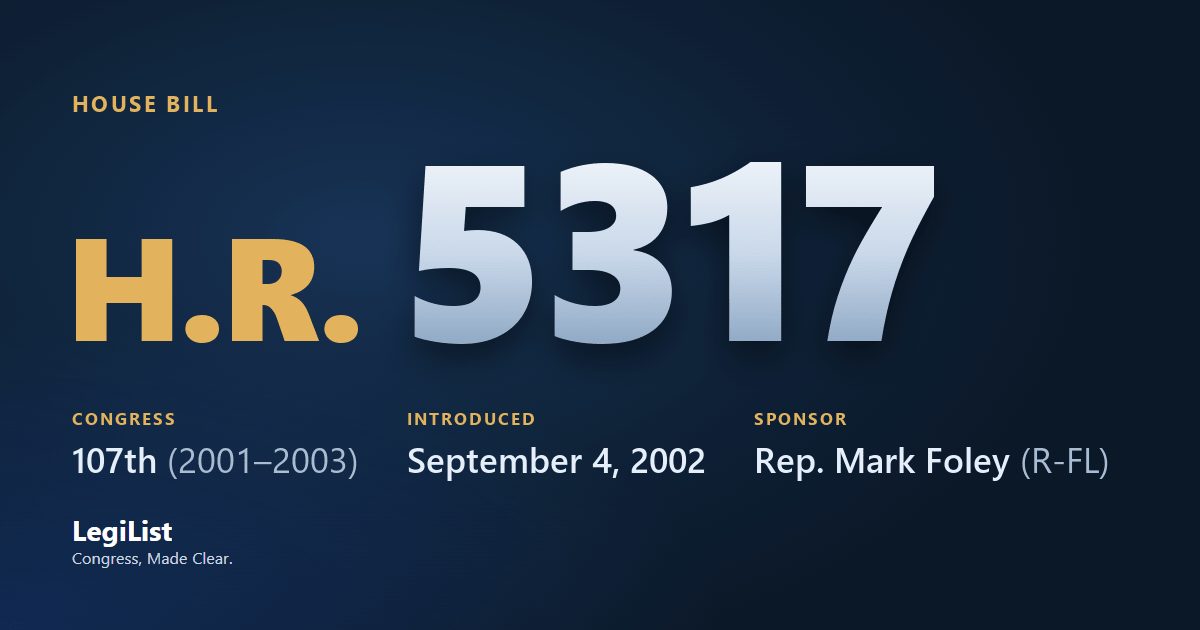
National AMBER Alert Act of 2002
Latest action · Sep 21, 2002 See also H.R. 5422.
Progress
Where this bill reached, and when. A stage with no date was not reached; one that failed a vote and later carried shows the date it carried.
- IntroducedSep 4, 2002
- Passed HouseNot reached
- Passed SenateNot reached
- To the PresidentNot reached
- Became lawNot reached
Summary
Directs the Secretary to make grants to certified States to develop, acquire, install, and construct facilities and equipment along highways to notify the public about missing children and their abductors.
Cosponsors 48
Members who signed on, in the order they did. Signatures ran from Sep 4, 2002 to Oct 3, 2002; 21 are original cosponsors, there from the day it was introduced.
| Seat | Cosponsor | Signed on | |
|---|---|---|---|
| D-FL | Alcee L. Hastings | Original | Sep 4, 2002 |
| D-FL | Allen Boyd | Original | Sep 4, 2002 |
| D-NY | Carolyn McCarthy | Original | Sep 4, 2002 |
| D-FL | Corrine Brown | Original | Sep 4, 2002 |
| D-NY | Edolphus Towns | Original | Sep 4, 2002 |
| R-VA | Edward L. Schrock | Original | Sep 4, 2002 |
| D-CA | Ellen O. Tauscher | Original | Sep 4, 2002 |
| R-NY | Felix J. Grucci Jr. | Original | Sep 4, 2002 |
| R-PA | James C. Greenwood | Original | Sep 4, 2002 |
| D-MA | James P. McGovern | Original | Sep 4, 2002 |
| D-VA | James P. Moran | Original | Sep 4, 2002 |
| R-SC | Lindsey Graham | Original | Sep 4, 2002 |
| D-OH | Marcy Kaptur | Original | Sep 4, 2002 |
| R-MN | Mark R. Kennedy | Original | Sep 4, 2002 |
| D-CA | Mike Thompson | Original | Sep 4, 2002 |
Committees 2
Where it was sent and what each committee and subcommittee did with it, in order.
| Chamber | Committee | What it did |
|---|---|---|
| House | Judiciary Committee | Referred Sep 4, 2002 |
| Crime and Federal Government Surveillance Subcommittee | Referred Sep 20, 2002 | |
| House | Transportation and Infrastructure Committee | Referred Sep 4, 2002 |
| Highways and Transit Subcommittee | Referred Sep 5, 2002 |
Actions 5
Everything that happened, newest first.
- Sep 21, 2002See also H.R. 5422.
- Sep 20, 2002Referred to the Subcommittee on Crime, Terrorism, and Homeland Security.
- Sep 5, 2002Referred to the Subcommittee on Highways and Transit.
- Sep 4, 2002Introduced in House
- Sep 4, 2002Referred to the Committee on the Judiciary, and in addition to the Committee on Transportation and Infrastructure, for a period to be subsequently determined by the Speaker, in each case for consideration of such provisions as fall within the jurisdiction of the committee concerned.
In the Congressional Record 1
Days the Record’s own index lists this bill, newest first, with the pages and the members it names. Pages starting H are the House, S the Senate, E Extensions of Remarks.
| Where | In the Record | Members | Date |
|---|---|---|---|
| House | Debate and remarks H6063 | Nick Lampson D-TX | Sep 5, 2002 |
Titles 3
Every title it has carried, official and short, at each stage.
- Official Title as Introduced
- To develop, coordinate, and improve the AMBER Alert communications network throughout the country.
- Short Titles as Introduced
- National AMBER Alert Act of 2002
- Popular Titles
- Enhance AMBER Alert bill
Subjects
Assigned by the Library of Congress. Policy area: Crime and Law Enforcement.
- Child safety
- Crime and Law Enforcement
- Criminal justice information systems
- Department of Justice
- Economics and Public Finance
- Executive reorganization
- Families
- Federal aid to law enforcement
- Federal aid to transportation
- Federal-local relations
- Federal-state relations
- Government Operations and Politics
- Information networks
- Informers
- Interstate relations
- Kidnapping
- Missing children
- Police communication systems
- Radio broadcasting
- Science, Technology, Communications
- Signs and signboards
- Standards
- Traffic signs and signals
- Transportation and Public Works
Text 1
Each version as it was printed, newest first.
- Sep 4, 2002Introduced in House
Support LegiList
This page is free, carries no paywall, and is built and maintained by one person. If the record here is useful to you, a few dollars keeps it going.
Everything here is as published by Congress: the summary is the Congressional Research Service's, the action wording is the clerks', and the subjects are the Library of Congress's. How far it got is read from the actions themselves, taking the most recent one of each kind, so a bill that failed a vote and later passed is shown as having passed. Records come from this bill on Congress.gov and govinfo.gov; cost estimates are the Congressional Budget Office's, and the hearings are the printed hearings GovInfo publishes, which can appear months after the hearing.