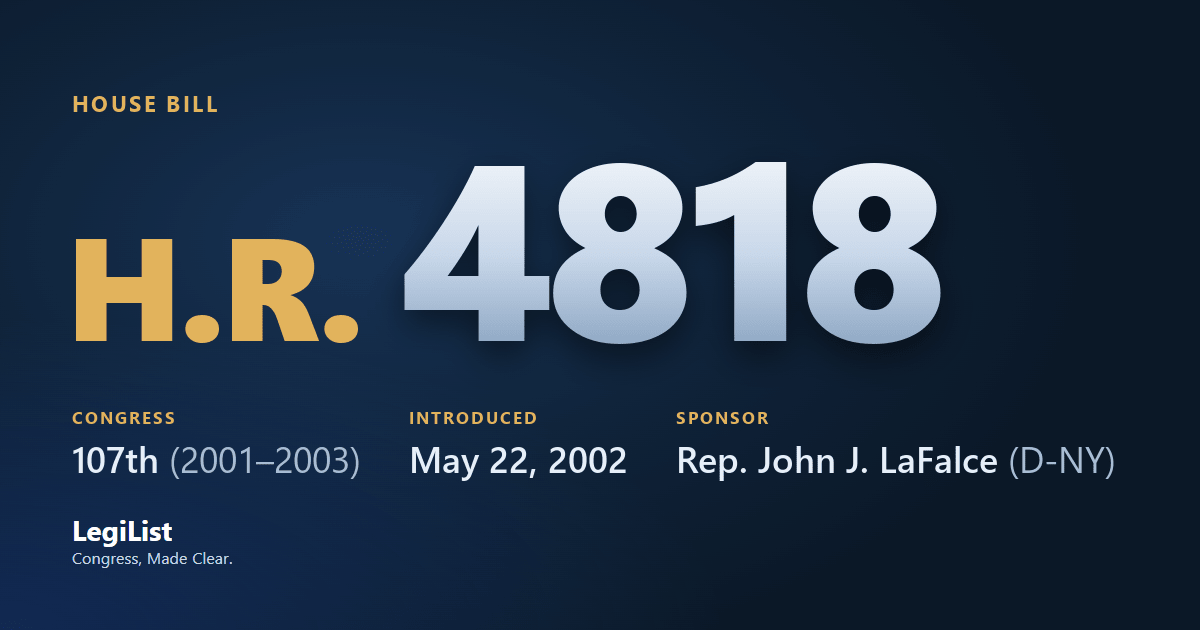
Mortgage Loan Consumer Protection Act
Latest action · May 31, 2002 Referred to the Subcommittee on Housing and Community Opportunity.
Progress
Where this bill reached, and when. A stage with no date was not reached; one that failed a vote and later carried shows the date it carried.
- IntroducedMay 22, 2002
- Passed HouseNot reached
- Passed SenateNot reached
- To the PresidentNot reached
- Became lawNot reached
Summary
Amends the Real Estate Settlement Procedures Act, with respect to the uniform settlement statement, to require: (1) separate lines for "closing costs, "prepaid items," and "all other costs paid at closing"; (2) at least two days' advance availability of the final settlement statement; and (3) disclosure of all lender fees.
Provides, with respect to special information booklets, for: (1) harmonization of good faith estimates and settlement statements; and (2) inclusion of refinancing and upfront payment option information.
Prohibits markups and unearned fees.
Sets forth servicer escrow-related liabilities.
Revises damage and cost, and jurisdiction and statute of limitations provisions.
Cosponsors
Members who signed on, in the order they did.
Committees 1
Where it was sent and what each committee and subcommittee did with it, in order.
| Chamber | Committee | What it did |
|---|---|---|
| House | Financial Services Committee | Referred May 22, 2002 |
| Housing and Insurance Subcommittee | Referred May 31, 2002 |
Actions 4
Everything that happened, newest first.
- May 31, 2002Referred to the Subcommittee on Housing and Community Opportunity.
- May 23, 2002Sponsor introductory remarks on measure. (CR E897-898)
- May 22, 2002Introduced in House
- May 22, 2002Referred to the House Committee on Financial Services.
In the Congressional Record 1
Days the Record’s own index lists this bill, newest first, with the pages and the members it names. Pages starting H are the House, S the Senate, E Extensions of Remarks.
| Where | In the Record | Members | Date |
|---|---|---|---|
| Extensions | Debate and remarks E897 | John J. LaFalce D-NY | May 23, 2002 |
Research
What has been written about this bill: committee reports, cost estimates, the sponsor’s authority statement, printed hearings and the Congressional Research Service’s work.
Printed hearings 1
Hearings whose printed record names this bill, newest first: hearings on it, and wider hearings where it came up.
| Number | Hearing | Committee | Held |
|---|---|---|---|
| Serial No. 107-85 | REFORMING THE REAL ESTATE SETTLEMENT PROCEDURE: REVIEW OF HUD'S PROPOSED RESPA RULE104 pages | Financial Services Committee | Oct 3, 2002 |
Titles 2
Every title it has carried, official and short, at each stage.
- Official Title as Introduced
- To amend the Real Estate Settlement Procedures Act of 1974 and the Truth in Lending Act to make the residential mortgage process more understandable, fair, and competitive.
- Short Titles as Introduced
- Mortgage Loan Consumer Protection Act
Subjects
Assigned by the Library of Congress. Policy area: Finance and Financial Sector.
- Bank accounts
- Commerce
- Consumer education
- Consumer protection
- Cost effectiveness
- Damages
- Economics and Public Finance
- Federally-assisted loans
- Federally-guaranteed loans
- Fees
- Finance and Financial Sector
- Finance charges
- Fines (Penalties)
- Government lending
- Government Operations and Politics
- Government publications
- Government publicity
- Housing and Community Development
- Insurance premiums
- Jurisdiction
- Law
- Legal fees
- Limitation of actions
- Mortgage banks
- Mortgage guaranty insurance
- Mortgage interest rates
- Mortgage loans
- Property insurance
- Real property tax
- Settlement costs
- Tax penalties
- Taxation
Text 1
Each version as it was printed, newest first.
- May 22, 2002Introduced in House
Support LegiList
This page is free, carries no paywall, and is built and maintained by one person. If the record here is useful to you, a few dollars keeps it going.
Everything here is as published by Congress: the summary is the Congressional Research Service's, the action wording is the clerks', and the subjects are the Library of Congress's. How far it got is read from the actions themselves, taking the most recent one of each kind, so a bill that failed a vote and later passed is shown as having passed. Records come from this bill on Congress.gov and govinfo.gov; cost estimates are the Congressional Budget Office's, and the hearings are the printed hearings GovInfo publishes, which can appear months after the hearing.