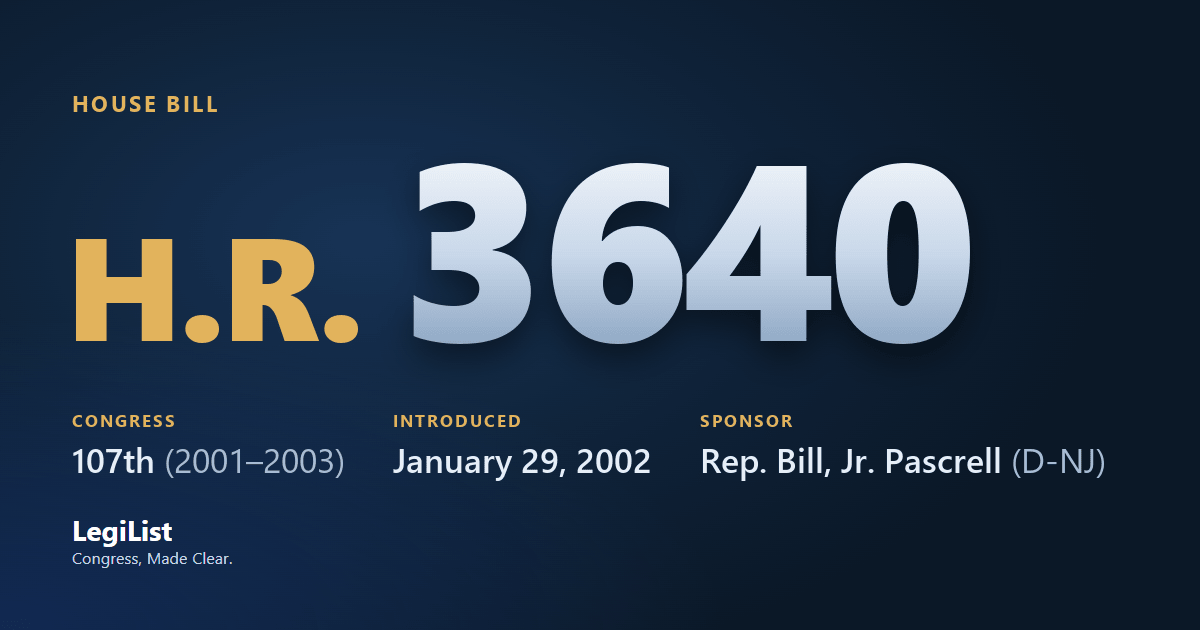
Pension Protection and Diversification Act of 2002
Latest action · May 9, 2002 Referred to the Subcommittee on Employer-Employee Relations.
Progress
Where this bill reached, and when. A stage with no date was not reached; one that failed a vote and later carried shows the date it carried.
- IntroducedJan 29, 2002
- Passed HouseNot reached
- Passed SenateNot reached
- To the PresidentNot reached
- Became lawNot reached
Summary
Amends Internal Revenue Code to: (1) allow employees to diversify assets in ESOPS after five years, and after they've reached age 35 (but requires a trustee-to-trustee transfer for those under age 55); and (2) reduce by 50 percent the allowable deduction for employer matching contributions to defined contribution plans made in employer securities.
Cosponsors 3
Members who signed on, in the order they did. Signatures ran from Feb 12, 2002 to Mar 11, 2002.
| Seat | Cosponsor | Signed on | |
|---|---|---|---|
| D-WA | Jim McDermott | Feb 12, 2002 | |
| D-ME | John Elias Baldacci | Feb 12, 2002 | |
| D-NJ | Donald M. Payne | Mar 11, 2002 |
Committees 2
Where it was sent and what each committee and subcommittee did with it, in order.
| Chamber | Committee | What it did |
|---|---|---|
| House | Ways and Means Committee | Referred Jan 30, 2002 |
| House | Education and Workforce Committee | Referred Jan 30, 2002 |
| Health, Employment, Labor, and Pensions Subcommittee | Referred May 9, 2002 |
Actions 3
Everything that happened, newest first.
- May 9, 2002Referred to the Subcommittee on Employer-Employee Relations.
- Jan 29, 2002Introduced in House
- Jan 29, 2002Referred to the Committee on Ways and Means, and in addition to the Committee on Education and the Workforce, for a period to be subsequently determined by the Speaker, in each case for consideration of such provisions as fall within the jurisdiction of the committee concerned.
Research
What has been written about this bill: committee reports, cost estimates, the sponsor’s authority statement, printed hearings and the Congressional Research Service’s work.
Printed hearings 1
Hearings whose printed record names this bill, newest first: hearings on it, and wider hearings where it came up.
| Number | Hearing | Committee | Held |
|---|---|---|---|
| Serial No. 107-52 | EMPLOYEE AND EMPLOYER VIEWS ON RETIREMENT SECURITY132 pages | Ways and Means Committee | Mar 5, 2002 |
Related bills 2
Companion bills and other measures the record links to this one.
| Bill | Title | Relationship | Latest action |
|---|---|---|---|
| S 1838 | Pension Protection and Diversification Act of 2001 | Identical bill | Dec 18, 2001 |
| HR 3692 | Pension Protection and Diversification Act of 2002 | Identical bill | May 9, 2002 |
Titles 3
Every title it has carried, official and short, at each stage.
- Official Title as Introduced
- To amend the Employee Retirement Income Security Act of 1974 and the Internal Revenue Code of 1986 to ensure that individual account plans protect workers by limiting the amount of employer stock each worker may hold and encouraging diversification of investment of plan assets, and for other purposes.
- Short Titles as Introduced
- Pension Protection and Diversification Act of 2002
- Popular Titles
- Pension Protection bill
Subjects
Assigned by the Library of Congress. Policy area: Labor and Employment.
- Administrative procedure
- Business income tax
- Commerce
- Corporate collapse
- Corporation taxes
- Department of Labor
- Employee ownership
- Employee pensions
- Finance and Financial Sector
- Government Operations and Politics
- Income tax
- Investments
- Labor and Employment
- Law
- Pension funds
- Stocks
- Tax deductions
- Tax-deferred compensation plans
- Taxation
- Trusts and trustees
Text 1
Each version as it was printed, newest first.
- Jan 29, 2002Introduced in House
Support LegiList
This page is free, carries no paywall, and is built and maintained by one person. If the record here is useful to you, a few dollars keeps it going.
Everything here is as published by Congress: the summary is the Congressional Research Service's, the action wording is the clerks', and the subjects are the Library of Congress's. How far it got is read from the actions themselves, taking the most recent one of each kind, so a bill that failed a vote and later passed is shown as having passed. Records come from this bill on Congress.gov and govinfo.gov; cost estimates are the Congressional Budget Office's, and the hearings are the printed hearings GovInfo publishes, which can appear months after the hearing.