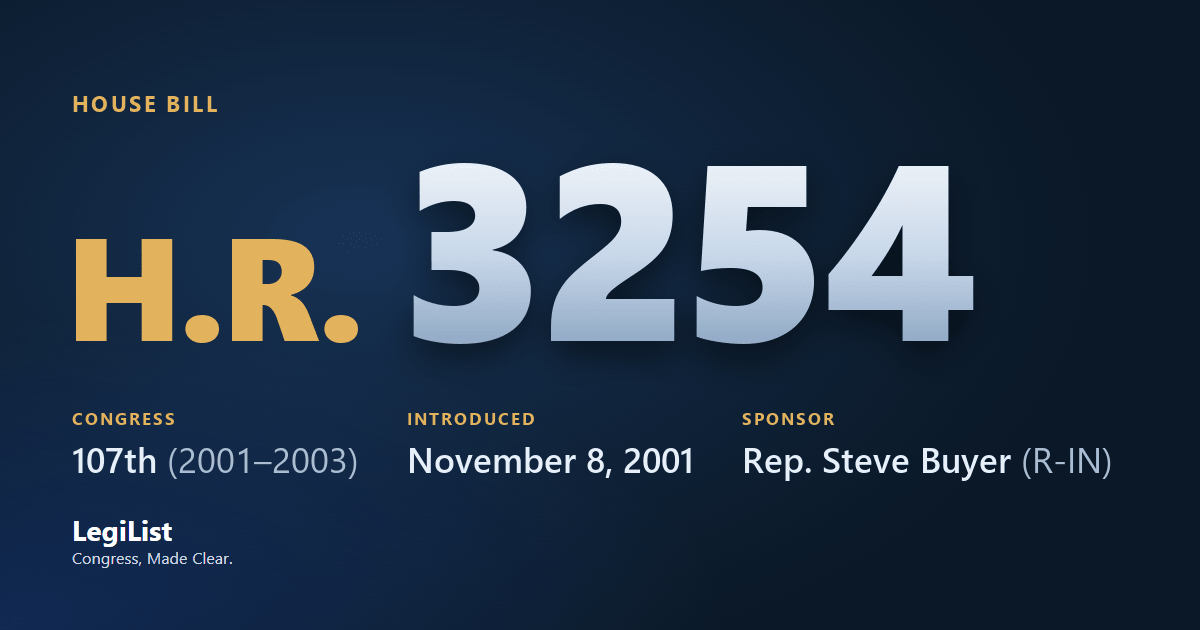
Medical Education for National Defense in the 21st Century Act
Latest action · Sep 18, 2002 Sponsor introductory remarks on measure. (CR E1602)
Progress
Where this bill reached, and when. A stage with no date was not reached; one that failed a vote and later carried shows the date it carried.
- IntroducedNov 8, 2001
- Passed HouseNot reached
- Passed SenateNot reached
- To the PresidentNot reached
- Became lawNot reached
Summary
Cosponsors 9
Members who signed on, in the order they did. Signatures ran from Nov 8, 2001 to Dec 11, 2001; 5 are original cosponsors, there from the day it was introduced.
| Seat | Cosponsor | Signed on | |
|---|---|---|---|
| R-NJ | Christopher H. Smith | Original | Nov 8, 2001 |
| R-FL | Cliff Stearns | Original | Nov 8, 2001 |
| R-NY | John M. McHugh | Original | Nov 8, 2001 |
| R-FL | Michael Bilirakis | Original | Nov 8, 2001 |
| D-AR | Vic Snyder | Original | Nov 8, 2001 |
| R-FL | Dave Weldon | Nov 16, 2001 | |
| D-GU | Robert A. Underwood | Nov 27, 2001 | |
| R-IL | Mark Kirk | Dec 4, 2001 | |
| D-CA | Ellen O. Tauscher | Dec 11, 2001 |
Committees 2
Where it was sent and what each committee and subcommittee did with it, in order.
| Chamber | Committee | What it did |
|---|---|---|
| House | Veterans' Affairs Committee | Referred Nov 8, 2001 |
| Health Subcommittee | Referred Mar 22, 2002Hearings Apr 10, 2002 | |
| House | Armed Services Committee | Referred Nov 8, 2001 |
| Military Personnel Subcommittee | Referred Jan 28, 2002 |
Actions 9
Everything that happened, newest first.
- Sep 18, 2002Sponsor introductory remarks on measure. (CR E1602)
- Apr 10, 2002Subcommittee Hearings Held.
- Mar 22, 2002Referred to the Subcommittee on Health.
- Jan 28, 2002Executive Comment Requested from DOD.
- Jan 28, 2002Executive Comment Requested from Veterans Affairs.
In the Congressional Record 2
Days the Record’s own index lists this bill, newest first, with the pages and the members it names. Pages starting H are the House, S the Senate, E Extensions of Remarks.
| Where | In the Record | Members | Date |
|---|---|---|---|
| Extensions | Debate and remarks E1602 | Steve Buyer R-IN | Sep 18, 2002 |
| House | Debate and remarks H7950 | Steve Buyer R-IN | Nov 8, 2001 |
Research
What has been written about this bill: committee reports, cost estimates, the sponsor’s authority statement, printed hearings and the Congressional Research Service’s work.
Printed hearings 1
Hearings whose printed record names this bill, newest first: hearings on it, and wider hearings where it came up.
| Number | Hearing | Committee | Held |
|---|---|---|---|
| Serial No. 107-24 | LEGISLATIVE HEARING ON BIOTERRORISM, H.R. 3253 AND H.R. 3254113 pages | Veterans' Affairs Committee | Apr 10, 2002 |
CRS reports 1
Congressional Research Service work that CRS links to this bill or the law it became, newest first.
Cite it 1
Products on other subjects that cite it, usually among other measures.
| Product | Title | Kind | Published |
|---|---|---|---|
| RL31263 | Public Health Security and Bioterrorism Preparedness and Response Act (P.L. 107-188): Provisions and Changes to Preexisting Law Archived | Report | Aug 21, 2002 |
Titles 2
Every title it has carried, official and short, at each stage.
- Official Title as Introduced
- To amend title 38, United States Code, to provide for a partnership between the Department of Veterans Affairs and the Department of Defense to develop and disseminate education and training programs on the medical responses to the consequences of terrorist activities.
- Short Titles as Introduced
- Medical Education for National Defense in the 21st Century Act
Subjects
Assigned by the Library of Congress. Policy area: Armed Forces and National Security.
- Armed Forces and National Security
- Biological warfare
- Biological weapons
- Chemical warfare
- Chemical weapons
- Continuing education
- Crime and Law Enforcement
- EBB Terrorism
- Education
- Emergency Management
- Emergency medical services
- Emergency medicine
- Health
- Higher education
- International Affairs
- Labor and Employment
- Medical education
- Military medicine
- Nuclear terrorism
- Terrorism
- Veterans' medical care
- Victims of terrorism
Text 1
Each version as it was printed, newest first.
- Nov 8, 2001Introduced in House
Support LegiList
This page is free, carries no paywall, and is built and maintained by one person. If the record here is useful to you, a few dollars keeps it going.
Everything here is as published by Congress: the summary is the Congressional Research Service's, the action wording is the clerks', and the subjects are the Library of Congress's. How far it got is read from the actions themselves, taking the most recent one of each kind, so a bill that failed a vote and later passed is shown as having passed. Records come from this bill on Congress.gov and govinfo.gov; cost estimates are the Congressional Budget Office's, and the hearings are the printed hearings GovInfo publishes, which can appear months after the hearing.