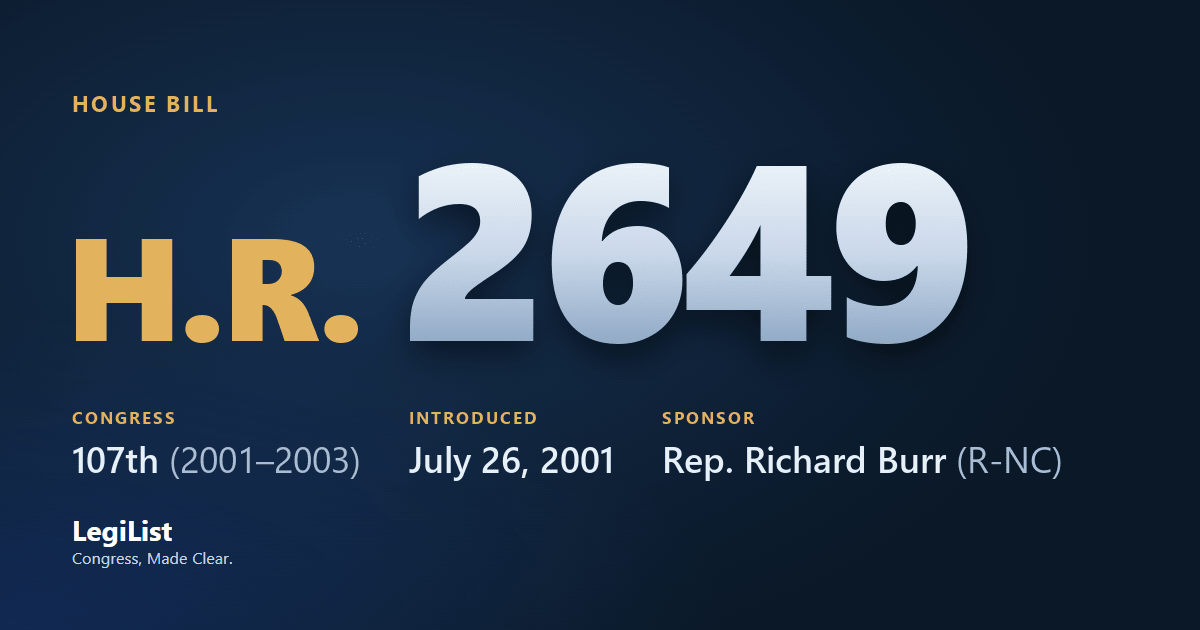
National Uniformity for Food Act of 2001
Latest action · Aug 10, 2001 Referred to the Subcommittee on Health.
Progress
Where this bill reached, and when. A stage with no date was not reached; one that failed a vote and later carried shows the date it carried.
- IntroducedJul 26, 2001
- Passed HouseNot reached
- Passed SenateNot reached
- To the PresidentNot reached
- Became lawNot reached
Summary
Prohibits any State or political subdivision from establishing or continuing in effect any notification requirement for a food that provides for a warning concerning the food's safety that is not identical to FDCA provisions. Allows current State notification or food safety requirements to continue for 180 days after the enactment of this Act, during which such State may petition for an exemption or a new national standard. Allows a State to petition for an exemption and for a national standard regarding any requirement under the FDCA, as amended by this Act, or the Fair Packaging and Labeling Act relating to food regulation. Allows a State to establish a requirement that would otherwise violate FDCA provisions relating to national uniform nutrition labeling or this paragraph if the requirement is needed to address an imminent hazard to health that is likely to result in serious adverse health consequences and if other requirements are met.
Cosponsors 96
Members who signed on, in the order they did. Signatures ran from Jul 26, 2001 to Nov 13, 2002; 25 are original cosponsors, there from the day it was introduced.
| Seat | Cosponsor | Signed on | |
|---|---|---|---|
| D-MD | Albert Russell Wynn | Original | Jul 26, 2001 |
| D-IL | Bobby L. Rush | Original | Jul 26, 2001 |
| R-GA | Charles W. Norwood | Original | Jul 26, 2001 |
| R-CA | Christopher Cox | Original | Jul 26, 2001 |
| R-TN | Ed Bryant | Original | Jul 26, 2001 |
| R-KY | Ed Whitfield | Original | Jul 26, 2001 |
| D-NY | Edolphus Towns | Original | Jul 26, 2001 |
| R-MI | Fred Upton | Original | Jul 26, 2001 |
| D-MI | James A. Barcia | Original | Jul 26, 2001 |
| R-PA | James C. Greenwood | Original | Jul 26, 2001 |
| R-AZ | Jim Kolbe | Original | Jul 26, 2001 |
| R-MO | Jo Ann Emerson | Original | Jul 26, 2001 |
| R-TX | Joe Barton | Original | Jul 26, 2001 |
| R-FL | Joe Scarborough | Original | Jul 26, 2001 |
| R-NY | John E. Sweeney | Original | Jul 26, 2001 |
Committees 1
Where it was sent and what each committee and subcommittee did with it, in order.
| Chamber | Committee | What it did |
|---|---|---|
| House | Energy and Commerce Committee | Referred Jul 26, 2001 |
| Health Subcommittee | Referred Aug 10, 2001 |
Actions 3
Everything that happened, newest first.
- Aug 10, 2001Referred to the Subcommittee on Health.
- Jul 26, 2001Introduced in House
- Jul 26, 2001Referred to the House Committee on Energy and Commerce.
Titles 2
Every title it has carried, official and short, at each stage.
- Official Title as Introduced
- To amend the Federal Food, Drug, and Cosmetic Act to provide for uniform food safety warning notification requirements, and for other purposes.
- Short Titles as Introduced
- National Uniformity for Food Act of 2001
Subjects
Assigned by the Library of Congress. Policy area: Agriculture and Food.
- Administrative procedure
- Administrative remedies
- Agriculture and Food
- Civil Rights and Liberties, Minority Issues
- Commerce
- Consumer education
- Department of Health and Human Services
- Dietary supplements
- Emergency Management
- Federal preemption
- Federal-state relations
- Food adulteration and inspection
- Food safety
- Government Operations and Politics
- Health
- Health warnings
- Judicial review of administrative acts
- Labeling
- Law
- Local laws
- Packaging
- Public service advertising
- Right of petition
- Standards
- State laws
Text 1
Each version as it was printed, newest first.
- Jul 26, 2001Introduced in House
Everything here is as published by Congress: the summary is the Congressional Research Service's, the action wording is the clerks', and the subjects are the Library of Congress's. How far it got is read from the actions themselves, taking the most recent one of each kind, so a bill that failed a vote and later passed is shown as having passed. Records come from this bill on Congress.gov and govinfo.gov; cost estimates are the Congressional Budget Office's, and the hearings are the printed hearings GovInfo publishes, which can appear months after the hearing.