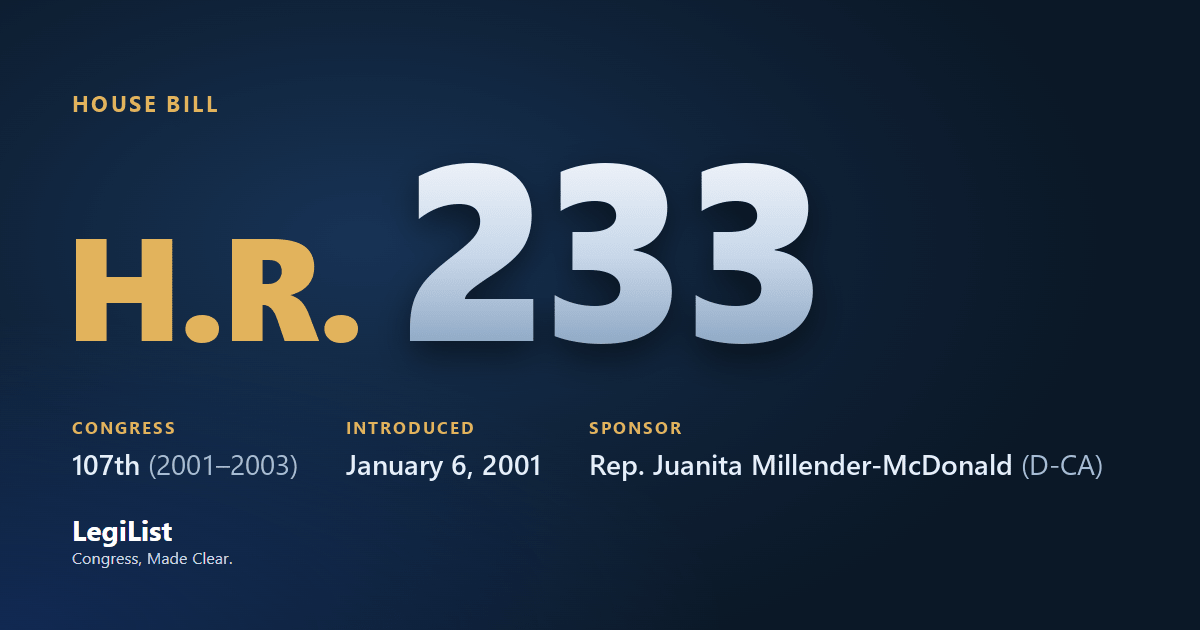
Child Safety Lock Act of 2001
Latest action · Feb 12, 2001 Referred to the Subcommittee on Crime.
Progress
Where this bill reached, and when. A stage with no date was not reached; one that failed a vote and later carried shows the date it carried.
- IntroducedJan 6, 2001
- Passed HouseNot reached
- Passed SenateNot reached
- To the PresidentNot reached
- Became lawNot reached
Summary
Directs the Secretary of the Treasury to: (1) prescribe such regulations governing the design, manufacture, and performance of trigger lock devices as are necessary to reduce or prevent the unintentional discharge of handguns, including setting a minimum safety standard to prevent children who have not attained age 18 from operating a handgun; and (2) in developing the standard, to consider such devices that are not detachable.
Authorizes the Secretary to issue an order prohibiting the manufacture, sale, transfer, or delivery of a trigger lock device which the Secretary finds has been designed, manufactured, transferred, or distributed in violation of this Act. Grants the Secretary specified authority regarding: (1) recall, repair, replacement, or refund with respect to such devices; and (2) inspections.
Authorizes the Secretary to: (1) assess a civil penalty of up to $10,000 per violation; and (2) revoke a Federal firearms license for a violation of this Act. Imposes criminal penalties for knowingly violating this Act.
Directs that a portion of firearms tax revenue be used for public education programs on the safe storage and use of firearms.
Cosponsors
Members who signed on, in the order they did.
Committees 1
Where it was sent and what each committee and subcommittee did with it, in order.
| Chamber | Committee | What it did |
|---|---|---|
| House | Judiciary Committee | Referred Jan 6, 2001 |
| Crime and Federal Government Surveillance Subcommittee | Referred Feb 12, 2001 |
Actions 3
Everything that happened, newest first.
- Feb 12, 2001Referred to the Subcommittee on Crime.
- Jan 6, 2001Introduced in House
- Jan 6, 2001Referred to the House Committee on the Judiciary.
In the Congressional Record 1
Days the Record’s own index lists this bill, newest first, with the pages and the members it names. Pages starting H are the House, S the Senate, E Extensions of Remarks.
| Where | In the Record | Members | Date |
|---|---|---|---|
| Extensions | Debate and remarks E732 | Juanita Millender-McDonald D-CA | May 4, 2001 |
Titles 2
Every title it has carried, official and short, at each stage.
- Official Title as Introduced
- To improve the safety of firearms.
- Short Titles as Introduced
- Child Safety Lock Act of 2001
Subjects
Assigned by the Library of Congress. Policy area: Crime and Law Enforcement.
- Accident prevention
- Administrative procedure
- Administrative remedies
- Child safety
- Commerce
- Consumer education
- Crime and Law Enforcement
- Defective products
- Department of the Treasury
- Emergency Management
- Excise tax
- Families
- Fines (Penalties)
- Firearms
- Firearms control
- Firearms injuries
- Government Operations and Politics
- Government publicity
- Health
- Health warnings
- Law
- Licenses
- Product safety
- Retail trade
- Safety measures
- Sales tax
- Standards
- Storage
- Taxation
- Warning labels
Text 1
Each version as it was printed, newest first.
- Jan 6, 2001Introduced in House
Support LegiList
This page is free, carries no paywall, and is built and maintained by one person. If the record here is useful to you, a few dollars keeps it going.
Everything here is as published by Congress: the summary is the Congressional Research Service's, the action wording is the clerks', and the subjects are the Library of Congress's. How far it got is read from the actions themselves, taking the most recent one of each kind, so a bill that failed a vote and later passed is shown as having passed. Records come from this bill on Congress.gov and govinfo.gov; cost estimates are the Congressional Budget Office's, and the hearings are the printed hearings GovInfo publishes, which can appear months after the hearing.