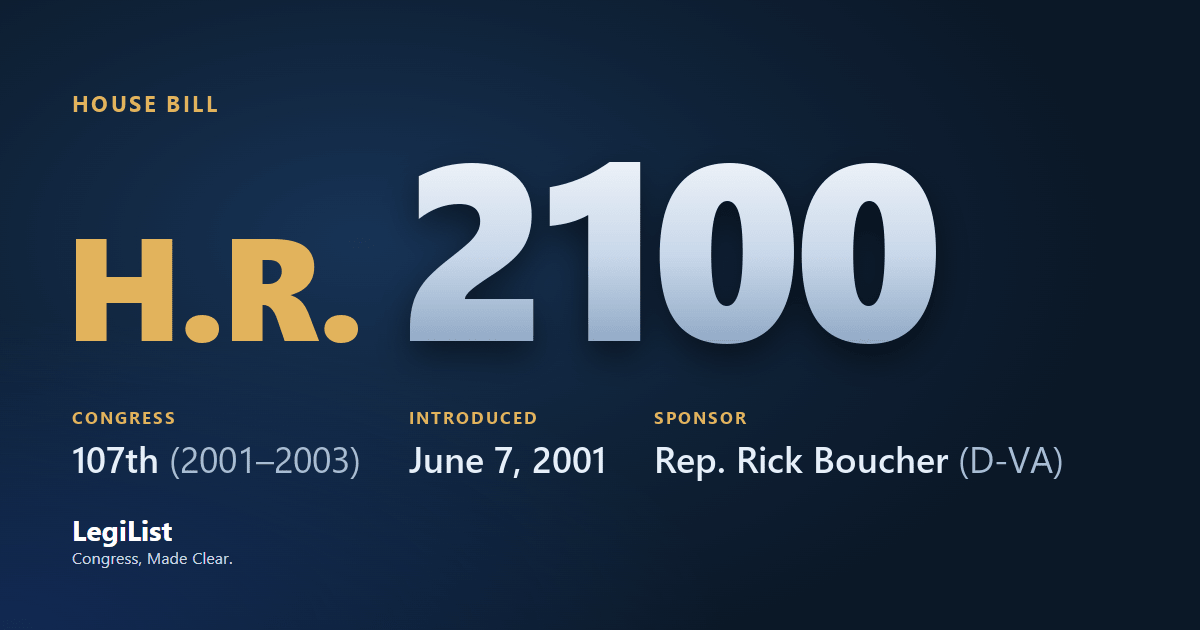
Twenty-First Century Distance Learning Enhancement Act
Latest action · Jun 18, 2001 Referred to the Subcommittee on Courts, the Internet, and Intellectual Property.
Progress
Where this bill reached, and when. A stage with no date was not reached; one that failed a vote and later carried shows the date it carried.
- IntroducedJun 7, 2001
- Passed HouseNot reached
- Passed SenateNot reached
- To the PresidentNot reached
- Became lawNot reached
Summary
Exempts from infringement liability, under specified conditions, governmental bodies, accredited nonprofit educational institutions, and nonprofit libraries by reason of the transient or temporary storage of material carried out through the automatic technical process of a digital transmission of the performance or display of that material.
Extends the current ephemeral recording exemption, under specified conditions, to copies or phonorecords embodying a performance or display in digital and analog form for use in making transmissions authorized by this Act.
Cosponsors 2
Members who signed on, in the order they did. Signatures ran from Jun 7, 2001 to Jun 20, 2001; 1 is an original cosponsor, there from the day it was introduced.
| Seat | Cosponsor | Signed on | |
|---|---|---|---|
| R-CA | Darrell Issa | Original | Jun 7, 2001 |
| D-NY | Gregory W. Meeks | Jun 20, 2001 |
Committees 1
Where it was sent and what each committee and subcommittee did with it, in order.
| Chamber | Committee | What it did |
|---|---|---|
| House | Judiciary Committee | Referred Jun 7, 2001 |
| Courts, Intellectual Property, Artificial Intelligence, and the Internet Subcommittee | Referred Jun 18, 2001 |
Actions 4
Everything that happened, newest first.
- Jun 18, 2001Referred to the Subcommittee on Courts, the Internet, and Intellectual Property.
- Jun 12, 2001Sponsor introductory remarks on measure. (CR E1076)
- Jun 7, 2001Introduced in House
- Jun 7, 2001Referred to the House Committee on the Judiciary.
In the Congressional Record 1
Days the Record’s own index lists this bill, newest first, with the pages and the members it names. Pages starting H are the House, S the Senate, E Extensions of Remarks.
| Where | In the Record | Members | Date |
|---|---|---|---|
| Extensions | Debate and remarks E1076 | Rick Boucher D-VA | Jun 12, 2001 |
Titles 2
Every title it has carried, official and short, at each stage.
- Official Title as Introduced
- To amend chapter 1 of title 17, United States Code, relating to the exemption of certain performances or displays for educational uses from copyright infringement provisions, to provide that the making of copies or phonorecords of such performances or displays is not an infringement under certain circumstances, and for other purposes.
- Short Titles as Introduced
- Twenty-First Century Distance Learning Enhancement Act
Subjects
Assigned by the Library of Congress. Policy area: Commerce.
- Arts, Culture, Religion
- Commerce
- Computer networks
- Conferences
- Copyright
- Copyright infringement
- Distance education
- Education
- Electronic government information
- Elementary and secondary education
- Government Operations and Politics
- Government publicity
- Higher education
- Intellectual property
- Internet
- Law
- Libraries
- Licenses
- Phonorecords
- Science, Technology, Communications
- Sound recording and reproducing
- Teaching
- Teaching materials
- Web sites
Text 1
Each version as it was printed, newest first.
- Jun 7, 2001Introduced in House
Support LegiList
This page is free, carries no paywall, and is built and maintained by one person. If the record here is useful to you, a few dollars keeps it going.
Everything here is as published by Congress: the summary is the Congressional Research Service's, the action wording is the clerks', and the subjects are the Library of Congress's. How far it got is read from the actions themselves, taking the most recent one of each kind, so a bill that failed a vote and later passed is shown as having passed. Records come from this bill on Congress.gov and govinfo.gov; cost estimates are the Congressional Budget Office's, and the hearings are the printed hearings GovInfo publishes, which can appear months after the hearing.