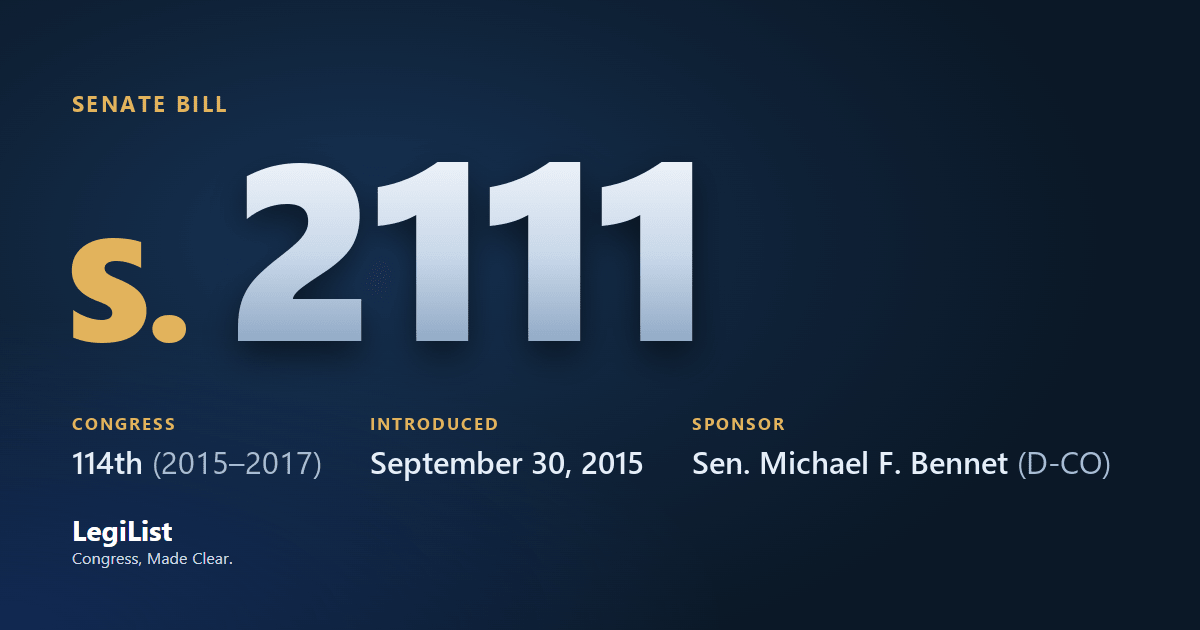
Higher Education Innovation Act
Latest action · Sep 30, 2015 Read twice and referred to the Committee on Health, Education, Labor, and Pensions.
Progress
Where this bill reached, and when. A stage with no date was not reached; one that failed a vote and later carried shows the date it carried.
- IntroducedSep 30, 2015
- Passed SenateNot reached
- Passed HouseNot reached
- To the PresidentNot reached
- Became lawNot reached
Summary
Higher Education Innovation Act
This bill amends the Higher Education Act of 1965 to establish a voluntary, alternative accreditation system for higher education providers.
The Department of Education (ED) must establish a process for approving innovation authorizers to authorize institutions of higher education or other providers that: promote student success outcomes and cost-effectiveness, agree to outcome-based oversight and reporting requirements, meet performance metrics, and comply with other specified requirements.
To apply to be an authorizer, an entity must agree to publicly disclose certain data and submit to ED details regarding its:
- experience and capabilities,
- financial ability to meet the requirements,
- authorization process,
- educational or subject matter focus,
- membership and relationship with industries and businesses, and
- conflict of interest controls.
An authorizer must use performance metrics relating to student learning, completion, and benefit to the student and affordability. The minimum threshold for each metric must meet or exceed the 60th-percentile student outcome.
Providers authorized using this process are eligible for Pell Grant and other federal funding, subject to specified funding requirements and allocations. An authorizer must agree to pay ED at least 25% of the annual balance of student loans that are in default and held by current or former students of providers that the authorizer approved.
Providers that meet the requirements of both an innovation authorizer and a recognized accrediting agency may hold both the accreditation and authorization or select which entity to use.
The authority for the alternative authorization system expires five years after enactment of this bill.
Cosponsors 1
Members who signed on, in the order they did. All signed on Sep 30, 2015.
| Seat | Cosponsor | Signed on | |
|---|---|---|---|
| R-FL | Marco Rubio | Original | Sep 30, 2015 |
Committees 1
Where it was sent and what each committee and subcommittee did with it, in order.
| Chamber | Committee | What it did |
|---|---|---|
| Senate | Health, Education, Labor, and Pensions Committee | Referred Sep 30, 2015 |
Actions 2
Everything that happened, newest first.
- Sep 30, 2015Introduced in Senate
- Sep 30, 2015Read twice and referred to the Committee on Health, Education, Labor, and Pensions.
Related bills 1
Companion bills and other measures the record links to this one.
| Bill | Title | Relationship | Latest action |
|---|---|---|---|
| S 615 | Higher Education Innovation Act | Reintroduced Bill | Mar 13, 2017 |
Titles 2
Every title it has carried, official and short, at each stage.
- Official Title as Introduced
- A bill to establish an alternative, outcomes-based process for authorizing innovative, high-quality higher education providers to participate in programs under title IV of the Higher Education Act of 1965.
- Short Titles as Introduced
- Higher Education Innovation Act
Subjects
Assigned by the Library of Congress. Policy area: Education.
Text 1
Each version as it was printed, newest first.
- Sep 30, 2015Introduced in Senate
Support LegiList
This page is free, carries no paywall, and is built and maintained by one person. If the record here is useful to you, a few dollars keeps it going.
Everything here is as published by Congress: the summary is the Congressional Research Service's, the action wording is the clerks', and the subjects are the Library of Congress's. How far it got is read from the actions themselves, taking the most recent one of each kind, so a bill that failed a vote and later passed is shown as having passed. Records come from this bill on Congress.gov and govinfo.gov; cost estimates are the Congressional Budget Office's, and the hearings are the printed hearings GovInfo publishes, which can appear months after the hearing.