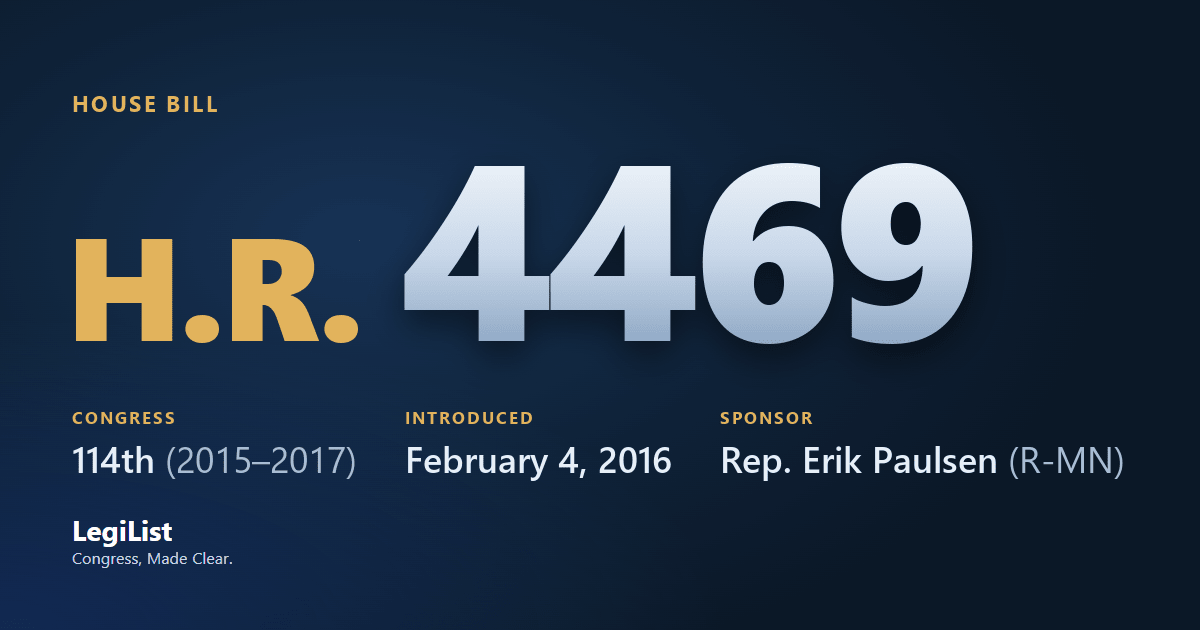
Health Savings Act of 2016
Latest action · Feb 24, 2016 Sponsor introductory remarks on measure. (CR H865)
Progress
Where this bill reached, and when. A stage with no date was not reached; one that failed a vote and later carried shows the date it carried.
- IntroducedFeb 4, 2016
- Passed HouseNot reached
- Passed SenateNot reached
- To the PresidentNot reached
- Became lawNot reached
Summary
Health Savings Act of 2016
This bill amends the Internal Revenue Code, with respect to the taxation of health savings accounts (HSAs), to:
- rename high deductible health plans as HSA-qualified health plans;
- allow spouses who have both attained age 55 to make increased catch-up contributions to the same HSA;
- make Medicare Part A (hospital insurance benefits) beneficiaries eligible to participate in an HSA;
- allow individuals eligible for hospital care or medical services under a medical care program of the Indian Health Service or of a tribal organization to participate in an HSA;
- allow individuals eligible to receive medical benefits under certain TRICARE plans to participate in an HSA;
- allow members of a health care sharing ministry to participate in an HSA;
- allow individuals who receive primary care services in exchange for a fixed periodic fee or payment, or who receive health care benefits from an onsite medical clinic of an employer, to participate in an HSA;
- include amounts paid for prescriptions and over-the-counter medicines or drugs as "qualified medical expenses" for which distributions from an HSA or an Archer Medical Savings Account may be used; and
- allow HSA distributions to be used to purchase health insurance coverage.
The bill amends the federal bankruptcy code to exempt HSAs from creditor claims in bankruptcy.
The bill amends the Social Security Act to reauthorize the use of Medicaid health opportunity accounts.
The bill allows a medical care tax deduction for: (1) exercise equipment, physical fitness programs, and membership at a fitness facility; (2) nutritional and dietary supplements; and (3) periodic fees paid to a primary care physician and amounts paid for pre-paid primary care services.
Cosponsors 17
Members who signed on, in the order they did. Signatures ran from Feb 4, 2016 to Nov 14, 2016; 2 are original cosponsors, there from the day it was introduced.
| Seat | Cosponsor | Signed on | |
|---|---|---|---|
| R-KS | Lynn Jenkins | Original | Feb 4, 2016 |
| R-PA | Mike Kelly | Original | Feb 4, 2016 |
| R-PA | Ryan A. Costello | Feb 11, 2016 | |
| R-MN | John Kline | Feb 24, 2016 | |
| R-VA | Barbara Comstock | Feb 25, 2016 | |
| R-OH | Bob Gibbs | Mar 15, 2016 | |
| R-UT | Jason Chaffetz | Apr 18, 2016 | |
| R-TX | Kenny Marchant | Apr 19, 2016 | |
| R-KY | Andy Barr | May 25, 2016 | |
| R-IN | Marlin A. Stutzman | May 25, 2016 | |
| R-CA | Darrell Issa | Jun 8, 2016 | |
| R-TN | David P. Roe | Jun 8, 2016 | |
| R-MT | Ryan K. Zinke | Jun 8, 2016 | |
| R-OH | Steve Chabot | Jun 8, 2016 | |
| R-WV | Alexander X. Mooney | Jun 9, 2016 |
Committees 3
Where it was sent and what each committee and subcommittee did with it, in order.
| Chamber | Committee | What it did |
|---|---|---|
| House | Ways and Means Committee | Referred Feb 4, 2016 |
| House | Judiciary Committee | Referred Feb 4, 2016 |
| House | Energy and Commerce Committee | Referred Feb 4, 2016 |
| Health Subcommittee | Referred Feb 5, 2016 |
Actions 4
Everything that happened, newest first.
- Feb 24, 2016Sponsor introductory remarks on measure. (CR H865)
- Feb 5, 2016Referred to the Subcommittee on Health.
- Feb 4, 2016Introduced in House
- Feb 4, 2016Referred to the Committee on Ways and Means, and in addition to the Committees on the Judiciary, and Energy and Commerce, for a period to be subsequently determined by the Speaker, in each case for consideration of such provisions as fall within the jurisdiction of the committee concerned.
In the Congressional Record 1
Days the Record’s own index lists this bill, newest first, with the pages and the members it names. Pages starting H are the House, S the Senate, E Extensions of Remarks.
| Where | In the Record | Members | Date |
|---|---|---|---|
| House | Debate and remarks H865 | Erik Paulsen R-MN | Feb 24, 2016 |
Research
What has been written about this bill: committee reports, cost estimates, the sponsor’s authority statement, printed hearings and the Congressional Research Service’s work.
Constitutional authority
The sponsor’s statement, as printed in the Congressional Record, vol. 162, no. 21, February 4, 2016, page H591.
Printed hearings 1
Hearings whose printed record names this bill, newest first: hearings on it, and wider hearings where it came up.
| Number | Hearing | Committee | Held |
|---|---|---|---|
| — | TAX-RELATED PROPOSALS TO IMPROVE HEALTH CARE89 pages | Ways and Means Committee | May 17, 2016 |
Related bills 8
Companion bills and other measures the record links to this one.
| Bill | Title | Relationship | Latest action |
|---|---|---|---|
| HR 1175 | Health Savings Act of 2017 | Reintroduced Bill | Mar 16, 2017 |
| HR 1752 | To amend the Internal Revenue Code of 1986 to make members of health care sharing ministries eligible to establish health savings accounts. | Related bill | Apr 21, 2015 |
| S 2499 | Health Savings Act of 2016 | Identical bill | Feb 4, 2016 |
| HR 2653 | American Health Care Reform Act of 2015 | Related bill | Jun 15, 2015 |
| HR 3404 | To amend the Internal Revenue Code of 1986 to allow tax free distributions from health savings accounts for fitness facility membership and classes. | Related bill | Jul 29, 2015 |
Titles 2
Every title it has carried, official and short, at each stage.
- Official Title as Introduced
- To amend the Internal Revenue Code of 1986 to improve access to health care through expanded health savings accounts, and for other purposes.
- Short Titles as Introduced
- Health Savings Act of 2016
Subjects
Assigned by the Library of Congress. Policy area: Taxation.
- Bankruptcy
- Employee benefits and pensions
- Health care costs and insurance
- Health care coverage and access
- Health personnel
- Hospital care
- Income tax deductions
- Indian social and development programs
- Inflation and prices
- Medicaid
- Medicare
- Military medicine
- Minority health
- Nutrition and diet
- Physical fitness and lifestyle
- Prescription drugs
- Religion
- Sales and excise taxes
- Sports and recreation facilities
- Tax administration and collection, taxpayers
- Tax treatment of families
- Taxation
Text 1
Each version as it was printed, newest first.
- Feb 4, 2016Introduced in House
Support LegiList
This page is free, carries no paywall, and is built and maintained by one person. If the record here is useful to you, a few dollars keeps it going.
Everything here is as published by Congress: the summary is the Congressional Research Service's, the action wording is the clerks', and the subjects are the Library of Congress's. How far it got is read from the actions themselves, taking the most recent one of each kind, so a bill that failed a vote and later passed is shown as having passed. Records come from this bill on Congress.gov and govinfo.gov; cost estimates are the Congressional Budget Office's, and the hearings are the printed hearings GovInfo publishes, which can appear months after the hearing.