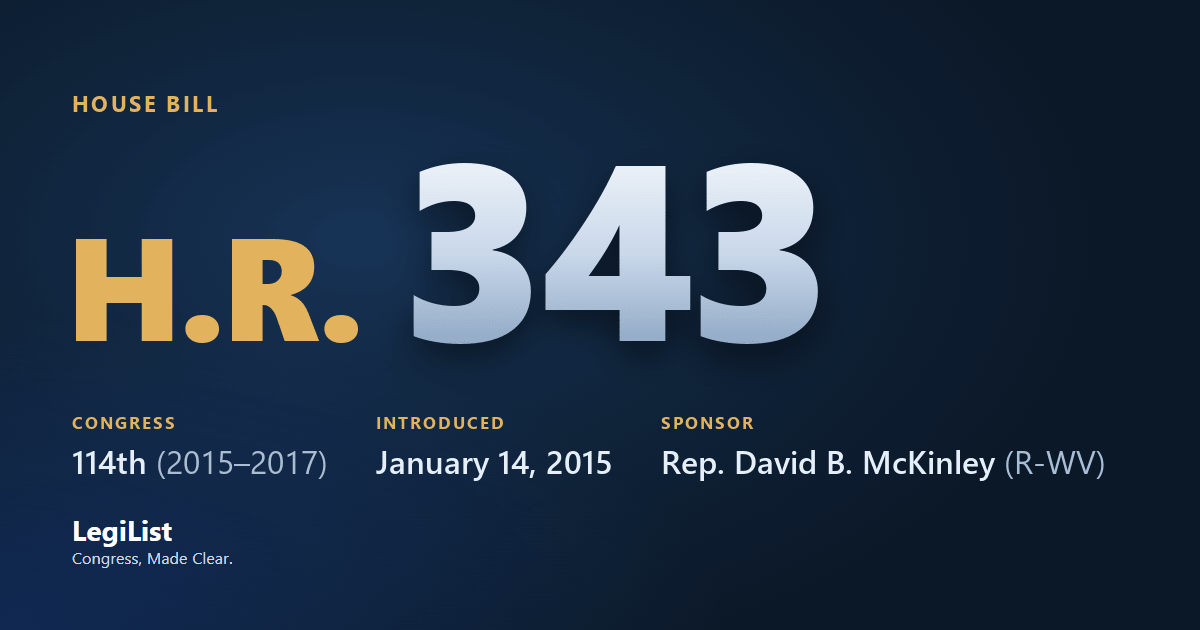
Volunteer Emergency Responders Tax Deduction Act
Latest action · Jan 14, 2015 Referred to the House Committee on Ways and Means.
Progress
Where this bill reached, and when. A stage with no date was not reached; one that failed a vote and later carried shows the date it carried.
- IntroducedJan 14, 2015
- Passed HouseNot reached
- Passed SenateNot reached
- To the PresidentNot reached
- Became lawNot reached
Summary
Volunteer Emergency Responders Tax Deduction Act
Amends the Internal Revenue Code to treat firefighting and prevention services, emergency medical services, ambulance services, civil air patrol, and search and rescue services rendered by a bona fide volunteer as a charitable contribution to the organization for which such services are rendered for purposes of the tax deduction for charitable contributions. Limits to 300 the amount of hours of services which a volunteer may render to an organization in a taxable year.
Cosponsors 39
Members who signed on, in the order they did. Signatures ran from Jan 14, 2015 to Jun 16, 2016; 8 are original cosponsors, there from the day it was introduced.
| Seat | Cosponsor | Signed on | |
|---|---|---|---|
| R-WV | Alexander X. Mooney | Original | Jan 14, 2015 |
| D-IL | Cheri Bustos | Original | Jan 14, 2015 |
| D-IA | David Loebsack | Original | Jan 14, 2015 |
| R-WV | Evan H. Jenkins | Original | Jan 14, 2015 |
| D-WA | Jim McDermott | Original | Jan 14, 2015 |
| D-DE | John C. Carney, Jr. | Original | Jan 14, 2015 |
| R-NJ | Leonard Lance | Original | Jan 14, 2015 |
| R-IN | Luke Messer | Original | Jan 14, 2015 |
| D-CT | Joe Courtney | Apr 15, 2015 | |
| R-NC | David Rouzer | Apr 16, 2015 | |
| R-LA | Ralph Lee Abraham | Apr 16, 2015 | |
| R-OH | David P. Joyce | Apr 21, 2015 | |
| D-NY | Kathleen M. Rice | Apr 21, 2015 | |
| D-MN | Richard M. Nolan | Apr 21, 2015 | |
| R-IN | Todd Rokita | Apr 21, 2015 |
Committees 1
Where it was sent and what each committee and subcommittee did with it, in order.
| Chamber | Committee | What it did |
|---|---|---|
| House | Ways and Means Committee | Referred Jan 14, 2015 |
Actions 2
Everything that happened, newest first.
- Jan 14, 2015Introduced in House
- Jan 14, 2015Referred to the House Committee on Ways and Means.
Research
What has been written about this bill: committee reports, cost estimates, the sponsor’s authority statement, printed hearings and the Congressional Research Service’s work.
Constitutional authority
The sponsor’s statement, as printed in the Congressional Record, vol. 161, no. 7, January 14, 2015, page H406.
Printed hearings 1
Hearings whose printed record names this bill, newest first: hearings on it, and wider hearings where it came up.
| Number | Hearing | Committee | Held |
|---|---|---|---|
| — | URGING CHINA'S PRESIDENT XI JINPING TO STOP STATE SPONSORED HUMAN RIGHTS ABUSES62 pages | Congressional-Executive Commission on China | Sep 18, 2015 |
Titles 2
Every title it has carried, official and short, at each stage.
- Official Title as Introduced
- To amend the Internal Revenue Code of 1986 to provide a charitable deduction for the service of volunteer firefighters and emergency medical and rescue personnel.
- Short Titles as Introduced
- Volunteer Emergency Responders Tax Deduction Act
Subjects
Assigned by the Library of Congress. Policy area: Taxation.
Text 1
Each version as it was printed, newest first.
- Jan 14, 2015Introduced in House
Support LegiList
This page is free, carries no paywall, and is built and maintained by one person. If the record here is useful to you, a few dollars keeps it going.
Everything here is as published by Congress: the summary is the Congressional Research Service's, the action wording is the clerks', and the subjects are the Library of Congress's. How far it got is read from the actions themselves, taking the most recent one of each kind, so a bill that failed a vote and later passed is shown as having passed. Records come from this bill on Congress.gov and govinfo.gov; cost estimates are the Congressional Budget Office's, and the hearings are the printed hearings GovInfo publishes, which can appear months after the hearing.