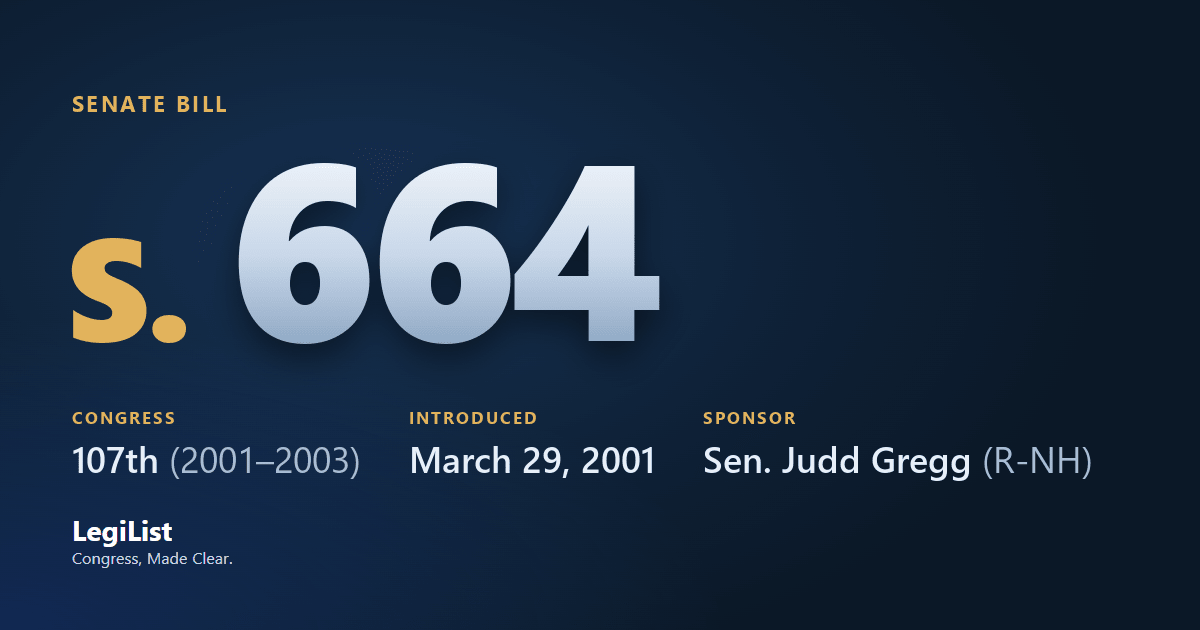
NET FAIR Act
Latest action · Mar 29, 2001 Read twice and referred to the Committee on Finance. (text of measure as introduced: CR S3173-3174)
Progress
Where this bill reached, and when. A stage with no date was not reached; one that failed a vote and later carried shows the date it carried.
- IntroducedMar 29, 2001
- Passed SenateNot reached
- Passed HouseNot reached
- To the PresidentNot reached
- Became lawNot reached
Summary
Prohibits a State from assessing any business activity tax which was imposed prior to this Act, if the imposition of such tax is prohibited, above.
Terminates a person's obligation to pay State-imposed business activity, sales, or use tax if such person no longer has a substantial physical presence in that State.
Cosponsors 2
Members who signed on, in the order they did. Signatures ran from Mar 29, 2001 to May 1, 2001; 1 is an original cosponsor, there from the day it was introduced.
| Seat | Cosponsor | Signed on | |
|---|---|---|---|
| D-WI | Herb Kohl | Original | Mar 29, 2001 |
| R-VA | George Allen | May 1, 2001 |
Committees 1
Where it was sent and what each committee and subcommittee did with it, in order.
| Chamber | Committee | What it did |
|---|---|---|
| Senate | Finance Committee | Referred Mar 30, 2001 |
Actions 3
Everything that happened, newest first.
- Mar 29, 2001Introduced in Senate
- Mar 29, 2001Sponsor introductory remarks on measure. (CR S3172-3173)
- Mar 29, 2001Read twice and referred to the Committee on Finance. (text of measure as introduced: CR S3173-3174)
In the Congressional Record 1
Days the Record’s own index lists this bill, newest first, with the pages and the members it names. Pages starting H are the House, S the Senate, E Extensions of Remarks.
| Where | In the Record | Members | Date |
|---|---|---|---|
| Senate | Debate and remarks S3172–S3174Text printed S3173 | Herb Kohl D-WI, Judd Gregg R-NH (text) | Mar 29, 2001 |
Titles 3
Every title it has carried, official and short, at each stage.
- Official Title as Introduced
- A bill to provide jurisdictional standards for the imposition of State and local tax obligations on interstate commerce, and for other purposes.
- Short Titles as Introduced
- NET FAIR Act
- New Economy Tax Fairness Act
Subjects
Assigned by the Library of Congress. Policy area: Taxation.
- Business income tax
- Commerce
- Electronic commerce
- Franchises (Retail trade)
- Government Operations and Politics
- Income tax
- Intergovernmental tax relations
- Internet
- Internet service providers
- Interstate commerce
- Law
- Licenses
- Local taxation
- Mail-order business
- Maintenance and repair
- Sales personnel
- Sales tax
- Science, Technology, Communications
- State taxation
- Taxation
- User charges
- Warranties
- Web sites
- World Wide Web
Text 1
Each version as it was printed, newest first.
- Mar 29, 2001Introduced in Senate
Everything here is as published by Congress: the summary is the Congressional Research Service's, the action wording is the clerks', and the subjects are the Library of Congress's. How far it got is read from the actions themselves, taking the most recent one of each kind, so a bill that failed a vote and later passed is shown as having passed. Records come from this bill on Congress.gov and govinfo.gov; cost estimates are the Congressional Budget Office's, and the hearings are the printed hearings GovInfo publishes, which can appear months after the hearing.